


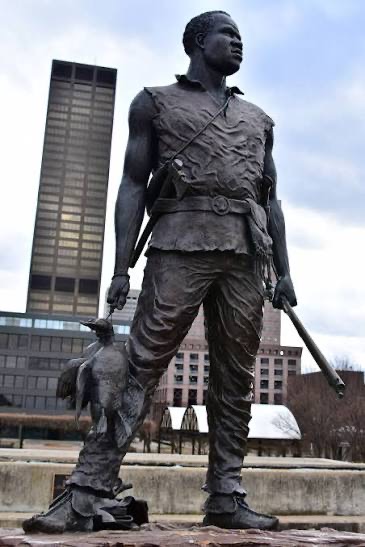
Across a Continent: The trials, legacy of the first African American to reach the Pacific Ocean, by Gift Luckson
York (1770–1775 – after 1815) was an enslaved man who was the only African-American member of the Lewis and Clark Expedition of 1804–1806.
Background
A lifelong slave and personal servant of William Clark, York participated in the entire exploration and made significant contributions to its success.
In doing so, he became the first African American to cross the continent and to see the Pacific Ocean.
A Worthy Icon
He has since become an American icon and several monuments depicting him have been erected in honour of his legacy.
York was born into slavery in the Colony of Virginia, the son of Old York and Rose, both of whom were enslaved by John Clark III, William Clark’s father.
William inherited York from his father in 1799. York was a large man; his weight has been estimated as 200 pounds (91 kg).
He was about the same age as Clark, perhaps a few years older or younger, and naturally strong
George Moses Horton: From slavery to a trailblazing African-American poet, by Gift Luckson
His skin was dark: he was “black as a bear”, said one who knew him, and his hair was short and curly.
Like most enslaved persons of the time, York was illiterate, and information about him is scant.
Pursuits of Freedom
York expected to be given his freedom after the expedition was successfully completed, in view of what he called his “immense services”, but Clark refused repeatedly and became angry when York would not go back willingly to his pre-expedition role as Clark’s body servant.
He also expressed irritation at York’s insistence on remaining in Louisville, where his wife and possibly children were. He whipped York and eventually sold him.
Documentation concerning York is lacking for the years immediately following the expedition. About 20 years later, Clark told Washington Irving that he had freed York and set him up in business, giving him six horses and a large wagon to start a drayage business moving goods between Nashville and Richmond.
William Clark called York his “playmate”. He was Clark’s “body servant”.
There is a single, unsupported oral report, from 1965, that York also went by the name Ben.
The name never appears in any of the many records of the Lewis and Clark expedition, nor in any other document. There is no doubt from the journals written during the expedition that York played a vital role in its success.
Not only did he fulfil his duties as a labourer through the course of the expedition, but the journals also suggest that the colour of York’s skin intrigued the native tribes so much that they seemingly gave the expedition a pass through the land and became willing to trade.
The journals also suggest that York had gained the respect of many of the men who were part of the expedition as well.
Darrell Millner has studied how York’s image has been shaped and presented over 200 years. He classifies scholarly treatment of York into what he calls two broad categories: the Sambo school, which has been the main trend until very recently, and the superhero school.
The Sambo version of York presents him as a happy slave, but, like all slaves, much in need of a white owner to run his life better than he could himself. In the Sambo tradition, York is neither manly nor heroic, qualities only whites can have.
Legacy
His role and contributions are systematically reduced to behaviour that was considered fitting and appropriate for a negro, ignoring the positive aspects of York’s character and contributions, distorting some incidents to cast them in the most unfavourable light possible, and projecting onto York unsubstantiated qualities, such as a thick “Negro” dialect and an insatiable sexual appetite.
In contrast, the superhero presentation of York has elevated him “to near superhuman status and his contributions to the expedition were unsurpassed by others in the Corps of Discovery.
The superhero York is the quintessential role model, a courageous, ingenious, brave, and self-sacrificing black hero who has overcome all of the obstacles that slavery and a hostile frontier threw at him.
This York ultimately prevails; he is a figure not only for blacks to admire but also for them to emulate.
Follow the Neptune Prime channel on WhatsApp:
Do you have breaking news, interview request, opinion, suggestion, or want your event covered? Email us at neptuneprime2233@gmail.com