


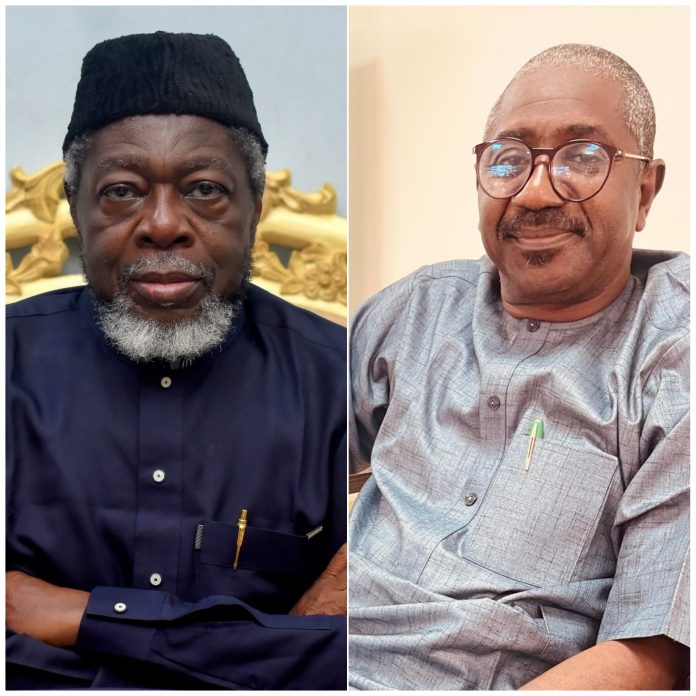
Beyond Promises: My reflections on Dr Hassan Gimba’s article and the Nigeria we want, by Dr Yusuf Ilyasu Maina
I read Hassan Gimba’s article, “The Candidate That Will Get My Vote,” with more than ordinary interest.
Hassan and I have known each other since childhood. So perhaps I did not read his article simply as political commentary. I read it as one friend listening to another friend who, like many of us, is deeply concerned about the direction of our country and the Nigeria we hope to leave behind. What stayed with me was not simply the candidate Hassan identified. It was the larger question beneath his argument:
What kind of politics will actually move Nigeria forward?
READ ALSO: The Candidate That Will Get My Vote (1), by Hassan Gimba
For too long, our political conversations have revolved around promises—roads, water, electricity, jobs, schools and other basic services. These are important. Nigerians deserve them. But perhaps we should begin asking a more fundamental question:
What is the plan behind the promise?
A road should not merely be a ribbon-cutting opportunity. It should connect farmers to markets, reduce transport costs and stimulate commerce. Electricity should not simply mean more poles and wires; it should power businesses, factories and productive communities. Water should support households, agriculture and industry. Education should not end with certificates; it should create skills, productivity and livelihoods.
This is where I believe Nigeria needs to move from the politics of promises to the politics of production and performance. We also need to change how we think about work.
Why do we sometimes speak as though success means moving people away from farming, livestock production, trading or craftsmanship into supposedly more prestigious professions?
Nigeria needs doctors, engineers, lawyers and technologists. But it also needs farmers, herders, mechanics, welders, traders, transporters, artisans, food processors and small manufacturers. These are not inferior occupations. They are the engines of an economy.
A young Fulani herder does not need to abandon livestock production to have a meaningful future. With improved breeds, veterinary services, animal identification and traceability, pasture and water infrastructure, insurance, finance, processing facilities and reliable markets, that young man could become a successful commercial livestock entrepreneur.
The same principle applies to the farmer, artisan, trader and small manufacturer.
The objective should not always be to change what people do. Sometimes, it is to change how productively they can do it.
This also brings us to insecurity.
Security operations are necessary, but insecurity has economic dimensions that cannot be ignored. Where young people see no credible pathway to legitimate prosperity, vulnerability increases. Where farmers cannot safely produce, livestock cannot move through functioning markets, and rural communities lack economic opportunities, security challenges become harder to resolve.
We therefore need an economic strategy that makes legitimate enterprise more attractive, productive and sustainable. This requires leadership that understands that government is a system, not a collection of isolated ministries. A president does not need to personally be an economist, engineer, agricultural scientist, veterinarian or technologist. But a president must know how to find competent people, bring expertise together, set measurable targets and hold those entrusted with public responsibility accountable.
We need leaders who understand the numbers—and, more importantly, understand the people behind the numbers. Inflation is not merely a statistic. It is the mother who can no longer afford the family meal.
Transport costs are not merely an economic indicator. They determine whether a farmer makes a profit or a loss. Unreliable electricity is not simply an infrastructure problem. It can determine whether a small business survives.
Food prices, employment, productivity, energy, agriculture, livestock, industry, transportation and household purchasing power are interconnected.
Perhaps this is the deeper lesson I take from Hassan’s article.
Nigeria does not merely need politicians who can tell us what they will give us. We need a political culture that asks them:
• How will you make Nigeria more productive?
• How will you create the conditions for Nigerians to prosper?
• How will you measure your performance?
• How will you account for the results?
That, to me, is the politics of issues.
And perhaps, more importantly, it is the beginning of the politics of performance.
Because behind every statistic is a Nigerian trying to build a life.
A mother wants to feed her children without having to decide which meal they can afford to miss. A farmer wants to harvest without watching his hard work disappear because there is no road to the market. A young person wants to believe that honest work can still lead somewhere. A small-business owner wants electricity, security and access to finance—not favours, just a fair chance to succeed.
These are not unreasonable demands. They are the ordinary dreams of citizens who want to believe in their country.
And perhaps that is our greatest responsibility: to build a Nigeria in which those dreams do not sound like miracles.
We owe that Nigeria to the people living in it today. But even more, we owe it to the children who will inherit whatever we choose to build—or whatever we choose to leave undone.
The Nigeria we want will not be built by promises alone. It will be built by ideas, competence, production, accountability and the courage to demand results.
That is the politics of issues.
That is the politics of performance.
And ultimately, that is the Nigeria worth building—and worth handing to the next generation.
Dr Yusuf Ilyasu Maina, QAA, IQAM, RPL, FCVSN. CEO, 4th Dimension Skills Ltd.
Follow the Neptune Prime channel on WhatsApp:
Do you have breaking news, interview request, opinion, suggestion, or want your event covered? Email us at neptuneprime2233@gmail.com

