

Damaturu and the Making of a Modern Capital: What Buni’s road and drainage projects mean for Yobe’s capital, by Maji Bappa Maina
Cities do not become capitals merely because a government places its administrative headquarters there.
A capital becomes a city when its roads, neighbourhoods, drainage systems, public institutions and commercial spaces begin to function as parts of one connected urban system.
This is why the recent expansion of roads and drainage infrastructure in Damaturu deserves to be looked at beyond individual construction projects.
READ ALSO: Building Yobe’s Future: Markets, Agriculture, and Economic Expansion Under Buni, by Maji MB
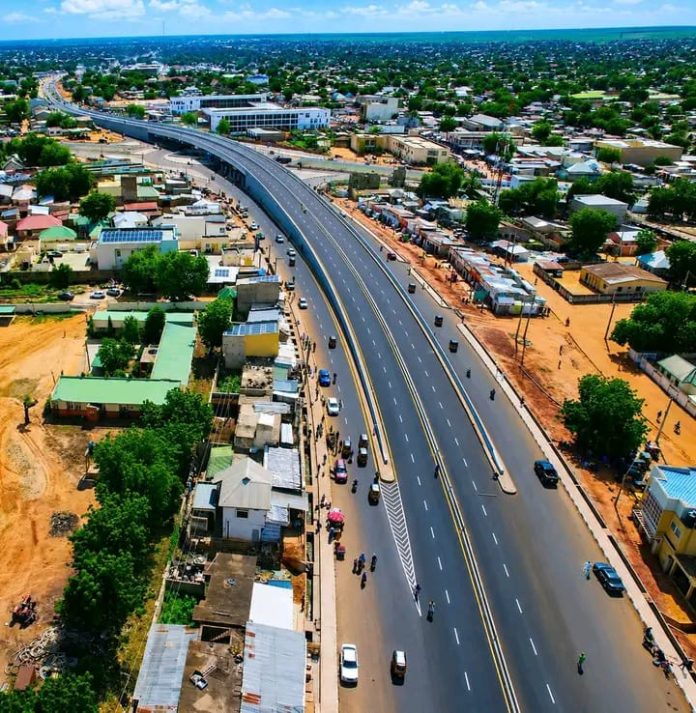
Under Governor Mai Mala Buni, several roads and drainage projects have been completed across different parts of the Yobe State capital, while others remain under construction.
Taken together, they point to something larger: the gradual physical expansion and restructuring of Damaturu.
The significance of these projects is therefore not only in the kilometres of asphalt laid.
It is also in the communities being connected, residential layouts being opened up, traffic routes being created and areas previously vulnerable to poor drainage being incorporated into the city’s growing urban network.
This distinction is important.
A road is not simply a road. In an expanding city, it determines how people move, where businesses emerge, how residential areas develop and how quickly different parts of the city can connect with one another.
Connecting a City That Is Expanding
Damaturu has expanded considerably beyond its older urban centres. New residential layouts, government quarters, commercial areas and peripheral settlements have increased the demand for reliable internal transportation infrastructure.
READ ALSO: Gov. Buni and the roots of tomorrow, by Maji Bappa Maina
The completed projects listed by the state include roads at Mallum Mattari, the Obasanjo–Nyanya link, Zannah Zakariya Estate, the Gujba Road–Potiskum/NTA corridor, NEP Layout, Bututu Bye-Pass, the Commissioner’s Quarters–Speaker’s House axis, Maina Lodge–Unicorn Junction and the Damaturu–Kalallawa corridor.
There are also road and drainage projects around Haba Maza, Abbati–Malaria–Gujba Road and other parts of the metropolis.
Seen individually, these may appear to be separate interventions.
Seen collectively, however, they represent an attempt to improve the internal connectivity of the capital.
That is where the wider urban significance lies.
A functioning road network reduces the physical distance between communities.
It can make access to schools, hospitals, government offices, markets and workplaces easier.
It can also encourage economic activity in places that previously remained at the margins of the city’s development.
Why Drainage Matters as Much as Asphalt
For Damaturu, the drainage component of these projects deserves particular attention.
In many developing cities, road construction without adequate drainage creates a familiar problem: the road may look new, but its long-term usefulness becomes threatened by erosion, stagnant water and flooding.
The inclusion of drainage in several of the Damaturu projects therefore has implications beyond aesthetics.
It is part of urban resilience.
The objective should not merely be to move vehicles from one point to another, but to build roads that can function within the environmental realities of the city.
This becomes particularly important as urbanisation increases and natural surfaces are gradually replaced by buildings, roads and other structures.
The more a city expands, the more carefully it must manage the movement of stormwater.
From Individual Projects to an Urban System
Among the more significant interventions is the Damaturu–Kalallawa dual carriageway, alongside the various township roads and link roads connecting residential and institutional areas.
The broader infrastructure programme has previously been described as part of efforts to improve connectivity and stimulate socioeconomic activity across Yobe.
Independent reporting has also documented substantial road and drainage construction across the state.
But the real test of any urban infrastructure programme is not the number of projects announced.
It is whether those projects eventually operate as a system.
For Damaturu, that means asking practical questions.
Do the new roads connect effectively with existing major corridors?
Do they reduce unnecessary pressure on older routes?
Are drainage channels properly maintained after construction?
Are new residential layouts being integrated into the wider transportation network?
And can the expansion of roads stimulate commercial activity without creating new problems of uncontrolled development?
These questions should remain part of the conversation as the capital continues to grow.
The Projects Still Under Construction
The transformation is also continuing.
Among the ongoing projects are roads around Obasanjo Housing Estate and Sabon Pegi–Layin PS, the Commissioner’s Quarters Extension–Bye-Pass, Pompamari Layin Mallam, the Adviser’s Office–Summit Hotel corridor, and road and drainage projects around the Industrial Layout and Afghanistan Housing Estate.
Their eventual completion will further extend the city’s network.
But completion should not be regarded as the final stage.
The next challenge is maintenance.
A city that invests heavily in roads must equally invest in keeping them functional. Drainages must remain clear. Road shoulders must be protected. Traffic management must evolve with population growth.
New layouts must be planned rather than allowed to grow entirely through informal expansion.
Infrastructure creates possibilities; planning determines how those possibilities are sustained.
What Is Happening to Damaturu?
Perhaps the most interesting question is not how many roads are being constructed.
It is what these roads are doing to the identity of Damaturu.
The capital is gradually moving from a collection of administrative and residential districts towards a more interconnected urban space.
Roads are opening up new areas. Drainages are becoming part of the city’s infrastructure response.
Residential layouts are being connected to established corridors. Commercial activity has greater opportunity to move beyond traditional centres.
This is how cities evolve.
The transformation of a capital city is rarely produced by one spectacular project.
It is usually the cumulative effect of many smaller connections made over time.
A road linking two neighbourhoods may appear modest on a project sheet.
But for the resident who previously struggled to reach the main road during the rainy season, its importance is much greater.
For a trader, it may mean easier movement of goods.
For a student, easier access to school.
For a patient, faster access to healthcare.
For a business owner, a new customer base.
And for the city itself, another piece of the urban network.
The Bigger Picture
Governor Mai Mala Buni’s road and drainage interventions in Damaturu should therefore be viewed not simply as construction activities, but as part of the continuing physical development of Yobe’s capital.
The projects completed and those still underway show a city being gradually opened up, connected and reorganised.
The important task now is to ensure that infrastructure development is matched by maintenance, effective urban planning, environmental management and responsible expansion.
Because ultimately, the success of a capital city is not measured only by how many roads it has.
It is measured by how effectively those roads connect people, communities, institutions and economic opportunities.
Damaturu is changing.
Its new roads are visible.
Its drainage networks are becoming more extensive.
Its urban boundaries are expanding.
The next chapter is to ensure that this physical expansion develops into a well-connected, resilient and functional capital city,one whose infrastructure can support the population and economic activities it is gradually attracting.
Maji Bappa Maina
Voice of Development | Leadership and public Insight.
Follow the Neptune Prime channel on WhatsApp:
Do you have breaking news, interview request, opinion, suggestion, or want your event covered? Email us at neptuneprime2233@gmail.com