


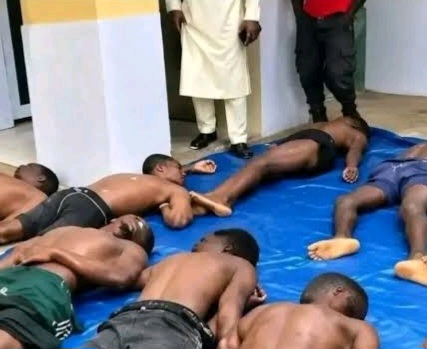
Deaths of Miners in Niger State: An incident that must not fizzle out, by Ayuba Ahmad
By now, Nigerians may be forgiven for appearing inured to reports of mass deaths and gruesome killings of their compatriots. Too often, lives are lost to insurgents, bandits, kidnappers and the recurring violence arising from intercommunal conflicts. Each new tragedy generates anger, grief and condemnation, only for public attention to eventually move on to the next crisis.
Yet, the recent deaths of 37 alleged illegal miners in Wushishi and Lukototin, Niger State, have provoked an unusual wave of anger and revulsion across the country. The outpouring of emotion and condemnation is reminiscent of a similar tragedy in Lagos in 1980 when 50 suspects awaiting trial died inside a Black Maria as a result of overcrowding and suffocation.
READ ALSO: Presidential hawks, attack dogs and pesky Catholic Bishops, by Ayuba Ahmad
The two unfortunate occurrences, separated by more than five decades, raise troubling questions about official negligence, lack of empathy and, most importantly, the apparent disregard for human life.
Nigerian prisons are notorious for their overcrowding and deplorable detention conditions. Correctional centres across the country have for years struggled with populations far beyond the capacity for which they were originally designed. Thousands of inmates are held in facilities where space, sanitation, medical care and other necessities are grossly inadequate.
This is not merely a question of statistics. Behind every number is a human being.
When a correctional facility designed to accommodate a limited number of people is forced to hold several times that number, the consequences are predictable. Cells become congested, sanitation deteriorates, diseases spread more easily, and medical facilities become overwhelmed. Correctional officers themselves are placed under enormous pressure, making effective supervision and rehabilitation increasingly difficult.
The Nigerian situation is, in some respects, similar to the experience of several Latin American countries, where prison overcrowding has remained a serious institutional problem. In some of those countries, correctional facilities have become notorious for violence, criminal networks and the influence of organised crime.
Instead of serving primarily as institutions for rehabilitation, prisons can become environments where criminal associations are strengthened and hardened criminal behaviour is reinforced.
Nigeria must not allow its correctional system to move further in that direction.
There have been numerous accounts over the years of people who claim that they acquired new criminal contacts or became more hardened during stints of incarceration. Whether every such account is accurate is a matter for individual verification, but the broader concern is undeniable: a correctional system that does not adequately separate, supervise, rehabilitate and support inmates can inadvertently contribute to the very criminality it is supposed to reduce.
But the Niger State tragedy raises a question that goes beyond the condition of correctional facilities: what value does the Nigerian state place on the life of an ordinary citizen?
READ ALSO: Challenges of tracking terrorists and bandits, by Ayuba Ahmad
This question becomes particularly important because the victims were reportedly illegal miners. Illegal mining is a serious national problem. It has implications for environmental degradation, public safety, loss of government revenue and the exploitation of the country’s natural resources. The government has a legitimate responsibility to enforce mining laws and to prevent activities that threaten communities and the environment.
But the allegation that someone has committed a crime cannot mean that the person’s life becomes expendable: a suspect is still a human being deemed to be innocent until proven otherwise.
A person accused of breaking the law is entitled to due process. The state has the authority to investigate, prosecute, and, where guilt is established by a competent court, punish offenders according to the law. What it does not have is an unrestricted licence to treat suspects as though they have forfeited their humanity.
This distinction is fundamental to any society that claims to be governed by the rule of law.
The circumstances surrounding the Niger State deaths therefore deserve a thorough, transparent and independent investigation. Nigerians need to know exactly what happened. How did the 37 people die? What were the circumstances leading to the incident? Were established procedures followed? Were there warnings or signs that something was going wrong? In other words, could the deaths have been prevented?
These are not questions that should be answered merely through official statements.
There is often a familiar pattern whenever a major tragedy occurs in Nigeria. There is an initial wave of shock. Government officials express sadness. Condolences are offered to the families. Investigations may be announced. Nigerians debate the matter passionately on social media and in the press. Then, after a few days or weeks, attention moves elsewhere.
The victims become statistics.
That is precisely what must not happen in this case.
The families of the dead deserve answers. They deserve to know what happened to their loved ones and whether anyone bears responsibility for their deaths. If negligence, abuse of authority or violation of established procedures is established, those responsible must face the consequences through due process.
There is also another dimension to the problem that deserves attention: the economic circumstances surrounding illegal mining. For many Nigerians living in communities where legitimate economic opportunities are scarce, mining can become an important source of income. While this does not justify illegal mining, it demands that if the government wants to eliminate illegal mining, it must also address the conditions that make the activity attractive in the first place.
This requires better regulation of the mining sector, stronger monitoring of mining operations, greater involvement of host communities and legitimate economic alternatives for people who depend on mining for survival.
READ ALSO: Attack on Peter Obi in Benue State: Another disturbing signpost to 2027, by Ayuba Ahmad
Law enforcement has a role to play, but enforcement without broader economic and institutional reform can simply push the problem from one location to another.
There is also a need for greater transparency in the management of Nigeria’s mineral resources. The country is blessed with enormous mineral wealth, yet communities where these resources are found wallow in poverty and inadequate development. Where valuable resources exist beneath the ground while the people living above them remain desperately poor, tensions and illegal exploitation should not come as a surprise.
The Niger State deaths should therefore serve as a warning on several fronts. They should compel the authorities to examine the immediate circumstances surrounding the deaths.
They should also prompt a broader review of how suspects and detainees are treated, how mining laws are enforced and whether government agencies have adequate safeguards to prevent avoidable deaths during enforcement operations.
Most importantly, the tragedy should remind Nigerians that the value of a human life does not depend on social status or an accusation.
The 37 people who died in Niger State were not merely numbers in a government report or names in a newspaper headline. They were someone’s fathers, sons, brothers, husbands, relatives and friends. Their deaths have left families who must now live with questions that may remain unanswered unless the authorities conduct a credible investigation.
Nigeria has mourned too many preventable deaths.
We have become accustomed to expressing outrage and then forgetting. We have become accustomed to tragedies being reduced to statistics and official explanations being accepted without sustained scrutiny. That culture must change.
The anger generated by the Niger State tragedy should not be allowed to disappear with the news cycle. It should be transformed into a demand for answers, accountability and institutional reform. The country owes this much to the dead and to their families.
The deaths in Wushishi and Kutoko must not fizzle out.
Very sadly, thirty-seven lives have been lost in a situation that prevents death. The least the country must do in its aftermath is ensure that their deaths are not forgotten, their families are not left without answers, and the lessons of the tragedy are not ignored.
Follow the Neptune Prime channel on WhatsApp:
Do you have breaking news, interview request, opinion, suggestion, or want your event covered? Email us at neptuneprime2233@gmail.com