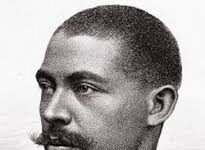
George Moses Horton: From slavery to a trailblazing African-American poet, by Gift Luckson
George Moses Horton (c. 1798–1867), was an African-American poet from North Carolina who was enslaved until Union troops, carrying the Emancipation Proclamation, reached North Carolina (1865).
Origin
Horton is the first African-American author to be published in the United States. (Phillis Wheatley’s poetry was published earlier, in the United Kingdom). He is the author of the first book of literature published in North Carolina and was known as the “Slave Poet”.
Horton was born into slavery on William Horton’s plantation in about 1798 in Northampton County, North Carolina. He was the sixth of ten children; the names of his parents are unknown.
Relocation and Painful Childhood
When Horton was six years old (1797), William Horton relocated his family and the people he held in slavery to a farm in Chatham County, North Carolina. This farm is where Horton lived until the end of the Civil War.
In 1814, William Horton gave the younger enslaved people as property to his relative James Horton.
Horton began an interest in learning to read and write by listening to the Bible read aloud and the hymns he heard. He learned to read and write based on what he was hearing during revival meetings (which were mainly the Bible), calling them his “reading lessons.”
Journey into Poetry
Horton began compiling pieces based on the verses that he remembered from the King James Version of the Bible.
Around 1817, Horton began making the approximately 10-mile (16 km) trip north to Chapel Hill to sell fruits and farm products for his master.
READ ALSO: Street Begging in Nigeria: A humanitarian crisis or security threat, by Gift Luckson
Here, Horton took his ability to compose to write love poems for the University of North Carolina students, selling them for 25 cents or more.
The students took an interest in Horton due to his ability to compose verses and his desire for greater knowledge. The students also gave him many books: he tells us of “Murray’s English Grammar and its accordant branches (Murray’s studies of other languages); Samuel Johnson’s Dictionary in miniature, and also Walker’s [Rhyming Dictionary] and [Thomas] Sheridan’s [A Complete Dictionary of the English Language], and parts of others.
He said, “And other books of use they gave me, which I had no chance to peruse minutely, Milton’s Paradise Lost, [James] Thompson’s Seasons, parts of Homer’s Iliad and Virgil, Shakespeare, Beauties of Byron, part of Plutarch, [Jedidiah] Morse’s Geography, The Columbian Orator, [Richard] Snowden’s History of the [American] Revolution, [Edward] Young’s Night Thoughts, and some others”.
Unexpected Assistance
Caroline Lee Hentz, author and playwright, also took an interest in Horton, teaching him to write and to improve his verses.
Teaching Blacks to read and write was legal in North Carolina until 1836, when restrictions were imposed because of fears about slave revolts.
Hentz was highly influential in getting his poems “Liberty and Slavery” and “Slavery” (1828) published in the Lancaster Gazette in April of 1828, and wrote an introductory note.
In June of the same year, she sent a third Horton poem, “On Poetry and Musick” (1828), to be also published by the Gazette.
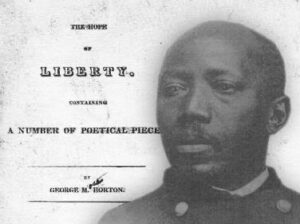
The three poems were renamed to be placed into his first collection, The Hope of Liberty (1829).
Becoming known as a poet, Horton attempted unsuccessfully to earn enough money from his poetry to purchase his freedom.
Family Life
Sometime in the 1830s, he “married” (legal marriages were not permitted) Martha Snipes, an enslaved woman owned by Franklin Snipes in Chatham County.
The couple had two children, Free and Rhody among them. Little else is known about the family.
Twice Horton attempted to have others aid in his freedom, In 1844 he wrote a letter to abolitionist William Lloyd Garrison and in 1852, he wrote another letter to Horace Greeley, the editor of the New York Daily Tribune, and included a poem titled “A Poet’s Feeble Petition” which expressed his longing for freedom. Neither letter reached its recipient due to the messenger Horton entrusted not passing them along and discarding them.
At age 60, around 1858, he described himself as “Belonging to Hal Horton living now in Chatham County”.
Freedom
In 1865, when Union troops arrived in his area, following the Emancipation Proclamation of 1863, they liberated all the enslaved in the states that had seceded.
Horton befriended a young Union officer with that group, William H. S. Banks. He left Chapel Hill with Banks, travelling to Philadelphia in the free state of Pennsylvania.
After the Civil War and finally becoming a free man, Horton continued to write poetry for local newspapers. His poem “Forbidden to Ride on the Street Cars” expressed his disappointment in the unjust treatment of Blacks after emancipation.
Arriving in Philadelphia before the summer of 1866, he wrote Sunday school stories on behalf of friends who lived in the city.
Disappointed with the racial discrimination he encountered in Philadelphia, Horton did succeed in emigrating to Bexley, Liberia, arriving on January 7, 1867.
This is the last known reference to him. While later death dates are found in some recent publications, his death location, date, and burial are unknown.
He may have returned to Philadelphia. Building towards his remembrance, biographies began to appear. The first was by Kemp Plummer Battle in May 1888, at that time President of the University of North Carolina. J. Donald Cameron noted Horton among notable North Carolina poets in 1890, in a speech that was reported in several newspapers.
Battle reprised his thoughts on Horton in his history of the university, published in 1907. In 1909, UNC professor Collier Cobb wrote a paper on Horton, which he published in 1925 at his own expense.
Legacy
Horton was remembered at the University of North Carolina on the occasion of the visit of James Weldon Johnson.
The centennial of his first book was noted in the New York Age after it was noted in Greensboro.
In 1927, Winston-Salem, North Carolina, opened a segregated library for Blacks in a YWCA building; it was named after George Moses Horton.
In the 1930s, A Horton School for Black children, opened in Pittsboro, North Carolina. It later became Horton High School. After integration in the 1970s, it became Horton Middle School.
In June 1978, North Carolina Governor Jim Hunt declared June 28 “George Moses Horton Day.”
In the 1990s, North Carolina erected a historical marker about Horton at the intersection of U.S. 15/501 and Mount Gilead Church Road, Chatham County Road 1700 (35° 47.618′ N, 79° 5.992′ W).
According to the marker, he lived about 2 miles southeast.
In 1996, Horton was inducted into the North Carolina Literary Hall of Fame.
Also in 1996, the George Moses Horton Society for the Study of African American Poetry was founded in Chapel Hill.
In 1997, Horton was named as Historic Poet Laureate of Chatham County, North Carolina.
In 2006, the University of North Carolina at Chapel Hill named a dormitory for George Moses Horton; it is believed to be the first university dormitory in the country to be named after a slave.
In 2015, author/illustrator Don Tate published Poet: The Remarkable Story of George Moses Horton, an illustrated biography for children. The Wilson Library at the University of North Carolina hosted the national launch of the book on September 3, 2015.
Follow the Neptune Prime channel on WhatsApp:
Do you have breaking news, interview request, opinion, suggestion, or want your event covered? Email us at neptuneprime2233@gmail.com