


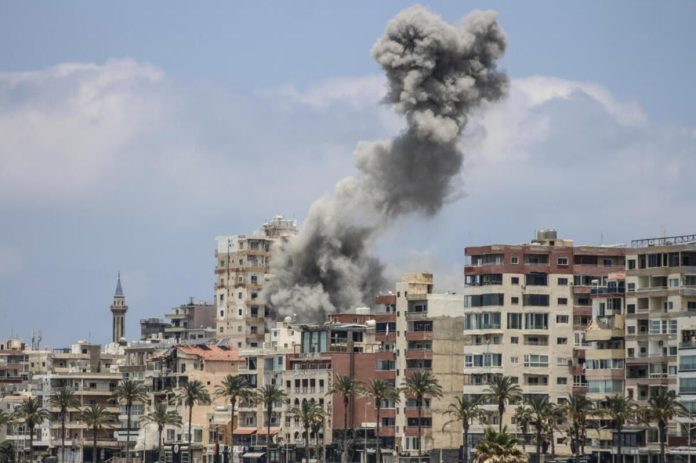
Iran attacks U.S bases in Bahrain, Jordan, issues warning to Gulf neighbours
Iran on Wednesday launched missile attacks on United States military bases in Bahrain and Jordan, while warning Gulf countries against allowing their territories to be used for military operations against the Islamic Republic.
The attacks marked a significant escalation in tensions between Tehran and Washington, coming days after the United States carried out strikes on Iranian targets following the downing of an American Apache helicopter. The latest confrontation has placed a fragile ceasefire reached in April under renewed strain.
The exchange of hostilities has triggered international concerns and calls for restraint, especially as the FIFA World Cup approaches. The United States is among the tournament’s co-hosts, while Iran is one of the participating nations.
The renewed violence has also cast doubt on US President Donald Trump’s assertion that negotiations aimed at securing a long-term peace agreement in the Middle East were nearing completion.
The conflict, which erupted after joint US-Israeli military actions against Iran, has unsettled the region and shaken global financial markets despite the temporary truce.
READ ALSO: US-Israeli strike destroys water infrastructure in Southern Iran
Residents of Bahrain’s capital, Manama, reported hearing multiple explosions after Iran’s Revolutionary Guards announced that they had targeted a US military installation in the Gulf kingdom.
The Revolutionary Guards also confirmed firing long-range missiles at American military positions in Jordan.
Jordanian military authorities said their air defence systems intercepted five incoming missiles, adding that no casualties or property damage were recorded. Bahrain similarly reported destroying several Iranian aerial threats before they reached their targets.
In neighbouring Kuwait, military officials said air defence units were actively responding to what they described as hostile airborne objects amid heightened regional tensions.
Iran’s Foreign Ministry reiterated that countries in the Gulf region have a legal and moral obligation to prevent the United States and Israel from using their territories, military facilities, or airspace to conduct operations against Iran.
The latest attacks followed a statement by the US military that it had completed retaliatory operations against Iran. President Trump described the action as a response to the shooting down of an American Apache helicopter.
READ ALSO: Iran strikes U.S. military facilities in Bahrain, Kuwait, and Jordan
According to the US Central Command, known as CENTCOM, American forces struck Iranian air defence systems, radar installations, and command centres near the strategic Strait of Hormuz.
Earlier, Iranian Foreign Minister Abbas Araghchi warned that Tehran would respond decisively to any aggression, declaring that Iran would leave no attack or threat unanswered.
Russia, China Call for Calm
The escalating confrontation prompted fresh appeals for de-escalation from both Russia and China.
Russia expressed deep concern over the latest round of military clashes and urged both Tehran and Washington to exercise maximum restraint.
China also called on all parties involved to avoid further escalation and to take concrete steps to reduce tensions in the region.
Just hours before the attacks, President Trump had maintained that negotiations to end the three-month conflict were in their final stages, suggesting a breakthrough could come within days.
READ ALSO: Iran, Israel trade fresh Missile attacks as fragile ceasefire nears collapse
However, following the helicopter incident, Trump stated that the United States would respond forcefully to protect its interests.
The ceasefire had already come under pressure over the weekend after Iran and Israel briefly resumed hostilities before later agreeing to halt attacks.
Iran has maintained that any comprehensive peace arrangement must also address the conflict in Lebanon, where the Iran-backed Hezbollah became involved after launching rockets into Israel in March.
Israel responded with extensive air strikes and a ground offensive that has reportedly claimed more than 3,600 lives. Despite intermittent ceasefires, clashes between Israeli forces and Hezbollah have continued.
Lebanese officials reported that 11 people were killed in Israeli air strikes on the southern city of Tyre on Tuesday.
The Israeli military subsequently issued evacuation warnings for the city, prompting thousands of residents to flee northward. Witnesses reported severe traffic congestion as families rushed to leave the area.
READ ALSO: Missile strikes rock Gulf Region as Iran launches retaliatory attacks on U.S. military assets
Displaced residents were also seen arriving in the coastal city of Sidon, many carrying their belongings on vehicles as they sought safety.
Hormuz Tensions Shake Oil Markets
The renewed conflict has further complicated efforts to reopen the Strait of Hormuz, a critical shipping route for global energy supplies that Iran has effectively blockaded since the war began.
Oil prices climbed by about one per cent on Wednesday as hopes for a diplomatic breakthrough faded. The increase followed a sharp decline a day earlier when markets reacted positively to reports of possible peace negotiations.
Foreign Minister Araghchi warned that foreign military forces operating near Iranian territory remained at constant risk and suggested that withdrawal from the region would be the safest course of action.
The Apache helicopter shot down this week is the second manned American aircraft confirmed lost during the conflict, following the destruction of a US F-15 fighter jet in April.
Follow the Neptune Prime channel on WhatsApp:
Do you have breaking news, interview request, opinion, suggestion, or want your event covered? Email us at neptuneprime2233@gmail.com

