Iran launches underwater missile facilities, issues security warning amid potential US attack
Iran has launched a network of underwater missile tunnels allegedly housing hundreds of long-range cruise missiles, while warning that the Strait of Hormuz would not remain safe if the country were attacked, amid rising tensions with the US.
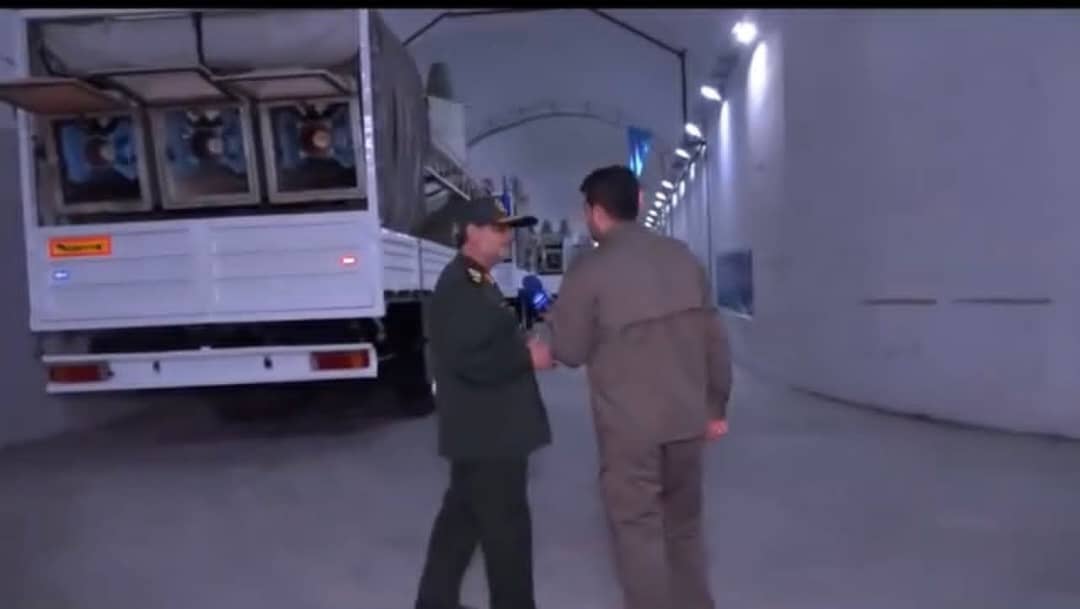
In footage broadcast by Iranian state television, the commander of the Islamic Revolutionary Guard Corps (IRGC) Navy, Alireza Tangsiri, appeared inside extensive submarine missile facilities, showing rows of rockets prepared for launch.
Tangsiri said the IRGC Navy possessed a wide network of missile tunnels beneath the sea, developed to confront US vessels operating in the Gulf and the Sea of Oman.
He said the tunnels housed hundreds of cruise missiles with a range exceeding 1,000 kilometres (around 621 miles).
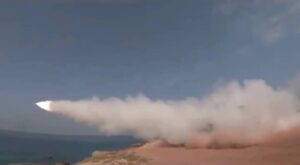
He added that the “Qader 380 L” missile, manufactured by the IRGC Navy, had a range exceeding 1,000 km and was equipped with smart guidance, capable of tracking targets until impact.
“Our capabilities are constantly developing,” Tangsiri said, stressing that Iranian forces were prepared to confront any threat “at any level and in any geography”.
READ ALSO: Iran launches drone attack on Israel, Israeli airspace closed (Update)
Hormuz under Iranian control
The unveiling came as Iran’s navy openly threatened to disrupt shipping through the Strait of Hormuz, a strategic waterway through which around one-fifth of global oil consumption passes each day.

Mohammad Akbarzadeh, political deputy of the IRGC naval forces, said Iran exercised “complete dominance” over the strait across air, surface and subsurface domains.
Quoted by Fars News Agency on Tuesday, Akbarzadeh said Iran receives real-time intelligence “from the sky, the surface and under the water of the Strait”, adding that its security is “dependent on decisions taken in Tehran”.
The Strait of Hormuz sees more than 21 million barrels of oil pass through daily, accounting for approximately 37 per cent of global oil traffic.
Akbarzadeh said Iran was able to track vessels sailing under different flags using modern technologies, stressing that Tehran does not seek war but remains fully prepared for one.
“If a war is imposed on us, the response will be more decisive than ever,” he said, adding that Iran’s defensive readiness, particularly in air defence, was “very high”.
He warned that neighbouring states were considered friendly, but would be treated as hostile if their airspace, land or territorial waters were used in an attack against Iran.
Iranian media close to the IRGC also published footage of the US aircraft carrier USS Abraham Lincoln and other American naval assets under the headline ‘An immediate message to Abraham Lincoln’, recalling Tehran’s detention of 10 US sailors in 2016 after they entered Iran’s territorial waters and broadcasting simulated targeting of the carrier.
Akbarzadeh said responses from regional states to Tehran’s warnings had been positive and that Iran possessed further capabilities that would be revealed “at the appropriate time”.
Iran calls for regional security without foreign forces
Senior Iranian politicians echoed the military warnings, stressing that security in the Strait of Hormuz was inseparable from wider regional stability.
Mohammad Mokhber, an adviser and aide to Iran’s supreme leader Ali Khamenei, told Fars News Agency on Wednesday that “security and stability in the region are either for everyone or for no one”.
Mokhber said Iran had played a “decisive role” in ensuring security in the Gulf, the Sea of Oman and strategic maritime routes, stressing that regional security was “an integrated whole that cannot be treated selectively or defined on an exclusionary basis”.
He said Tehran had pursued a path of peace and stability but would not hesitate to defend its national interests, warning of the consequences of “adventurism” by forces from outside the region.
READ ALSO: Amid middle east tensions, Iran launches heaviest space payload into orbit
According to Mokhber, foreign powers face a choice between rationality and regional cooperation, or escalation and “bearing the full consequences”.
He added that the region now needed the withdrawal of “adventurous foreign forces” and the opening of a new phase of collective dialogue among coastal states, aimed at establishing a comprehensive and sustainable regional security system.
Any “uncalculated step” or “irrational action” targeting Iran’s interests would be met with a “strong and decisive response that will not be forgotten”, he said.
He warned that the repercussions would not be limited to the attacking party but would affect the entire region and its allies, with “dangerous shockwaves” likely to severely impact the global economy.
Follow the Neptune Prime channel on WhatsApp:
Do you have breaking news, interview request, opinion, suggestion, or want your event covered? Email us at neptuneprime2233@gmail.com