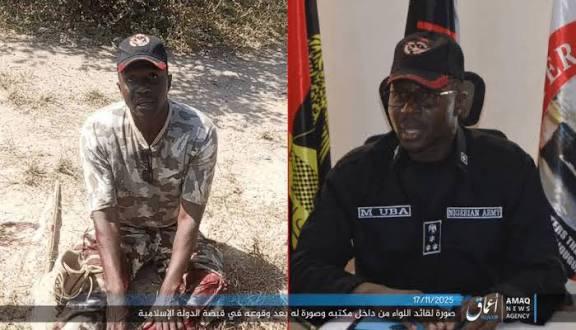
Issues around the death of General Musa Uba and others by ISWAP, by Ayuba Ahmad
The reported death of Brigadier General Musa Uba and his troops last week at the hands of operatives of the Islamist insurgents, ISWAP, should have once again graphically highlighted the grim reality of the war against terrorism that has been raging for the past sixteen years. Generals in most armies of the modern world, do not suffer that kind of gruesome death in battles.
According to reports, General Musa Uba and his troops had run into a booby trap and an ambush by the insurgents. While virtually nothing has been heard of the several other rank and file he was leading, General Uba had initially escaped the carnage with injuries to his legs. His respite or seeming good fortunes lasted however, only for a short while.
He bravely endured his pains as he marched away from the immediate vicinity of the encounter and began to make attempts to ask for rescue from the operational base by way of reinforcement and air evacuation. Getting close to a nearby “village”, strangely, in the godforsaken forest, he became frantic with his messages beginning to indicate desperation.
Even as he sent an eerie distress message to his command headquarters that his cellphone battery was down to 30%, he yet sounded optimistic that help would come his way. That was evident in his saying that he would “come out into the open, raising and waving my peak cap”, obviously intended to guide the crew of his anticipated rescue helicopter to his location.
Read also:ISWAP ambushes military convoy, abducts brigade commander, kills soldier
Instead of his rescuers, those who appeared were a horde of the bloodhounds of ISWAP. Viciously, they pounced on him, inflicted mortal injuries on him, and finally beheaded him.
There are a number of issues arising from the gory development.
It is perturbing that the war against terrorism has dragged on for this long and has degenerated to the point that a General is having to go to the battlefields. Under normal circumstances, a Brigadier General commands from the rear, a brigade consisting of over 700 officers and men. He is not supposed to be a commander of platoons, which is the task for lieutenants and captains, or battalions, usually assigned to officers of the rank of a major, a lieutenant colonel or a full colonel. Thus the question: what was the strength of the officers and men that were with him at the point of the fatal encounter?
Whatever the circumstances that necessitated the presence of the General on the ill-fated mission, it is evident that the troops were overwhelmed by the fighters of ISWAP that attacked them.
There is also the unfortunate but palpable fact that the ISWAP fighters had a superior intelligence network, logistics assets, communication gadgets and other fighting accoutrements in their war chest. That is the apparent and logical explanation for the insurgents’ foreknowledge of the troops’ movement and thereby, the wiring of booby traps on their route.
According to reports, as soon as the troop got caught in the booby traps, alarms were simultaneously triggered in the ISWAP communication centres and with effective logistics, the enemies swooped with lightning speed on the unsuspecting officers and men.
The superior communication capabilities of the ISWAP further manifested in their ability to locate and arrive at the position of General Musa Uba before the rescuers he was expecting. It would be a pathetic story if the failure of the army and the air force to mobilise and swiftly respond in such an emergency situation was, the result of the usual reasons of inadequate or dysfunctional arsenal. In which case, the ISWAP showed an upper hand in organisation and preparedness.
Brigadier General Musa Uba and his officers and men paid the supreme price at the desolate forest of Wajiroko village in Damboa, Borno state, due to the abject failure of the wider society in strategic planning and future projections. Related to its defence architecture, the nation witnessed the calamity that occurred at Wajiroko largely as an outcome of our long history of complacency and lackadaisical attitudes to issues of critical importance for the country’s survival and progress.
Very long before the advent of insurgency, beginning with Boko Haram in 2009, a nation with visionary leaders would have been alarmed by global trends and accordingly, made proactive contingency plans ahead.
It is absurd as it smacks of mental laziness to keep blaming the lacklustre performance of the military against terror on the lame excuse that, “the war against terrorism is an asymmetrical warfare alien to the training and experience of the Nigerian armed forces”! It does not reflect positively on the leadership of the country, if, sixteen years after its outbreak, the military is yet to develop the needed tactics and capability to deal with the challenges of terrorism.
All explanations for the abysmal campaigns of the country against insecurity and terrorism, must take
into account the role of widespread mismanagement of budgetary allocations to the defence and security sectors.
For several years now, the sectors have been receiving the lion’s share of the nation’s annual fiscal allocations, but without commensurate results for the humongous investments.
In place of new and modern world-standard equipment, reports alarmingly tell of poor, inadequate and substandard arsenals. This has inevitably translated into lowered morale of the troops and consequently, their level of performance.
The low figures of the manpower in the country’s armed forces are a significant factor that must be addressed for a change in the negative narratives in the war against terror. To enhance its capacity to cope with the expanding frontiers of insecurity challenges, the Nigerian military requires a program of drastic expansion.
The military’s information machinery has a lot of clarifications to do on the true picture of the prevailing situation. In certain reports, Brigadier Uba and his men are said to have”gallantly repelled” those ISWAP fighters that had attacked them, and the General is alive. That will be a positive and inspiring piece of news. The military, therefore, should, with bravado, come out from its cocoon of secrecy and let a perplexed public into the true picture.
Follow the Neptune Prime channel on WhatsApp:
Do you have breaking news, interview request, opinion, suggestion, or want your event covered? Email us at neptuneprime2233@gmail.com