


It goes beyond the creation of new army divisions, by Ayuba Ahmad
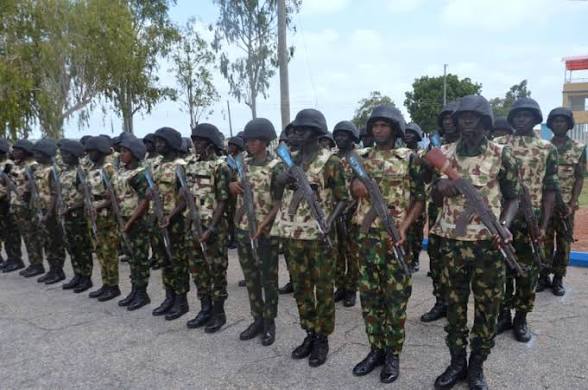
The federal government recently announced the establishment of four new divisions of the Nigerian Army in addition to the existing eight. The decision was clearly informed by the prevailing security challenges and the resultant need to bolster the nation’s security architecture.
Strategically located across the country, the new divisions will be enhancing shorter response times to emergency crisis situations while also preventing the fomenting and ruptures of potential threats to volatile regions and theatres in the country.
READ ALSO: Lessons in the rescue of the Oyo school children, by Ayuba Ahmad
The expansion in the army formations would improve command and control by spreading command responsibilities across the zones as well as providing for the ongoing programme for increased recruitment and enlistment of personnel.
Coming soon after the establishment of two new training depots, in addition to the age-old Zaria Depot, and the recruitment of 48, 000 personnel, the federal government’s policy thrust on reinventing the nation’s military is indeed gathering momentum.
With an estimated 230,000 personnel in its military and trailing behind Egypt and Algeria in terms of military strength in Africa, there are several compelling reasons why Nigeria should have since expanded its military strength. These include its huge population, vast land mass, its dicey position as an anglophone country sandwiched between francophone nations, and the persistent role the country has always played in peacekeeping missions in Africa and beyond.
The incidents of virulent jihadist insurgency in the northeast and other forms of insecurity ravaging other parts of the country for close to two decades are additional imperatives to increase the size of the nation’s military.
However, a sharp increase in the number of army divisions will not automatically lead to the attainment of the desirable goal of stamping out insecurity in all its ramifications. Numbers in this context must be complemented and buoyed with substance. In other words, an increased number of army divisions must be made to translate into the emergence of an increased number of soldiers with enhanced operational capacity and efficiency.
Besides surpassing Nigeria in terms of the numbers of men and women under arms, the rating of the Egyptian and Algerian militaries over the Nigerian military is derived substantially from the point of view of the quality and quantity of modern military equipment in the military assets of the three countries.
While the types and quantity of weapons of the Nigerian military are highly guarded secrets, obviously, for security reasons, it is very unlikely that the country can boast of the war assets of either Egypt or Algeria. For instance, the 440,000-strong Egyptian military boasts of over 3,600 tanks and well over one thousand aircraft.
READ ALSO: Puzzles of the PFIPC and palaces in the 2026 national budget, by Ayuba Ahmad
Algeria, the 27th in the global ratings of military strength, is reported to have about 1,500 tanks and 6000 aircraft in use by its military.
South Africa’s military, rated to be fourth in Africa, has the advantage of advanced, world-class military technology. The country also has a strong domestic defence industry.
Thus, Nigeria should not only be looking at boosting its military capacity through increasing the numbers of personnel, but it must also be focusing very pertinently on the areas of modernisation through increased acquisition and application of technology for its military in general, and the army in particular.
Nigeria faces a number of formidable impediments to the realisation of a vibrant and efficient military. Without equivocation, endemic corruption stands out as the most serious hurdle in the way of the goals of modernisation of the nation’s military.
For instance, the Nigerian Defence Industry Corporation, DIC, was established in 1964, the same year and on the same model as the Brazilian Embraer Defence Industry.
At its inception, the DIC was statutorily mandated to produce the bulk of the small- and medium-scale arms and ammunition for the country’s military. However, soon after the civil war, the corporation collapsed, went into a state of doldrums for close to four decades until recently, when it resumed the production of rifles and small ammunition.
Paradoxically, the Brazilian Embraer has progressed to the production of armoured tanks, drones, helicopters, fighter jets, commercial and passenger airliners, and sea-going varieties of warships. There can be no other logical explanation for this unfortunate turn of events for the DIC, but the malady of corruption that has ruined every sinew and organ of our society.
Also, it is corruption that weakened professionalism, morale, and patriotism, thereby resulting in the reduced capacity of the military to face the tidal wave of security threats and the rising strength of the Islamist insurgents as well as other forms of terrorists.
In a nutshell, the creation of new army divisions will certainly go a long way in bolstering the country’s security architecture. However, the physical expansion in formations must be matched with a corresponding increase in the number of personnel.
Very pertinently, an expanded number of personnel in the armed forces calls for a programme on rapid modernisation through increased acquisition and application of modern security equipment and technology. This, in turn, implies a resort to the strategy of stimulating private sector involvement in the production of military armaments of all grades and types.
The Defence Industry (Amendment) Act 2023, which emphasises private sector investment and joint ventures in local arms manufacturing, must be vigorously pursued and implemented.
It is gratifying that, as a result of the Act, over thirty private indigenous defence manufacturing organisations have since come together under an association: Defence Industries Association of Nigeria (DIAN).
The increased number of army divisions from eight to twelve may have inadvertently achieved a salient goal of firming the roots of the nation’s democracy by making coup planning a very cumbersome venture. It will henceforth require the near-impossible scenario of the collaboration of twelve General Officers Commanding.
The expansion of the Army divisions from eight to twelve is an epochal milestone in the trajectory of the nation’s military. President Bola Ahmed Tinubu, Commander-in-Chief; Minister of Defence, General Christopher Musa (rtd); the Chief of Defence Staff, General Olufemi Oluyede; and the Chief of Army Staff, General Shaibu Waidi, jointly killed many birds with one slingshot.
Follow the Neptune Prime channel on WhatsApp:
Do you have breaking news, interview request, opinion, suggestion, or want your event covered? Email us at neptuneprime2233@gmail.com

