


Mecca pact delegates turn to Iran as regional security calculations shift
The recent visit by senior officials from Saudi Arabia, Türkiye and Pakistan to Iran has highlighted changing security calculations in the Middle East, raising questions about the future of regional alliances and efforts to contain Tehran.
The officials travelled to Tehran on Monday, October 26, 2026, for discussions with Iranian representatives amid growing concerns over renewed regional hostilities and the risk of further escalation.
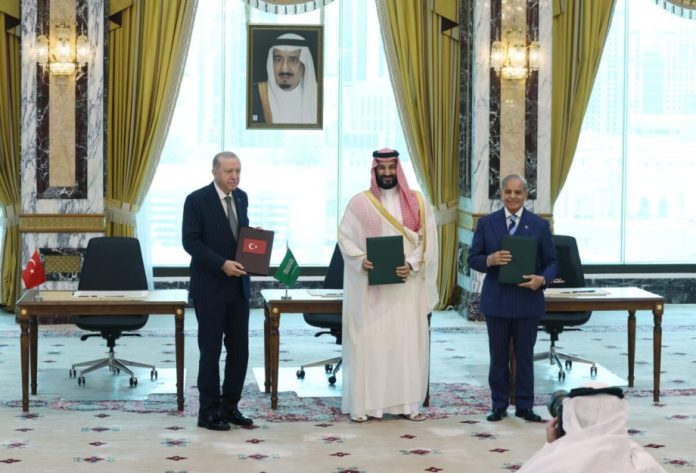
The visit involved Saudi Defence Minister Prince Khalid bin Salman, Pakistan’s Army Chief Field Marshal Asim Munir and Türkiye’s intelligence chief, Ibrahim Kalın. Their meeting with Iranian officials marked a significant diplomatic development following the signing of a trilateral defence agreement, known as the Mecca Pact, by Saudi Arabia, Türkiye and Pakistan in August.
In an opinion article published by Middle East Monitor, writer Junaid S. Ahmad argued that the engagement reflected a growing recognition among regional powers that Iran cannot be excluded from discussions about Middle Eastern security.
Read Also: “Return to Mecca”: The Israeli plan to occupy Saudi Arabia
According to Ahmad, decades of sanctions, military pressure and diplomatic isolation have failed to eliminate Iran’s influence or prevent it from remaining a significant factor in regional affairs.
He argued that the recent diplomatic engagement illustrated the difference between military superiority and achieving long-term strategic objectives, noting that the ability to inflict military damage does not necessarily translate into political submission.
The article also examined Saudi Arabia’s security challenges, particularly its longstanding reliance on American military support and its difficulties in addressing threats linked to Yemen’s Houthi movement, also known as Ansar Allah.
Ahmad maintained that Riyadh’s engagement with Tehran reflected the need to explore diplomatic solutions to regional conflicts that military capabilities alone have not resolved.
Pakistan, meanwhile, faces the challenge of balancing its defence commitments to Saudi Arabia with its geographical proximity to Iran and the potential consequences of being drawn into wider regional hostilities.
Türkiye also has strategic considerations, given its membership in NATO, regional ambitions and geographical position. The article argued that Ankara cannot develop a sustainable regional security framework without taking Iran’s influence into account.
The writer further highlighted a potential contradiction within the Mecca Pact: while the agreement seeks to strengthen collective defence, its members must also consider the risks of becoming involved in a broader confrontation involving Iran, Israel and the United States.
However, the diplomatic engagement does not necessarily indicate that the three countries have abandoned their existing security partnerships or embraced Iran’s political ideology. Rather, it suggests that dialogue with Tehran remains an important consideration in addressing shared regional security concerns.
The four countries have agreed to continue discussions on regional peace and security, although no specific new commitments were announced following the initial meeting.
Ahmad concluded that the engagement demonstrated how efforts to isolate Iran may have reinforced the need for regional powers to account for its role in future security arrangements.
The developments come at a time of heightened regional tensions, with diplomacy increasingly viewed as an important avenue for preventing further escalation and protecting the interests of countries across the Middle East.
The article is based on an opinion piece by Junaid S. Ahmad published by Middle East Monitor. Its interpretations of regional strategy reflect the author’s analysis and are not necessarily the positions of the governments involved.
Follow the Neptune Prime channel on WhatsApp:
Do you have breaking news, interview request, opinion, suggestion, or want your event covered? Email us at neptuneprime2233@gmail.com

