


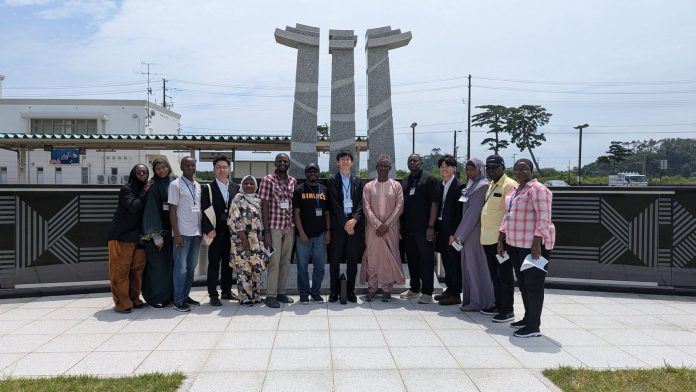
Nine Lessons from Japan, Lesson Seven: Sendai Framework — When Policy Walks on the Streets, by Dr Suleiman Dauda
Before visiting Japan, the Sendai Framework for Disaster Risk Reduction 2015–2030 existed in my mind largely as another impressive international policy document: four priorities, seven global targets, carefully negotiated language and the now-famous principle of Build Back Better.
READ ALSO: Nine Lessons from Japan, Lesson Four: The loudest thing in Japan is silence, by Dr Suleiman Dauda
Then we travelled through the Tohoku region, and suddenly the Framework was no longer a document. It was visible. I saw its principles in roads and seawalls, evacuation routes, elevated land, resilient public infrastructure, hazard maps, memorials, community drills and the seriousness with which ordinary citizens approached disaster preparedness. What struck me most was not that Japan had a disaster policy, many countries do, but that policy had somehow escaped from government documents and entered everyday life.
The Sendai Framework was adopted in Sendai in March 2015, four years after the Great East Japan Earthquake and Tsunami. Its four priorities are straightforward: understanding disaster risk; strengthening disaster-risk governance; investing in resilience; and enhancing preparedness while Building Back Better in recovery and reconstruction. Our journey through Tohoku helped me understand what those words actually mean in practice.
On 11 March 2011, a magnitude 9.0 earthquake struck northeastern Japan, triggering a devastating tsunami and the Fukushima nuclear accident. Japan’s Reconstruction Agency records 19,729 deaths, 2,559 people missing, more than 470,000 evacuees and almost 122,000 buildings completely destroyed. But the disaster destroyed more than buildings. It challenged how Japan understood risk.
At Tohoku University, we learned how disaster-risk thinking evolved after 2011. Greater emphasis was placed on planning for extreme events, community-based disaster governance, stronger connections between science, policy and society, and combining physical infrastructure with evacuation and community preparedness.
That distinction matters. A seawall can reduce risk, but it cannot eliminate it. Technology can issue warnings, but people must understand what those warnings mean and know what to do. Government can develop plans, but communities must understand and participate in them. Resilience cannot simply be constructed with concrete; it must also be constructed in human behaviour.
Perhaps the most powerful lesson I brought home from Tohoku was that reconstruction should never be confused with replacement. Japan did not simply ask, How do we rebuild what the tsunami destroyed? It also asked, Why was it vulnerable in the first place, and how can we prevent the next disaster from producing the same consequences?
READ ALSO: Nine Lessons from Japan, Lesson Six: Climate-smart agriculture in Japan, by Dr Suleiman Dauda
The reconstruction plans we studied reflected this thinking. Miyagi Prefecture combined disaster-resistant communities with economic revitalisation, health and welfare, education and environmental protection. Sendai integrated physical protection with evacuation systems, livelihood recovery, community rebuilding and disaster education.
Even memory became part of preparedness. The ruins of Arahama Elementary School, devastated by the tsunami, were preserved as a memorial and educational facility not simply to remember what happened, but to teach future generations why preparedness matters.
That is Build Back Better in its deeper sense: recovery should reduce the vulnerabilities that allowed disaster to become catastrophe in the first place.
As I travelled through Tohoku, my thoughts repeatedly returned home. Japan’s experience and that of North-East Nigeria are obviously different. Japan has largely confronted natural hazards, while Borno, Adamawa and Yobe have endured years of insurgency, displacement and destruction.
Yet both confront the same fundamental reconstruction question: Do we simply rebuild what existed before the crisis, or use recovery to correct the vulnerabilities that existed before it?
This question has become even more urgent because conflict is no longer the Northeast’s only major risk. The September 2024 Maiduguri flood demonstrated how multiple vulnerabilities can collide. Communities already carrying the consequences of insurgency and displacement were displaced again this time by water.
That experience should fundamentally reshape our approach to recovery. A community reconstructed after conflict but subsequently destroyed by flooding has not been sustainably reconstructed. Recovery from insurgency must therefore consider flood risk, climate change, urbanisation, livelihoods, environmental pressures and social vulnerability together.
So, what would the Sendai Framework look like if it truly walked the streets of Maiduguri, Damaturu, Potiskum, Bama or Mubi? It would mean flood-risk maps influencing where communities and public infrastructure are located. Drainage would be treated as resilience infrastructure, not merely an urban sanitation issue. Schools would teach children what to do during emergencies. Communities would know evacuation routes and safe locations before disaster strikes. Early-warning information would reach households in languages they understand. And reconstruction and resettlement decisions would consider security, livelihoods and environmental risks before, not after, communities are rebuilt.
It would also mean changing how we finance development. It is cheaper and certainly more humane to invest in drainage before flooding than to distribute relief materials afterwards; to enforce risk-sensitive land-use planning before settlements expand than to relocate thousands later; and to prepare communities before emergencies rather than improvise when disaster strikes.
The Sendai Framework therefore became clearer to me in Japan than it ever was on paper. For Nigeria, particularly the North-East, the lesson is simple: we have become relatively experienced at responding to emergencies; our next challenge is to become equally serious about preventing them.
Disaster management must move beyond emergency response. Recovery must become development. Preparedness must become governance. And resilience must become everyday policy.
Japan taught me that the success of a policy framework is ultimately not measured by how beautifully it is written. It is measured by whether, when you leave the conference room and walk into a community, you can see it.
Dr Suleiman Dauda writes from Damaturu, Yobe State.
Follow the Neptune Prime channel on WhatsApp:
Do you have breaking news, interview request, opinion, suggestion, or want your event covered? Email us at neptuneprime2233@gmail.com

