The Aye-Aye: One of the forest’s most unusual nocturnal hunters, by Fatima Ma’aji Muhammad
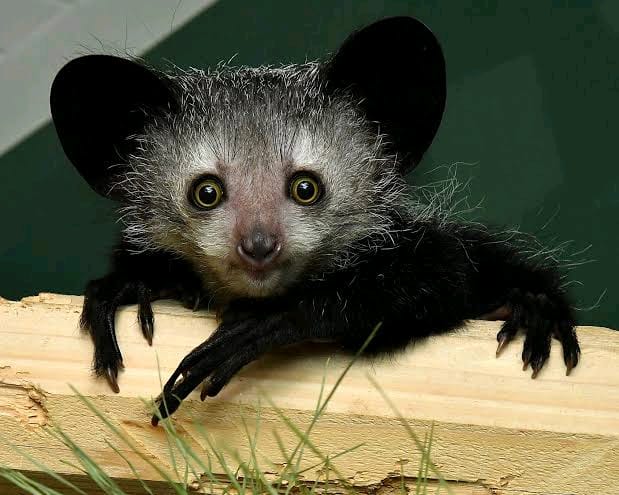
Story by Fatima Ma’aji MUHAMMAD (Student at Helwan University, Cairo, Egypt)
When darkness falls in the forests of Madagascar, a strange creature begins its hunt. With glowing eyes and silent movements, the aye-aye creeps along tree branches, listening carefully to the world around it.
Suddenly tap, tap, tap. It drums its long, thin finger against the bark of a tree, as if sending a secret code. It isn’t random. The aye-aye is searching. It listens closely, waiting for the hollow sound that reveals insects hiding deep inside. The moment it finds one, it bites through the wood and slips its finger in to pull out its prey.
Everything about the aye-aye is built for this nighttime mission. Its sharp ears catch the faintest sounds. Its wide eyes see clearly in the dark. Its long tail helps it balance as it moves swiftly through the trees.
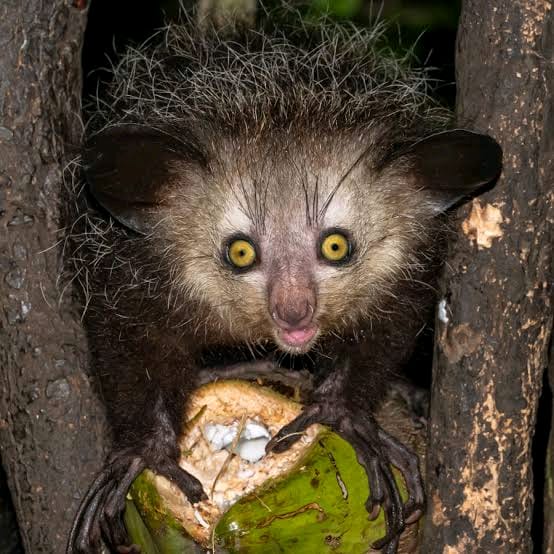
By day, it disappears, curled up in a nest of leaves high above the ground. But at night, it becomes one of the forest’s most unusual hunters.
Though it may look eerie, the aye-aye is harmless and incredibly clever. It is not a monster of the night, but a survivor, perfectly designed for life in the shadows.
It is the world’s largest nocturnal primate. It is characterised by its unusual method of finding food: it taps on trees to find grubs, then gnaws holes in the wood using its forward-slanting incisors to create a small hole into which it inserts its narrow middle finger to pull the grubs out.
This foraging method is called percussive foraging and takes up 5–41% of foraging time. The only other living mammal species known to find food in this way are the striped possum and trioks (genus Dactylopsila) of northern Australia and New Guinea, which are marsupials.
From an ecological perspective, the aye-aye fills the niche of a woodpecker, as it is capable of penetrating wood to extract the invertebrates within.