


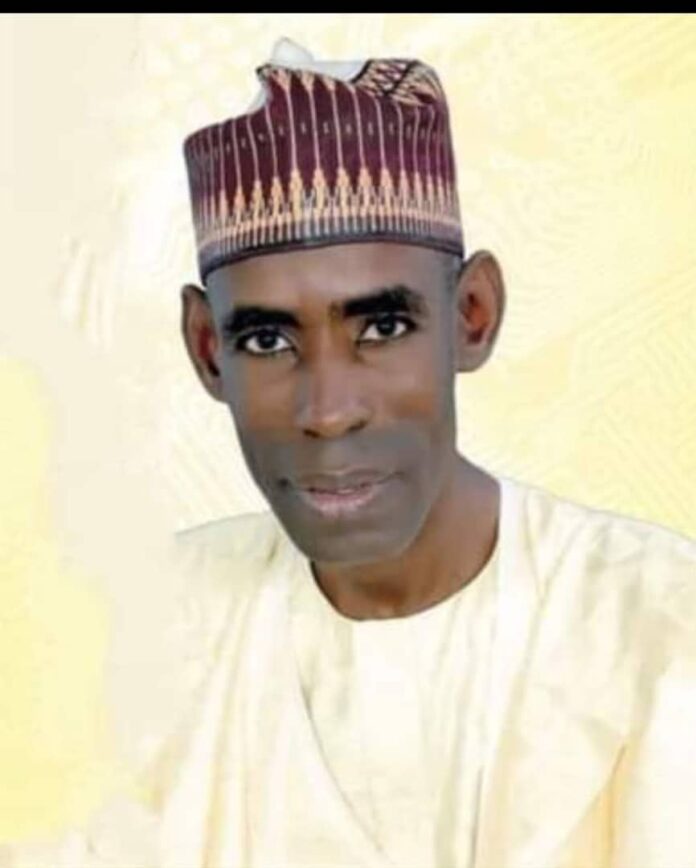
Opposition Politics: Senator Ibrahim Mantu style, by Engr. Bello Gwarzo Abdullahi, FNSE
When Engr. Buba Galadima stated during a recent interview that the opposition, in their own wisdom, did a decoy to deceive the ruling party about their inability to unite for a cause, and that at the last minute supporters can be told where to cast their votes, the statement reminded me of what transpired between yours sincerely and the late Senator Ibrahim Mantu at the Jos Airport, Heipang, in 1999. We had a discussion on the implications of power shift, the people representing us at various positions, and how to prevent an extension of tenure. He told me you cannot do that in Nigeria and succeed. We parted on that note, only for me to later find him as one of the key proponents of Obasanjo’s failed third term bid. I was so sad and surprised by his actions that I wrote an article reminding him of my airport encounter with him. It was only last year, while discussing with someone, that I brought up the matter and was informed of the covert but effective role he played in truncating the third term bid. This was further confirmed by Senator Orji Kalu in a recent interview and by another confirmation I got from a different source. With this cheering news, and looking at the dismal performance of the APC administration, I am confident that Nigerians will do the needful — vote them out.
READ ALSO: Politics vs Engineering: Nigeria’s infrastructure dilemma, by Engr. Bello Gwarzo Abdullahi, FNSE
This is not the first time Nigerian politics has rewarded the man who plays two boards at once. Mantu’s case has since been corroborated in far greater detail than the rumour I first heard. Senator Orji Kalu, in his autobiography and in subsequent interviews, has stated plainly that Mantu was the one who designed the strategy that killed the third term bill — that he was the one who insisted they keep the senate president and certain other principal officers out of the loop, precisely because they could not be trusted not to report back to the Villa. The man who stood at the podium mouthing the amendment was, by Kalu’s account, the same man quietly organising its defeat behind the scenes. If that is not decoy politics, I do not know what is. And it is exactly the pattern Galadima is describing today: a public posture of disarray or compromise, concealing a private hand steering the outcome.
READ ALSO: Opposition unity and the hard politics of 2027, by Engr. Bello Gwarzo Abdullahi, FNSE
I raise this history not as nostalgia but as a caution against a very Nigerian mistake — reading opposition politics only by its surface noise. We are conditioned to judge unity by how loudly people agree with each other on camera, and disunity by how loudly they disagree. Mantu taught me, painfully, that the two are not reliable proxies for what is actually happening. A politician can sound compromised in public and be working against the very outcome he appears to champion. Equally, a coalition can look fractured in the newspapers while its principal actors have already settled, quietly, on how the vote will go. Nigerians who take every squabble among opposition figures as proof that 2027 is a lost cause are making the same reading error I nearly made in 1999, when I mistook Mantu’s caution for capitulation.
None of this is an argument for complacency. Decoy tactics are a poor substitute for the discipline of an early, transparent coalition — they depend on the very secrecy that makes them impossible to plan around, and they have failed as often as they have succeeded. Nigeria’s opposition has spent much of the 2026 season locked in the disputes that Galadima himself has been chronicling: a coalition ADC now contending with legal challenges to its own logo, an NDC still assembling itself as a platform, and rival camps unable to agree on a single presidential ticket well into the year the primaries were meant to settle it. If the plan truly is to let the public theatre of disunity run until the last responsible moment, that is a strategy of considerable risk, and one that depends on discipline the opposition has not yet consistently shown in the open.
What should reassure Nigerians is not the tactic itself but the arithmetic beneath it. An administration cannot govern on inflation, a depreciating naira, and unresolved insecurity, and expect the theatre of opposition disarray to save it indefinitely. Mantu’s example shows that history does eventually correct the record — the man wrongly praised in public for loyalty to a bad project was, in the end, credited by his own collaborator for having destroyed it. I expect 2027 to write its own correction. Whether by open coalition or by the kind of quiet coordination Galadima describes, the outcome Nigerians actually need — a government held accountable at the ballot box — does not depend on the ruling party correctly reading the opposition’s hand before election day. It depends on the opposition, whatever its public face, actually voting as one when it counts.
Written Engr. Bello Gwarzo Abdullahi, FNSE.
Email: bgabdullahi@gmail.com
Follow the Neptune Prime channel on WhatsApp:
Do you have breaking news, interview request, opinion, suggestion, or want your event covered? Email us at neptuneprime2233@gmail.com

