


Samarkand, Uzbekistan: The enduring relevance of an ancient city of splendour and civilisation
Samarkand is a city in southeastern Uzbekistan and among the oldest continuously inhabited cities in Central Asia.
Samarkand is the capital of the Samarkand Region and a district-level city that includes the urban-type settlements Kimyogarlar, Farhod and Khishrav.
With 551,700 inhabitants (2021), it is the third-largest city in Uzbekistan. Historically, Samarkand has long been one of the principal urban centres of Iranian (Persian-Tajik) civilisation in Central Asia and played a major role in the cultural and commercial networks of the Silk Road.
An Ancient City of Significance
There is evidence of human activity in the area of the city dating from the late Palaeolithic. Though there is no direct evidence of when Samarkand was founded, several theories propose that it was founded between the 8th and 7th centuries BC. Prospering from its location on the Silk Road between China, Persia and Europe, at times Samarkand was one of the largest cities in Central Asia.
By the time of the Persian Achaemenid Empire, it was the capital of the Sogdian satrapy. The city was conquered by Alexander the Great in 329 BC, when it was known as Markanda, which was rendered in Greek as Μαράκανδα.
The city was ruled by a succession of Iranian and Turkic rulers until it was conquered by the Mongols under Genghis Khan in 1220.
Dominant Language and Religion
Since the 11th century, the city has been under Turkic/Uzbek political control, but the city’s culture and dominant language have always been Persian.
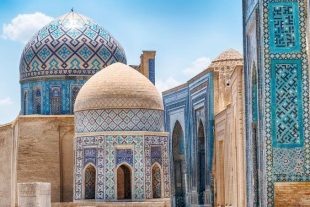
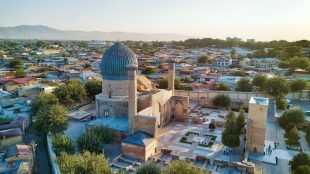
The city is noted as a centre of Islamic scholarly study and the birthplace of the Timurid Renaissance. In the 14th century, Timur made it the capital of his empire and the site of his mausoleum, the Gur-e Amir.
READ ALSO: The Ancient City of Nineveh: From world-ruling empire to ruins of history, by Gift Luckson
The Bibi-Khanym Mosque, rebuilt during the Soviet era, remains one of the city’s most notable landmarks. Samarkand’s Registan square was the city’s ancient centre and is bounded by three monumental religious buildings.
Preserved Tradition
The city has carefully preserved the traditions of ancient crafts: embroidery, goldwork, silk weaving, copper engraving, ceramics, wood carving, and wood painting. In 2001, UNESCO added the city to its World Heritage List as Samarkand – Crossroads of Cultures.
Modern Samarkand is divided into two parts: the old city, which includes historical monuments, shops, and old private houses; and the new city, which was developed during the days of the Russian Empire and Soviet Union and includes administrative buildings along with cultural centres and educational institutions. On 15 and 16 September 2022, the city hosted the 2022 SCO summit.
Remarkable History
Samarkand has a multicultural and plurilingual history that was significantly modified by the process of national delimitation in Central Asia.
A small group of inhabitants of the city are bilingual speakers of the Tajik language, whereas Uzbek is the official language and Russian is also widely used in the public sphere, as per Uzbekistan’s language policy. The city was named Marakanda when captured by Alexander the Great in 329 BC.
According to some sources, the present name comes from the eastern Iranian language Sogdian samar “stone, rock” and kand “fort, town.” In this respect, Samarkand shares the same meaning as the name of the Uzbek capital Tashkent, with tash- being the Turkic term for “stone” and -kent the Turkic analogue of kand borrowed from Iranian languages.
This cannot be proven because the city was given its name long after the Turkification of the Sogdians.
From more realistic and historical sources, according to 11th-century scholar Mahmud al-Kashghari, the city was known in Karakhanid Turkic as Sämizkänd or Sämerkänd, meaning “fat city.” 16th-century Mughal emperor Babur also mentioned the city under this name, and 15th-century Castilian traveller Ruy González de Clavijo stated that Samarkand was simply a distorted form of it.
READ ALSO: The Ancient City of Agadez in Niger: A tale of resilience and revival, by Gift Luckson
Some languages have their own spellings or variations of the name, such as the French “Samarcande”, the Italian and Spanish “Samarcanda”, and the Turkish “Semerkant”.
An Old Inhabited City
Along with Bukhara, Samarkand is one of the oldest inhabited cities in Central Asia, prospering from its location on the trade route between China and Europe. There is no direct evidence of when it was founded. Researchers at the Institute of Archaeology of Samarkand date the city’s founding around 700 BC.
Archaeological excavations conducted within the city limits (Syob and midtown) as well as suburban areas (Hojamazgil, Sazag’on) unearthed 40,000-year-old evidence of human activity, dating back to the Upper Palaeolithic.
A group of Mesolithic (12th–7th millennia BC) archaeological sites were discovered in the suburbs of Sazag’on-1, Zamichatosh, and Okhalik. The Syob and Darg’om canals, supplying the city and its suburbs with water, appeared around the 7th–5th centuries BC (early Iron Age). From its earliest days, Samarkand was one of the main centres of Sogdian civilisation. By the time of the Achaemenid dynasty of Persia, the city had become the capital of the Sogdian satrapy.
The Arrival and Acceptance of Islam
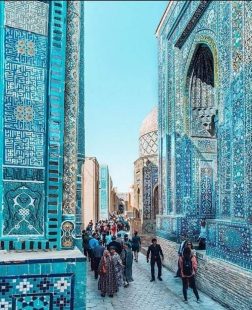
Islam entered Samarkand in the 8th century, during the invasion of the Arabs in Central Asia (Umayyad Caliphate). Before that, almost all inhabitants of Samarkand were Zoroastrians, and many Nestorians and Buddhists also lived in the city. From that point forward, throughout the reigns of many Muslim governing powers, numerous mosques, madrasahs, minarets, shrines, and mausoleums were built in the city.
Many have been preserved. For example, there is the Shrine of Imam Bukhari, an Islamic scholar who authored the hadith collection known as Sahih al-Bukhari, which Sunni Muslims regard as one of the most authentic (sahih) hadith collections. His other books included Al-Adab al-Mufrad. Samarkand is also home to the Shrine of Imam Maturidi, the founder of Maturidism and the Mausoleum of the Prophet Daniel, who is revered in Islam, Judaism, and Christianity.
Most inhabitants of Samarkand are Muslim, primarily Sunni (mostly Hanafi) and Sufi. Approximately 80–85% of Muslims in the city are Sunni, comprising almost all Tajiks, Uzbeks, and Samarkandian Arabs living therein. Samarkand’s best-known Islamic sacred lineages are the descendants of Sufi leaders such as Khodja Akhror Wali (1404–1490) and Makhdumi A’zam (1461–1542), the descendants of Sayyid Ata (first half of 14th c.) and Mirakoni Khojas (Sayyids from Mirakon, a village in Iran).
The liberal policy of President Shavkat Mirziyoyev opened up new opportunities for the expression of religious identity. In Samarkand, since 2018, there has been an increase in the number of women wearing the hijab.
READ ALSO: Jericho: The great ancient city gripped by turmoil and struggle for control, by Gift Luckson
Modern Times
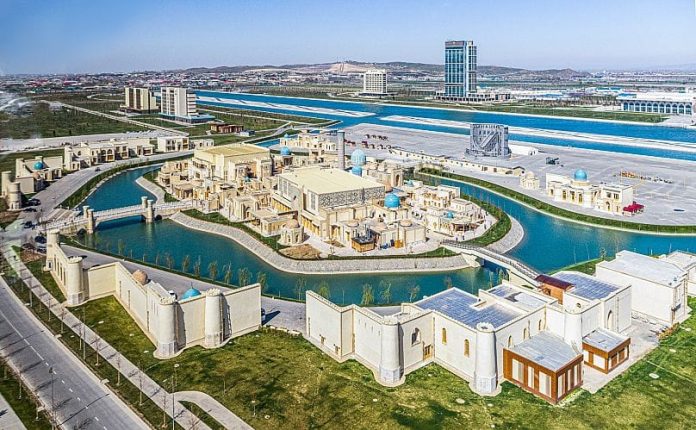
Silk Road Samarkand is a modern multiplex which opened in early 2022 in eastern Samarkand. The complex covers 260 hectares and includes world-class business and medical hotels, eateries, recreational facilities, park grounds, an ethnographic corner and a large congress hall for hosting international events.
Eternal city situated in Silk Road Samarkand complex. This site, which occupies 17 hectares, accurately recreates the spirit of the ancient city, backed up by the history and traditions of Uzbek lands and Uzbek people for the guests of the Silk Road Samarkand. The narrow streets here house multiple shops of artists, artisans, and craftsmen. The pavilions of the Eternal City were inspired by real houses and picturesque squares described in ancient books. This is where you can plunge into a beautiful oriental fairy tale: with turquoise domes, mosaics on palaces, and high minarets that pierce the sky.
A Site for Tourism
Visitors to the Eternal City can taste national dishes from different eras and regions of the country and also see authentic street performances. The Eternal City showcases a unique mix of Parthian, Hellenistic, and Islamic cultures so that the guests could imagine the versatile heritage of bygone centuries in full splendour. The project was inspired and designed by Bobur Ismoilov, a famous modern artist.
Follow the Neptune Prime channel on WhatsApp:
Do you have breaking news, interview request, opinion, suggestion, or want your event covered? Email us at neptuneprime2233@gmail.com

