


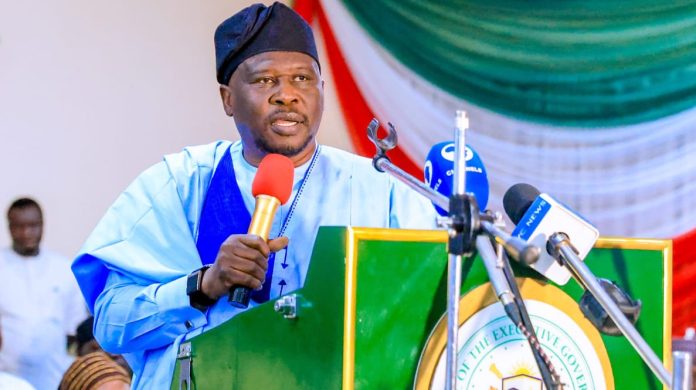
The Post-Mortem of an Empire: How the ‘Abuja mosquito’ displaced Fintiri’s political family, by Abubakar M. Kareto
In a recent and deeply compelling commentary, the respected writer Alhaji Iyawa invoked a potent psychological and political warning from Islamic history: the downfall of King Namarud (Nimrod). Known widely across the Muslim-North of Nigeria as ‘Lamarudu,’ he was a monarch whose hegemony reportedly eclipsed even the tyrannical Pharaoh of Moses’ era. Namarud’s intoxication with power was absolute. His arrogance led him to claim divinity and decree the execution by fire of Prophet Ibrahim. Yet, as Iyawa brilliantly reminded us, his ruin came not from a vast invading army, but from the most unassuming of creatures, which was a single mosquito.
The insect pierced the monarch’s defences, lodging itself within his skull. The resulting affliction, a relentless and maddening tinnitus mimicking the unending whine of a mosquito, drove the tyrant to literal self-destruction. He ordered his servants to beat his head with heavy objects to silence the internal buzz, ultimately shattering his own skull. It is a timeless lesson in humility, proving that the most absolute earthly power can be dismantled by the quietest, most microscopic of catalysts.
Centuries later, in 21st-century Nigeria, Iyawa’s allegory finds its perfect, chilling resonance. On paper, our 1999 Constitution (as amended) establishes a democracy anchored on the separation of powers among the executive, legislature, and judiciary. In practice, however, the sheer generosity of executive privileges has fostered a culture where leaders, once seated on the executive saddle for a year, become drunk on authority. The legislature and judiciary are frequently reduced to rubber stamps. It was Lord Acton who famously observed in 1887 that power tends to corrupt, and absolute power corrupts absolutely. He could not have better described the behavioural mutation that occurs when immense structural power falls into the hands of men who lack the character to carry it.
A textbook case of this political mutation has played out in Adamawa State. When Governor Alhaji Ahmadu Fintiri consolidated his second term following the hotly contested 2023 elections, a disturbing transformation occurred. While one cannot deny his developmental footprints, particularly the infrastructural facelift and road networks cutting across the state capital, his rhetorical posture shifted from governance to an incendiary, binary tribalism.
As Iyawa rightly observed, Governor Fintiri began operating within a split personality. On one hand, he played the messianic democrat. On the other hand, he prosecuted a narrow tribal agenda dictated by a group determined to weaponise history. He channelled historical grievances from nearly two centuries ago, long before British, French, and German colonialists partitioned the old Fombina Emirate, to justify a deep-seated animosity against the map of the Fulbe (Fulani) population. He dug up accounts of an iron-fisted Fulani district head who once ruled Madagali, Gulak, Michika and Uba, using it to indict an entire contemporary demographic.
This historical revisionism was both flawed and dangerous, deliberately conflating traditional emirate administrators with the ordinary Fulbe masses, who possess neither royal privilege nor executive influence. In a heavy-handed display of state power, he systematically unbundled post-independent emirates, stripping traditional domains from the Lamido of Adamawa until his traditional territory was virtually restricted to Yola. Meanwhile, development in the state capital was strictly skewed toward Jimeta, leaving the main city of Yola largely neglected.
READ ALSO: Is Nuhu Ribadu in a helpless situation?, by Abubakar M. Kareto
For the longest time, Fintiri’s political ideology was a zero-sum game of Us versus Them, meaning the minority tribes against the Fulbe. He was fiercely determined to engineer a successor from outside the Fulbe demographic. But then, the Abuja mosquitoes began to buzz.
In a swift and stunning overnight reversal, the Governor was forced to completely abandon his original political calculus. A dossier pulled from a secure locker in the nation’s capital, which was a muted buzz of political and legal consequences delivered with stealth, was all it took. The mosquito is a dangerous insect precisely because it operates without fanfare. By the time you hear the whine, the systemic infection has already taken hold.
Fintiri did not just bend under this pressure; he completely capitulated. In his rush to bow to superior external forces, the Governor actively turned on his own loyalists during the high-stakes primary contests. He abandoned his own political bloodline and surrendered to the enforcement of the Abuja favourite, Ahmadu Tijjani Galadima Aminu, who is a Pulloh and the younger brother of the late 1958 district head. Today, Galadima has been successfully enforced as the flagbearer, standing prominently by Fintiri’s side at official functions more frequently than even the deputy governor.
With the conclusion of these primaries, the devastating, irreversible cost of Fintiri’s surrender has finally come to light. The structural destruction is over, and the dust has settled. The once-trusted, prominent members of Fintiri’s original political family in the race were left completely unprotected, battered, and ultimately defeated. By succumbing to the enforcement of Galadima, Fintiri’s original political home base has not just been threatened; it has been officially dispersed, displaced, and shattered.
Looking at the debris of this self-inflicted wreckage, the warnings I issued before the hammer fell now stand as a stark, tragic autopsy of an empire that failed to protect itself:
“Maintaining the unity of the ‘Fintiri political family’ should be Governor Fintiri’s highest priority. This is the same strong coalition that successfully took over leadership from former Governor Bindo. Any lack of vigilance or internal division could permanently scatter his political base. For Fintiri, keeping this structure united is crucial; allowing it to break apart would be a defining political misstep that could impact his legacy indefinitely.”
Yet, that vigilance was completely discarded in exchange for political survival. By failing to shield his core allies from the Abuja onslaught, the very foundation of his local empire dissolved.
“Governor Fintiri’s top priority must be keeping his political structure united. This is the team that won power from former Governor Bindo. Any division now could completely scatter his base and become a lifetime political mistake. Protecting his legacy requires absolute vigilance, and preserving the core of this political family remains the only viable option to hold the structure together.”
Because these warnings went unheeded, the Fintiri political family has been effectively scattered to the four winds. Tribal politics is the refuge of second-rate politicians who rely on whipped-up sentiments of the gullible, but sacrificing your own foundational foot soldiers to survive an onslaught from Abuja creates a catastrophic, permanent vacuum.
Across the country, the arrogant, chest-beating governors who once made governance turbulent for the presidency have now all fallen into an orderly line, like ducklings following a mother duck. The presidency required no overt warfare because the silent, institutional power of the Mosquito did the mobilisation work for it.
For Fintiri, the price of survival was the total displacement of his political legacy. You cannot build a sustainable future by destroying the very machinery that brought you to power. By allowing his political family to be broken and scattered, Fintiri has committed a lifetime political blunder from which there is no recovery. The lesson of Adamawa, built upon Iyawa’s profound historical reflection, is a chilling warning to leaders who believe executive power makes them invincible. When you use tribalism as a shield, you become blind to the quiet instruments of the state. The Abuja mosquito did not just make the governor fall in line; it left his home empire completely empty, completely displaced, and shattered from within by the betrayal of his own house.
Abubakar M. Kareto is a prominent Public Affairs Analyst based in Nigeria, specialising in political party dynamics, structural governance, and executive power in the Northeast region and beyond. He can be reached via email at amkareto@gmail.com.
Follow the Neptune Prime channel on WhatsApp:
Do you have breaking news, interview request, opinion, suggestion, or want your event covered? Email us at neptuneprime2233@gmail.com