


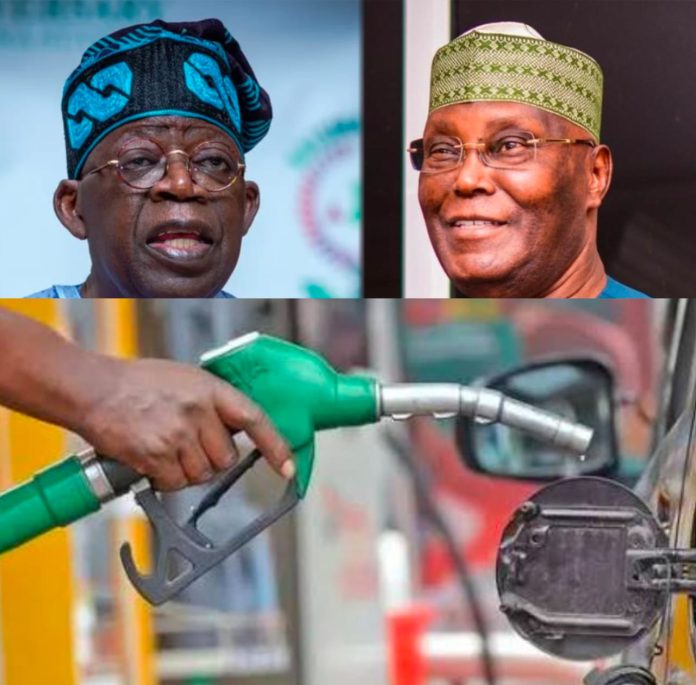
Tinubu vs. Atiku: Decoding Nigeria’s petroleum price clash, sovereign debt, and the future of energy reform, by Abubakar M. Kareto
The sharp confrontation between the Federal Government and former Vice President Atiku Abubakar over fuel subsidy policy has reopened the central economic fault line in Nigerian public life. In an official communication from the State House, Abuja, the Presidency dismissed Atiku’s remarks suggesting a review of the fuel price support regime as fiscally regressive, legally incompatible with the Petroleum Industry Act, and politically opportunistic. The administration specifically noted that the opposition failed to provide any practical arithmetic, concrete funding model, or operational roadmap to back its position. In response, Atiku’s camp argued that President Bola Ahmed Tinubu’s immediate subsidy removal inflicted an unbearable cost of living crisis on citizens while failing to deliver transparent dividends. Beyond the partisan friction, the confrontation reflects a deep public dilemma: if trillions of naira were truly saved by ending the subsidy, why has ordinary life become so painfully expensive, and where did the money go?
The argument for reassessing how energy pricing is managed begins with the well-documented corruption of the past. For years, official records claimed Nigeria consumed between 65 million and 90 million litres of petrol daily, yet recent operational data and domestic refining figures reveal that actual domestic demand sits closer to 30 to 35 million litres per day. The massive surplus represented paper transactions, phantom vessel discharge claims, and fuel diverted across regional borders, proving that historical subsidy outlays were heavily driven by fraud and unmonitored importation schemes.
To address these historical distortions, policy analysis points to a clear structural alternative: leveraging domestic refining capacity, led by mega-assets like the Dangote Petroleum Refinery, to build a transparent, trackable downstream ecosystem that eliminates import-driven leakages entirely. By sourcing fuel locally, Nigeria eliminates ocean freight margins, port demurrage, and foreign exchange import fees, while establishing strict end-to-end accounting from the refinery gate to retail stations. However, fiscal realism requires acknowledging that domestic refining alone does not make crude oil free. Because crude remains an internationally priced asset, selling it at a discount to domestic refiners reduces Federation export revenue, while forcing refiners to sell below cost risks private capital insolvency. Any structured price stabilisation mechanism, regardless of how clean and transparent, must still be funded through disciplined, auditable budgetary provisions rather than opaque off-budget liabilities.
READ ALSO: The undebated driver of naira devaluation, inflation and dwindling economy, by Abubakar M Kareto
The paradox deepening public cynicism is that while subsidy removal was promoted as the ultimate cure for sovereign borrowing, government debt accumulation actually accelerated. Official data from the Debt Management Office shows Nigeria’s total public debt stock climbed from 87.38 trillion naira in mid-2023 to over 153.29 trillion naira by late 2025, driven by currency devaluation on foreign loans, the securitisation of central bank advances, and frequent resort to domestic debt markets to fund widening budget deficits. Although gross statutory allocations shared by the Federation Account Allocation Committee surged from pre-reform averages of 700 billion naira to over 2 trillion naira monthly, debt servicing alone consumed over 10.8 trillion naira in the first nine months of 2025. Because expanded revenues were absorbed by mounting debt repayments rather than ring-fenced development projects, the public watched borrowing increase while bearing the full weight of reform.
This burden was compounded because petrol in Nigeria serves as the primary energy backbone for informal small businesses, agro-logistics, and rural irrigation pumps. When pump prices jumped above 1,000 naira per litre, transport and food logistics costs surged across the entire domestic supply chain. Meanwhile, key mitigating measures lagged behind: the national Compressed Natural Gas rollout encountered infrastructure bottlenecks, pipeline deficits, and a severe shortage of certified conversion technicians, preventing public transit operators from adopting cheaper fuel alternatives at scale.
Comparative international experience demonstrates that removing energy subsidies requires careful social sequencing. In Indonesia, the government executed phased fuel price increases only after establishing the unconditional cash transfer program Bantuan Langsung Tunai, which covered over nineteen million low-income households before pump prices were adjusted. Egypt carried out a multi-year phased removal using automatic price indexation formulas while directing massive capital spending into mass transit rail and urban commuter lines to shield workers from transport spikes. In contrast, Nigeria executed an immediate, total price deregulation alongside a full foreign exchange float without functional mass transit or automated social safety nets ready to cushion the blow.
READ ALSO: The Refining Paradox: Why NNPC burned billions while Dangote built a giant, by Abubakar M. Kareto
The clash between the Tinubu administration and Atiku Abubakar highlights a fundamental governance lesson. Economic theory can prove that subsidising fuel consumption is wasteful, but politics dictates that demanding sacrifice without visible returns fractures public trust. Defending fiscal reform cannot rely solely on reminding citizens of past corruption or warning against future debt while borrowing continues unabated. The Federal Government and state governors must publish transparent, project-specific accounting of how expanded revenues are deployed, while accelerating investments in compressed natural gas mass transit, rural feeder roads, and basic public services. Until the proceeds of fiscal discipline produce clear improvements in the daily lives of citizens, the debate over returning to fuel subsidies will continue to dominate the national stage.
Author’s Bio:
Abubakar M. Kareto is a public affairs analyst, communications strategist, and political commentator specialising in governance, public policy, and socio-economic developments in Nigeria and beyond. He can be reached via amkareto@gmail.com or on X at @amkareto.
Follow the Neptune Prime channel on WhatsApp:
Do you have breaking news, interview request, opinion, suggestion, or want your event covered? Email us at neptuneprime2233@gmail.com

