


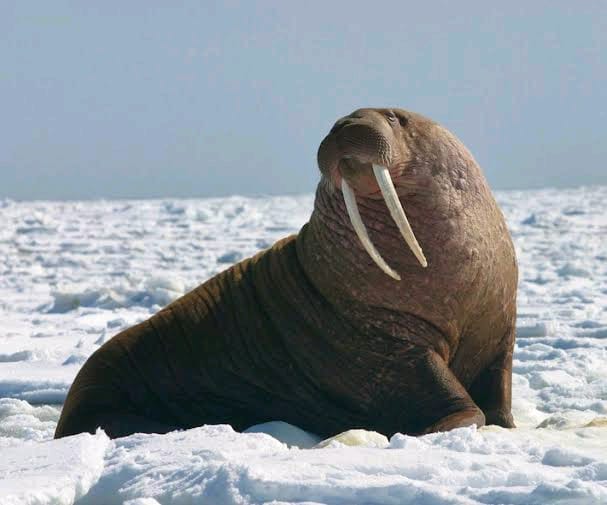
The walrus is a large pinniped marine mammal with a discontinuous distribution around the North Pole in the Arctic Ocean and subarctic seas of the Northern Hemisphere. It is the only extant species in the family Odobenidae and genus Odobenus.
This species is subdivided into two subspecies: the Atlantic walrus (O. r. rosmarus), which lives in the Atlantic Ocean, and the Pacific walrus (O. r. divergens), which lives in the Pacific Ocean.
Adult walruses are characterised by prominent tusks and whiskers, and considerable bulk; adult males in the Pacific can weigh more than 2,000 kilograms (4,400 pounds) and, among pinnipeds, are exceeded in size only by the two species of elephant seals.
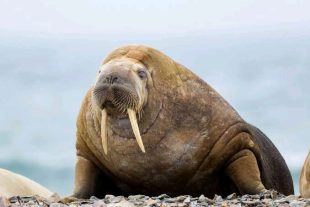
Walruses live mostly in shallow waters above the continental shelves, spending significant amounts of their lives on the sea ice looking for benthic bivalve molluscs. Walruses are relatively long-lived, social and intelligent animals, and are considered a keystone species of the Arctic marine region.
The walrus has played a prominent role in the cultures of many indigenous Arctic peoples, who have hunted it for meat, fat, skin, tusks, and bone. During the 19th century and the early 20th century, walruses were widely hunted for their blubber, walrus ivory, leather, and meat; in this period, the walrus population dropped rapidly all around the Arctic region.
It has rebounded somewhat since, though the populations of Atlantic and Laptev walruses remain fragmented and at low levels compared with the time before human interference.
Walruses live to about 20–30 years old in the wild. The oldest-living walrus on record was Slowpoke, a captive walrus at SeaWorld Orlando, who lived to be 49 years old when he died.

The males reach sexual maturity as early as 7 years, but do not typically mate until fully developed at around 15 years of age. They rut from January through April, decreasing their food intake dramatically. The females begin ovulating as soon as 4-6 years old. Females reach physical maturity at 10–12 years of age, and males at 15–16 years of age.
The females are diestrous, coming into heat in late summer and around February, yet the males are fertile only around February; the potential fertility of this second period is unknown. Breeding occurs from January to March, peaking in February.
Males aggregate in the water around ice-bound groups of oestrous females and engage in competitive vocal displays. The females join them and copulate in the water.
Gestation lasts 15 to 16 months. The first three to four months are spent with the blastula in suspended development before it implants itself in the uterus. This strategy of delayed implantation, common among pinnipeds, presumably evolved to optimise both the mating season and the birthing season, determined by ecological conditions that promote newborn survival.
Calves are born during the spring migration, from April to June. They weigh 45 to 75 kg (99 to 165 lb) at birth and are able to swim. The mothers nurse for over a year before weaning, but the young can spend up to five years with the mothers.
Walrus milk contains higher amounts of fats and protein compared to land animals but lower compared to phocid seals. This lower fat content in turn causes a slower growth rate among calves and a longer nursing investment for their mothers.
Young may be suckled at sea as well as during long haul-outs, making walrus the only pinnipeds that exhibit aquatic suckling. Because ovulation is suppressed until the calf is weaned, females give birth at most every two years, leaving the walrus with the lowest reproductive rate of any pinniped. Male walruses may help inexperienced young as they learn to swim, and have even been recorded caring for orphans. When a group is threatened, all the adults may protect the young.
The rest of the year (late summer and fall), walruses tend to form massive aggregations of tens of thousands of individuals on rocky beaches or outcrops. The migration between the ice and the beach can be long-distance and dramatic.
READ ALSO:Vultures: Remarkable scavengers that use their own urine to cool their bodies, by Gift Luckson
In late spring and summer, for example, several hundred thousand Pacific walruses migrate from the Bering Sea into the Chukchi Sea through the relatively narrow Bering Strait.
Traditional hunters used all parts of the walrus. The meat, often preserved, is an important winter nutrition source; the flippers are fermented and stored as a delicacy until spring; tusks and bone were historically used for tools, as well as material for handicrafts; the oil was rendered for warmth and light; the tough hide made rope and house and boat coverings; and the intestines and gut linings made waterproof parkas.
While some of these uses have faded with access to alternative technologies, walrus meat remains an important part of local diets, and tusk carving and engraving remain a vital art form.
In the 18th and 19th centuries, the walrus was heavily exploited by American and European sealers and whalers, leading to the near-extinction of the Atlantic subspecies.
READ ALSO:Dogs eat Tigers in Nigeria, by Suyi Ayodele
As early as 1871, traditional hunters were expressing concern about the numbers of walrus being hunted by whaling fleets. Commercial walrus harvesting is now outlawed throughout its range, although Chukchi, Yupik and Inuit peoples are permitted to kill small numbers towards the end of each summer.
According to Adolf Erik Nordenskiöld, European hunters and Arctic explorers found walrus meat not particularly tasty, and only ate it in case of necessity; however, walrus tongue was a delicacy.
Walrus hunts are regulated by resource managers in Russia, the United States, Canada, and Greenland, and by representatives of the respective hunting communities. An estimated 4000–7000 Pacific walruses are harvested in Alaska and in Russia, including a significant portion (about 42%) of struck and lost animals.
Several hundred are removed annually around Greenland. The sustainability of these levels of harvest is difficult to determine given uncertain population estimates and parameters such as fecundity and mortality. The Boone and Crockett Big Game Record book has entries for Atlantic and Pacific walrus.
The recorded largest tusks are just over 30 inches and 37 inches long, respectively.
Follow the Neptune Prime channel on WhatsApp:
Do you have breaking news, interview request, opinion, suggestion, or want your event covered? Email us at neptuneprime2233@gmail.com

