


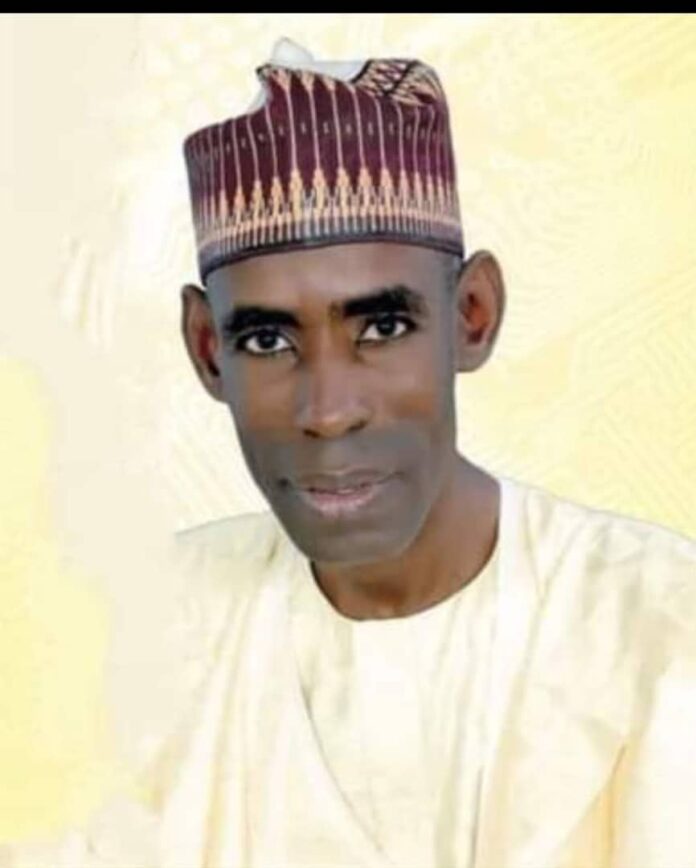
When a Pandora’s Box is Opened, the Files Must Follow: A rejoinder in support of Solomon Dalung’s intervention on the Musa-El-Rufai allegation, by Engr. Bello Gwarzo Abdullahi, FNSE
It needs to be stated clearly, unambiguously and patriotically that Barr. Solomon Dalung’s intervention deserves to be read slowly, not scrolled past. It does something Nigerian public commentary rarely manages anymore: it separates the emotional weight of an allegation from the evidentiary weight it would need to actually stand up. That distinction — between a grievance that is real and an accusation that is proven — is exactly what our public discourse has lost, and its loss is costing us more than we seem willing to admit.
I support Dalung’s central argument without reservation. General Christopher Musa’s claim that Nasir El-Rufai “deliberately planned for the killing of our people” is not an ordinary political jab. It is an allegation of intent to commit mass atrocity, made by a sitting Minister of Defence and former Chief of Defence Staff — a man whose every public word now carries the institutional authority of the office he holds. When such a man speaks, Nigerians do not hear a private citizen venting; they hear the state itself appearing to render a verdict. That is precisely why the standard of proof cannot be a television interview and a reference to unspecified videos. If the allegation is true, it deserves a full, formal, evidentiary reckoning — a probe, a tribunal, a documented trail — not a talk-show soundbite that Nigerians are simply invited to believe on the strength of the speaker’s rank.
This is where the principle I want to add to Dalung’s argument becomes unavoidable: look before you leap. Not as a caution against speaking on national issues, but as a discipline for how we speak on them. Musa did not invent the pain of Southern Kaduna — that pain is real, decades deep, and well documented by people like Gen. Martin Luther Agwai, who is himself from Kagoro. But real pain does not automatically validate every explanation offered for it. “He told us he paid bandits” is a sentence that could describe a war crime, or it could describe the very Agwai-negotiated compensation scheme — paid to transhumant Fulani who had lost cattle and relatives in the 2011 violence, in exchange for an end to reprisals — that Agwai himself insisted should be extended to all aggrieved parties, not only herdsmen. Those are not shades of the same fact. They are two entirely different factual worlds, and collapsing them into one soundbite is exactly the kind of leap that responsible national conversation cannot afford.
Consider what looking before leaping would actually have required here. It would have required naming the specific payments, the specific recipients, and the specific dates before calling them payments to “bandits.” It would have required asking Maj.-Gen. Danjuma Ali-Keffi, who commanded 1 Division in the relevant period, whether any governor ever instructed him to stand down military operations — a question Ali-Keffi has already answered publicly, and in the negative. It would have required asking the obvious institutional question: if a governor was deliberately enabling killings while the Nigerian Army was conducting clearance operations in the same state, what did the military’s own chain of command know, and when? These are not hostile questions. They are the ordinary due diligence that any serious allegation demands before it is repeated as settled fact — and their absence from the original claim is the single biggest reason Dalung’s rejoinder was necessary in the first place.
The same discipline applies to how the country talks about the Muslim-Muslim question that shadows this entire episode. If a Muslim-Muslim ticket is inherently divisive, that principle has to be applied consistently — including to the federal ticket under which the Minister of Defence himself now serves. If it is not inherently divisive, then whatever criticism is aimed at El-Rufai’s Kaduna ticket needs a sharper target than its composition alone. Nigerians have watched this argument get deployed selectively too many times, praised in one context and condemned in another depending on whose ox is being gored. Look before you leap means naming the actual principle and applying it evenly, not reaching for whichever version of it is convenient in the moment.
READ ALSO: Let us make what works, work for Nigeria, by Engr. Bello Gwarzo Abdullahi, FNSE
I want to go a step further than Dalung on one point, because I think it is the most dangerous part of this entire episode and deserves to be said plainly. What should worry every Nigerian — not just Kaduna people, not just Southern Kaduna people — is how a man like General Musa has been drawn into this. For most of his career, Musa was precisely the kind of figure Nigeria is supposed to be able to trust across every fault line: a professional soldier who rose through Operation Hadin Kai and the Infantry Corps to Chief of Defence Staff on the strength of competence, not tribal or partisan calculation. Officers like that are supposed to be the ballast of the nation — the people whose credibility survives changes of government precisely because they stayed out of the trenches. When such a figure is repositioned as a partisan voice in an internal APC and Kaduna political contest, firing allegations that read like ammunition in a succession battle, something has shifted that should alarm us far more than the El-Rufai dispute itself.
This is not really about whether El-Rufai was a good governor or a difficult one — reasonable people can and do disagree fiercely about that, and his record deserves the scrutiny Dalung is careful to preserve. It is about the precedent being set: that even our most senior, most professionally insulated national figures are not safe from being pulled into the machinery of power politics and used as instruments in it. If a former Chief of Defence Staff can be deployed this way, no institution is exempt. Today it is a security chief drawn into a Kaduna succession quarrel. Tomorrow it could be a judge, a central bank governor, an electoral commissioner, or a service chief still in uniform. Once the country accepts that rank and professional standing offer no protection from being conscripted into political combat, we have normalised something that no democracy can absorb indefinitely without real damage to the institutions that are supposed to stand above the fray. That is the dangerous precedent Dalung’s piece gestures toward, and it deserves to be stated without euphemism.
It is against this backdrop that the case for unity in diversity in the North becomes not sentimental but strategic. The North is not a small or marginal player pleading for attention; it is three-fifths of Nigeria’s landmass and home to more than sixty percent of its population, bound together by centuries of intermarriage, trade, and shared history across ethnic and religious lines that long predate the boundaries colonial cartography later drew. A region of that size and that history does not have the luxury of letting internal disputes — Kaduna’s included — be exploited as wedges. Every fracture that Southern and Northern Kaduna, Muslim and Christian, Hausa-Fulani and Atyap, Bajju, or Adara communities allow to widen along ready-made fault lines is a fracture that weakens the North’s ability to speak with one voice on the challenges that threaten every one of its component parts equally: banditry ravaging Zamfara, Katsina, and Sokoto; farmer-herder conflict tearing at the North Central; insurgency’s long shadow over the North East; and the poverty and youth unemployment that respect no state boundary at all. A divided North is a North that can be managed piece by piece. A North that insists on due process, presumption of innocence, and evidence-based accountability — applied evenly, regardless of which faction benefits — is a North that remains what it has long been: the stabilising force the rest of the country has depended on, and cannot afford to lose.
READ ALSO: G100, 2027 and the future of democracy in Nigeria, by Engr. Bello Gwarzo Abdullahi, FNSE
So I associate myself fully with Dalung’s closing demand. If General Musa has evidence that Nasir El-Rufai deliberately planned the killing of Southern Kaduna’s people, let him produce it — formally, to the appropriate authorities, not merely to a television camera. If he is describing the Agwai-negotiated compensation, let him say so plainly and explain why a documented reconciliation exercise should now be redescribed as payment to bandits. And if he possessed credible evidence of a deliberate killing campaign while he still wore the uniform, Nigerians are entitled to ask, without being accused of disloyalty for asking, what he did with that knowledge and to whom he reported it.
Kaduna’s wounds are old, and they are real. They deserve truth, not another round of selective memory dressed up as candour. And Nigeria’s institutions — military, ministerial, judicial — deserve to remain places where professional standing still means something, rather than assets to be spent in the next round of a power contest. Look before you leap. On a matter this grave, that is not caution for its own sake. It is the only responsible way to speak on a national wound that has already bled for far too long.
Ultimately, let it be stated loud and clear: General Musa has opened a Pandora’s box. Now he must be prepared to open the files. Solomon Dalung Esq. has raised the right questions, and this rejoinder stands fully with him — with one added worry, that men once considered above the fray are now being pulled into the trenches of power, and that the North must close ranks before the fire spreads any further.
Written by Engr. Bello Gwarzo Abdullahi, FNSE
Email: bgabdullahi@gmail.com
Follow the Neptune Prime channel on WhatsApp:
Do you have breaking news, interview request, opinion, suggestion, or want your event covered? Email us at neptuneprime2233@gmail.com