


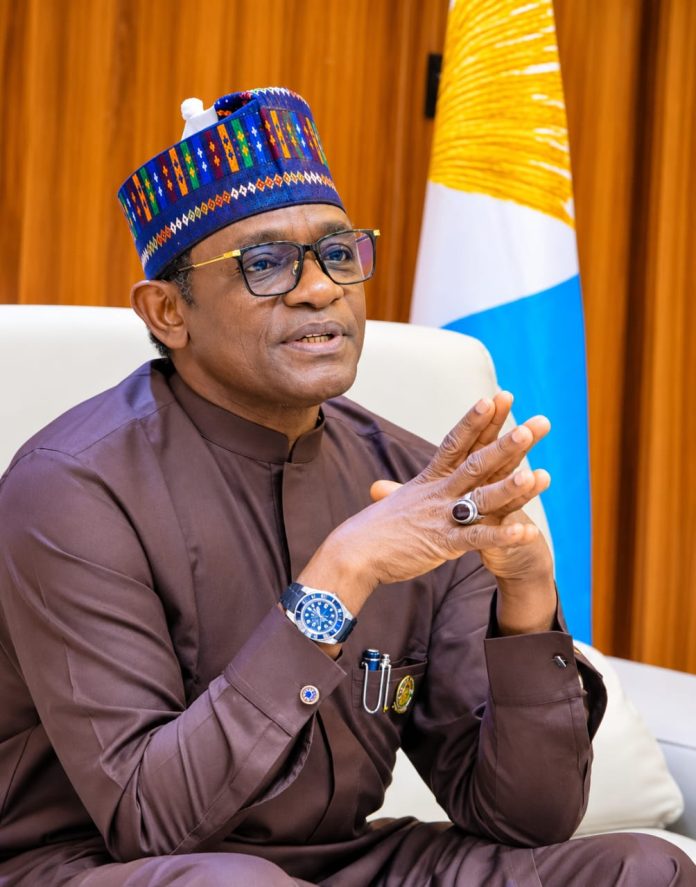
Yobe’s Development Calculus: The institutional logic behind Buni’s five policy priorities, by Maji Bappa Maina
The history of governance in Yobe State cannot be properly understood without considering the circumstances under which the present administration assumed office in May 2019.
The state was emerging from years of insurgency, widespread displacement, damaged public infrastructure, disrupted educational activities and weakened economic livelihoods.
READ ALSO:
These conditions presented a governing challenge that extended far beyond the conventional responsibilities of managing a state.
Governor Mai Mala Buni inherited a development environment in which the immediate demands of recovery had to coexist with the longer-term responsibilities of building institutions, expanding public services and creating economic opportunities.
His administration subsequently adopted the principle of Continuity, Consolidation and Innovation as its policy direction, seeking to sustain existing development efforts while introducing new approaches to the state’s priorities.
Seven years into the administration, it is worth examining the policy architecture that has shaped its development agenda.
Five broad pillars stand out: post-insurgency recovery and community reintegration, education and human capital development, healthcare expansion, agricultural transformation, and infrastructure development and economic connectivity.
These are not merely five sectors receiving government attention.
They represent interconnected policy interventions through which the administration has sought to address Yobe’s historical challenges while positioning the state for a more productive economic future.
The first and perhaps most defining pillar is post-insurgency recovery, peace and community reintegration.
For Yobe, the consequences of insurgency were not limited to insecurity.
They extended into the disruption of family livelihoods, the destruction of communities, the displacement of populations and the weakening of local economic activities.
The Buni administration recognised that restoring security alone would not automatically return affected communities to normal economic and social life.
People who had lost their homes, farms, businesses and access to essential services required a more comprehensive intervention.
This informed the development of the state’s post-insurgency recovery framework, which placed emphasis on the reintegration of internally displaced persons, the return of displaced communities and collaboration with humanitarian and international development partners.
The administration’s 2023 inaugural address specifically identified the reintegration of displaced populations and the dignified return of affected communities, including Malam Dunari Ward in Gujba Local Government Area, as part of its recovery efforts.
It also called on United Nations agencies and humanitarian partners to align their interventions with the state’s recovery and reintegration plan.
An important institutional expression of this direction is the Yobe State Action Plan on Durable Solutions.
The framework brings together security, livelihood development, education, healthcare, infrastructure, housing, governance and social cohesion.
It was developed through collaboration involving government institutions, United Nations agencies, the World Bank, humanitarian organisations, civil society and affected communities.
The plan estimates a three-year implementation requirement of approximately ₦2.1 trillion and identifies 2.8 million people as its target population, including internally displaced persons, returnees and other displacement-affected residents.
These figures represent the scale of the plan’s ambition and resource requirements, not evidence that the entire amount has been secured or spent.
The significance of this approach lies in its recognition that recovery must be treated as a development responsibility rather than a temporary humanitarian exercise.
Returning people to their ancestral communities is important, but the sustainability of that return depends on whether they can access healthcare, education, water, housing, security and opportunities to earn a living.
The second pillar is education revitalisation and human capital development.
On 29 May 2019, Governor Buni declared a state of emergency in the education sector, signalling that the condition of education required a deliberate institutional response.
The administration subsequently established the Yobe Education Council, constituted technical committees, introduced an education fundraising framework and established the Yobe State Education Trust Fund.
These measures were intended to provide institutional direction and support for the revitalisation of basic and secondary education.
In his 2023 inaugural address, the Governor reported the establishment of eight Government Girls Day Senior Secondary Schools, seven model schools and seven mega schools.
He also reported the recruitment of 2,600 teachers, rehabilitation of schools affected by insurgency and scholarship support for 38,000 students studying within Nigeria and 371 studying abroad at that time.
These interventions deserve attention because the education challenge in Yobe is not simply a question of constructing additional classrooms.
It involves rebuilding an entire learning system, improving access, strengthening teaching capacity, retaining girls in school and preparing young people for the demands of a changing economy.
The establishment of institutions and scholarship programmes is important, but the deeper measure of educational reform lies in learning outcomes.
How many children who previously lacked access to education are now enrolled? Are teachers adequately equipped to deliver quality instruction? Are graduates acquiring the knowledge and technical skills required by employers and emerging industries?
These questions are essential because education investment produces its greatest public value when it translates into a more capable population.
Yobe’s future economic ambitions will require engineers, health professionals, agricultural specialists, researchers, entrepreneurs, technicians and administrators.
The education sector must therefore remain connected to the human-resource requirements of the state’s development agenda.
The third pillar is healthcare expansion and the pursuit of wider access to essential medical services.
One notable feature of the administration’s health policy is its emphasis on strengthening primary healthcare while improving access to secondary and specialist services.
The policy objective is to establish a functional Primary Healthcare Centre in each of the state’s 178 electoral wards, bringing basic healthcare closer to communities that have historically faced difficulties accessing medical services.
The administration has also established the Yobe State Contributory Healthcare Management Agency, the Yobe State Drugs and Medical Consumables Management Agency and the Yobe State Emergency Medical Ambulance Services, among other institutions.
Its 2023 inaugural address reported the establishment of functional primary healthcare facilities in 138 wards at that time, alongside the construction of a 375-bed maternal, newborn and paediatric healthcare complex at the Yobe State University Teaching Hospital in Damaturu.
The Governor also highlighted free dialysis services for deserving patients.
By May 2026, the Acting Secretary to the State Government, Dr Mohammed Goje, reported that 143 of the 178 targeted primary healthcare centres had been completed.
He also reported the upgrading of five general hospitals to specialist hospitals and the construction of more than 500 kilometres of roads as part of the administration’s wider development record.
The health policy is significant because it combines physical infrastructure with healthcare financing, medicine supply, emergency transportation and institutional regulation.
The introduction of contributory health insurance, for instance, recognises that access to healthcare is not determined solely by the availability of hospitals.
The ability of households to afford treatment is equally important.
However, the next stage of healthcare development must place considerable attention on functionality.
A completed primary healthcare centre requires qualified personnel, essential medicines, reliable equipment, electricity, water and adequate operating resources.
The objective should be to ensure that every facility provides dependable services rather than simply adding to the number of completed projects.
The fourth pillar is agricultural transformation and economic diversification.
In a state where agriculture remains central to rural livelihoods, food production and household income, agricultural policy carries implications for almost every aspect of economic development.
Governor Buni described agriculture as the backbone of Yobe’s economy in his second-term inaugural address.
He also outlined an agricultural transformation agenda anchored on agribusiness, mechanised farming, agricultural financing, irrigation, cash-crop production, storage, agro-allied industries, transportation and livestock processing.
The administration reported the development of the 2,000-hectare Lava Irrigation Scheme, the establishment of livestock development centres across the three senatorial districts, the distribution of approximately 120 tractors and implements, and support to farmers through fertiliser and improved seedlings.
It also announced the establishment of the Yobe Agricultural Development and Implementation Committee, known as YADIC, to drive the transformation agenda with participation from the private sector and development partners.
The importance of this policy lies in its attempt to expand the economic meaning of agriculture. Farming should not end with harvesting.
Its wider value comes from the activities that follow production: storage, processing, packaging, transportation, marketing and access to domestic and international markets.
For example, the production of sesame, gum arabic, groundnuts and other agricultural commodities presents opportunities for local processing industries, commercial investment and employment.
Livestock development similarly creates possibilities in meat processing, dairy production, veterinary services and animal feed industries.
This is where agricultural policy intersects with private-sector development.
Government can provide infrastructure, financing arrangements, technical support and an enabling regulatory environment, but sustainable expansion requires businesses capable of creating markets and adding value to agricultural production.
The real test of agricultural transformation will therefore be the extent to which farmers’ productivity improves, agricultural products find dependable markets, local processing expands and rural households experience measurable improvements in income.
The fifth pillar is infrastructure development and economic connectivity.
Infrastructure remains one of the most visible aspects of government activity, but its importance should be examined through its contribution to economic and social development.
Yobe’s geographical and ecological conditions create particular infrastructure demands.
Communities require reliable road connections, drainage systems, water infrastructure, electricity and transport facilities.
These investments are not only about physical development; they influence the cost of doing business, access to public services and the movement of agricultural produce.
In his 2023 address, Governor Buni specifically connected road development to the need to service communities and transport farm produce.
He also identified the Damaturu cargo airport as an investment intended to facilitate import and export activities.
The administration’s subsequent infrastructure programme has included township and inter-community roads, markets, transport facilities, housing and other public assets.
In May 2026, the government reported more than 500 kilometres of roads constructed or rehabilitated over seven years, alongside the Damaturu Flyover and Underpass and other major road projects.
The 2026 budget further illustrates the administration’s emphasis on capital investment.
The approved budget is available through the Yobe State Ministry of Budget and Planning, while the original proposal was presented under the title Budget of Economic Growth and Infrastructural Transformation.
The proposal allocated approximately 62.7 per cent to capital expenditure, although the final approved figures were subsequently adjusted.
The economic significance of infrastructure becomes clearer when individual projects are considered in relation to the communities and industries they serve.
A road connecting agricultural settlements to commercial centres can reduce transportation difficulties.
A modern market can provide a better trading environment.
Reliable electricity can support small businesses and processing facilities.
An airport, if supported by the necessary logistics, cargo handling and commercial arrangements, can expand the state’s access to wider markets.
The challenge is to ensure that infrastructure investments are geographically balanced, economically useful and adequately maintained.
Their value should ultimately be reflected in improved connectivity, lower business costs, greater access to services and stronger economic activity across the state’s 17 local government areas.
Taken together, these five pillars reveal an important feature of the Buni administration’s policy direction.
They are not isolated programmes operating independently of one another.
Recovery creates the conditions for communities to return to productive life.
Education develops the human capacity required to sustain economic growth.
Healthcare protects the population’s productive potential.
Agriculture provides opportunities for rural economic expansion, while infrastructure connects people, markets and institutions.
This relationship is particularly important in understanding the principle of Continuity, Consolidation and Innovation.
Continuity provides a basis for sustaining development programmes and institutional arrangements.
Consolidation concerns strengthening existing interventions and improving their delivery.
Innovation creates room for new ideas, partnerships and approaches to emerging challenges.
Nevertheless, a serious assessment of governance must distinguish between policy announcements, budgetary commitments, completed projects and measurable outcomes.
The existence of a policy framework does not automatically establish its effectiveness, just as the completion of infrastructure does not by itself prove that the intended social or economic benefits have been achieved.
For the Buni administration, the remaining task is to deepen the institutional systems that connect these five pillars.
Strong monitoring and evaluation, transparent project reporting, reliable public data, effective local government participation and sustainable financing will be essential in determining how much of the policy ambition translates into lasting improvements in people’s lives.
The questions are therefore larger than how many schools, hospitals, roads or agricultural facilities have been delivered.
Has the recovery framework restored sustainable livelihoods in affected communities? Are educational investments producing the skills required by the state’s economy? Are primary healthcare facilities consistently functional? Is agricultural production translating into processing, trade and higher household incomes? Are infrastructure projects creating economic opportunities across the state?
These are the questions that should guide the next phase of development assessment in Yobe.
Governor Buni’s administration has pursued a development agenda shaped by the particular circumstances of the state and the demands of its future.
Its five broad policy pillars provide a useful framework for understanding that agenda.
Their ultimate significance, however, will depend on the extent to which they reinforce one another and produce results that remain visible in the everyday lives of citizens.
A state recovering from prolonged disruption cannot afford to treat development as a collection of unrelated projects.
Its institutions, people, productive resources and infrastructure must work within a connected framework.
That is the larger policy challenge facing Yobe, and it is also the standard against which the legacy of the present administration will increasingly be examined.
Maji Bappa Maina
Voice of Development, Leadership and public Insight.
Follow the Neptune Prime channel on WhatsApp:
Do you have breaking news, interview request, opinion, suggestion, or want your event covered? Email us at neptuneprime2233@gmail.com

