Cuffy, Kofi Badu: A bold symbol of resistance against slavery, by Gift Luckson
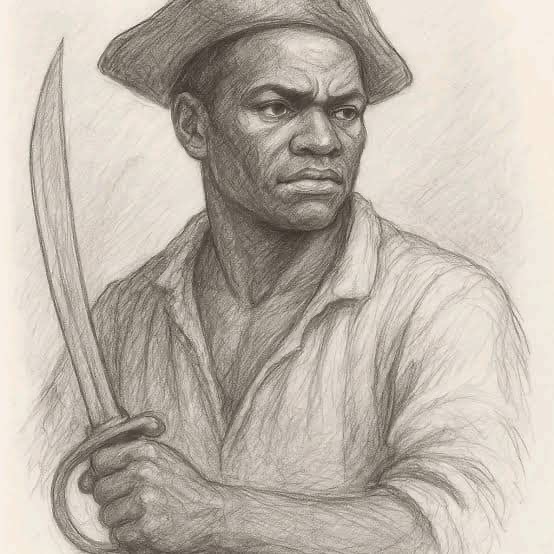
Cuffy, also known as Kofi Badu was an African Akan man who was a slave in the Dutch colony of Berbice in present-day Guyana.
In 1763, he led a major slave revolt of around 5,000 slaves against the Dutch. The slave revolt was eventually suppressed and Cuffy committed suicide. Today, he is a national hero in Guyana.
Origin
Cuffy was born in the 18th century in what is now southern Ghana. At some point, he was captured and sent across the ocean as part of the Atlantic slave trade.
He was sent to Guyana, where he and many other African slaves were made to work on Dutch plantations.
Resistance
Cuffy lived in Lilienburg, a plantation on the Berbice River, as a house-slave for a cooper (barrel maker). He was owned by the widow Berkey.
On 23 February 1763, slaves on the plantation on the Canje River rebelled, protesting harsh and inhumane treatment.
They torched the plantation house and made for the River where Caribs and troops commanded by Governor Wigbold Crommelin of Suriname attacked and killed them.
READ ALSO: Waja Tribe of Gombe: Guardians of heritage and harmony in Nigeria’s Northeast, by Gift Luckson
On 27 February 1763, a revolt took place on the Hollandia plantation next to Lilienburg. Cuffy is said to have organised the slaves into a military unit, after which the revolt spread to neighbouring plantations.
When Dutch Governor Wolfert Simon Van Hoogenheim sent military assistance to the region, the rebellion had reached the Berbice River and was moving steadily towards the Berbice capital, Fort Nassau. They took gunpowder and guns from the attacked plantations.
By 3 March, the rebels were 600 in number. Led by Cossala, they tried to take the brick house of Peerenboom. They agreed to allow the Dutch to leave the brick house, but as soon as they left, the rebels killed many and took several prisoners, among them Sara George, the 19-year-old daughter of the Peerenboom Plantation owner, whom Cuffy kept as his wife.
Cuffy was soon accepted by the rebels as their leader and declared himself Governor of Berbice. Doing so he named Captain Accara as his deputy in charge of military affairs, and tried to establish discipline over the troops.
Accara was skilful in military discipline. They organised the farms to provide food supplies.
End of Resistance
Wolfert Simon van Hoogenheim committed himself to retaking the colony. Accara attacked the Dutch three times without permission from Cuffy, and eventually, the colonists were driven back. Thus began a dispute between the two rebels. On 2 April 1763, Cuffy wrote to Van Hoogenheim saying that he did not want a war against the Dutch and proposed a partition of Berbice with the Dutch occupying the coastal areas and the blacks the interior. Van Hoogenheim delayed his decision, replying that the Society of Berbice in Amsterdam had to make that decision and that it would take three to four months. He was waiting for support from neighbouring colonies; a ship from Suriname had already arrived and reinforcements from Barbados and Sint Eustatius soon followed.
READ ALSO: Venture Smith’s courageous journey from slavery to freedom, by Gift Luckson
Cuffy then ordered his forces to attack the Dutch in May 1763, but they suffered so many losses in the process. The defeat opened a division among the rebels and weakened their organisation. Accara became the leader of a new faction opposed to Cuffy, which led to a civil war among themselves.
On 19 October 1763, it was reported to the governor that Captains Atta had revolted against Cuffy, and that Cuffy had committed suicide. In the meantime, the colonists had already been strengthened by the arrival of soldiers. On 15 April 1764, Captain Accabre, the last of the insurgents, was captured.
Legacy and National Honour
The anniversary of the Berbice Rebellion, 23 February, has been Republic Day in Guyana since 1970.
Cuffy is commemorated in the 1763 Monument in the Square of the Revolution in the capital Georgetown. This statue is called the 1763 Monument or the Cuffy Monument. The statue was designed by the Guyanese sculptor Philip Moore. It stands at 15 feet tall and weighs two and a half tons.
The figure of Cuffy standing on top has many symbols. His pouting mouth symbolises his defiance, the face on his chest forms a symbolic breastplate that gives protection during battle, and the honed faces on his thighs represent revolutionaries from Guyanese history.
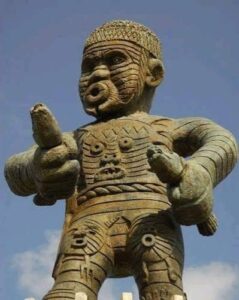
He holds in his hands a dog and a pig, both being throttled, with the dog representing covetousness and greed, while the pig represents ignorance.
Follow the Neptune Prime channel on WhatsApp:
Do you have breaking news, interview request, opinion, suggestion, or want your event covered? Email us at neptuneprime2233@gmail.com