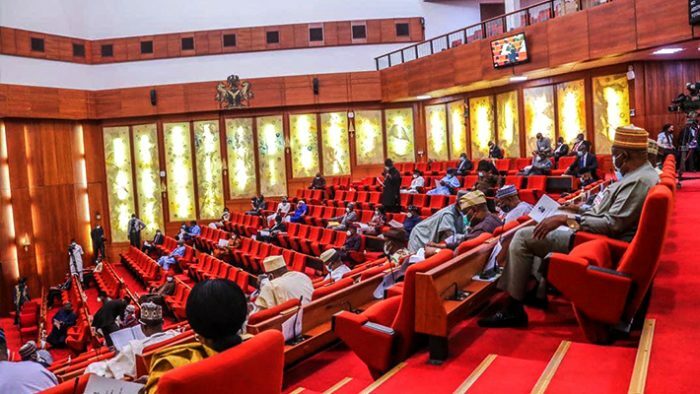
Let’s stop the charade: The Senate is undermining credible elections in 2027, by Abba Dukawa
Following the passage of amendments to the Electoral Act ahead of the 2027 general elections, Nigerians had hoped for decisive reforms that would safeguard the integrity of their votes.
Yet the question on everyone’s mind remains: let’s stop pretending. The Senate appears to be actively undermining credible elections in 2027. Recent decisions have sparked alarm and widespread distrust, eroding confidence in the democratic process.
Turning the tide will not happen on its own—it demands real transparency, genuine engagement with stakeholders, and meaningful reforms. The path forward is clear—but will the Senate have the courage to take it, or will it continue the charade?
What has emerged instead is deeply troubling, raising a fundamental question: does the Nigerian Senate truly seek credible elections, or is it merely preparing the ground for yet another contested mandate?
READ ALSO: Game of Power: Throne reclaim, by Abba Dukawa
By rejecting mandatory real-time electronic transmission of election results, the Senate has reinforced public anxiety about its commitment to electoral reform. This decision represents not progress, but a step backward—legislation that weakens transparency while preserving vulnerabilities long associated with electoral malpractice.
Public concern has now given way to alarm, as the Senate’s actions appear designed to retain opaque processes where manipulation is most likely to occur.
The backlash that followed the handling of the Electoral Act amendments is therefore justified. Civil society organisations, election observers, and opposition stakeholders have condemned what amounts to a dilution of the Electoral Act 2022.
Blocking compulsory real-time electronic transmission undermines transparency and erodes confidence in the electoral process. For voters who have endured repeated electoral failures, this move signals disregard for hard-earned democratic lessons.
There is, in truth, no persuasive argument against electronic transmission of results.
Nigeria’s electoral crises have rarely originated at polling units; they occur during collation and transmission, where figures are altered and outcomes distorted.
By preserving ambiguity around electronic transmission, the Senate has chosen discretion over certainty, and manipulation over accountability.
The Core Dispute: Section 60(3) of the Electoral Bill 2026 stipulates that presiding officers shall electronically transmit polling unit results to INEC’s IREV portal in real time after signing Form EC8A.
READ ALSO: Senseless killings expose coordination failures in the security apparatus, by Abba Dukawa
This provision was intended to eliminate post-poll interference. Yet, during plenary, the Senate discarded this safeguard and reverted to the weaker 2022 framework, which permits—but does not require—real-time transmission.
This was not a procedural oversight. It was a deliberate legislative choice. Stakeholders have rightly described it as an attempt to preserve manual collation and expand opportunities for post-election manipulation.
Such decisions signal indifference to the long-term stability of Nigeria’s democracy. Elections compromised by fraud do more than install poor leadership; they generate distrust, unrest, and political instability.
Senate President Godswill Akpabio’s ruling that Clause 60 was adopted “as amended and not as recommended” effectively nullified mandatory electronic transmission. That ruling extinguished one of the few remaining assurances of credible elections in 2027.
READ ALSO: Mai Mala Buni @ 58: Celebrating an Uncommon Leader, by Abba Dukawa
Subsequent efforts by Senator Abdul Ningi to minimise the implications do little to change the reality. Regardless of intent, the outcome is a weakened legal framework that enables electoral abuse.
A Pattern of Regressive Choices
beyond electronic transmission, the Senate has proposed removing the 10-year disqualification for vote buying. In a political system already saturated with money politics, this move is indefensible.
A ₦5 million fine is no deterrent to wealthy political actors; it merely converts electoral crime into a calculable expense. Reducing sanctions does not curb corruption—it institutionalized it.
Equally troubling is the proposal to reduce the Notice of Election period from 360 days to 180 days.
READ ALSO: Open memo to the Inspector‑general of Police (IGP), by Abba Dukawa
Nigerians are familiar with the consequences of compressed timelines: logistical failures, delayed materials, and voter disenfranchisement.
Reintroducing such constraints reflects not reform, but disregard for empirical evidence and past failures.
Cost Without Credibility
Both chambers of the National Assembly must also confront the financial implications of these decisions.
The 2027 general elections are projected to be the most expensive in Nigeria’s history. INEC has been allocated ₦1,013,778,401,602 in the 2026 budget—an extraordinary sum that raises serious concerns about fiscal responsibility.
This allocation is nearly three times the amount provided for the 2023 elections. At a time when Nigerians are struggling with inflation, unemployment, and failing public services, committing over ₦1 trillion to elections whose credibility is undermined by law is profoundly unsettling.
Since the return to democracy in 1999, election spending has risen steadily: ₦32 billion in 1999; ₦55.172 billion in 2003; ₦74.2 billion in 2007; ₦99.7 billion in 2011; ₦122.9 billion in 2015; ₦242.2 billion in 2019; ₦355.298 billion in 2023; and now a projected ₦1 trillion for 2027.
This trajectory demands rigorous scrutiny, transparent justification, and a reassessment of national priorities.
READ ALSO: Defection Storm: A looming threat to Nigeria’s political stability, by Abba Dukawa
A Breach of Public Trust
At a moment when Nigerians are demanding accountability, and when technology has demonstrated its capacity to enhance electoral transparency, the Senate’s actions represent a profound breach of public trust.
They signal a troubling preference for political control over democratic integrity and send a damaging message to citizens, observers, and the international community.
The Senate must reverse these decisions and recommit to reforms that guarantee free, fair, and credible elections. Anything less will reinforce the belief that lawmakers are intentionally weakening electoral safeguards ahead of 2027.
Genuine reform requires open engagement with civil society, election experts, and the broader public—not legislative manoeuvres conducted in opacity.
The Senate had an opportunity to address the structural failures exposed in recent elections. It chose political expediency over public interest and discretion over transparency. By prioritising elite survival above electoral integrity, it has implied that the will of the people is negotiable.
READ ALSO: Governor Mai Mala Buni’s Visionary Leadership: Transforming Yobe State, by Abba Dukawa
That implication will endure.
Should the 2027 elections fail to meet basic standards of credibility, responsibility will lie squarely with those who dismantled essential safeguards. Nigeria deserves an electoral framework that reflects democratic values, not one that erodes them at enormous public cost.
Dukawa writes from Abuja and can be reached at abbahydukawa@gmail.com
Follow the Neptune Prime channel on WhatsApp:
Do you have breaking news, interview request, opinion, suggestion, or want your event covered? Email us at neptuneprime2233@gmail.com