On Taxes, Debt and Government Spending: Part II, by Ibrahim T. Tumsah
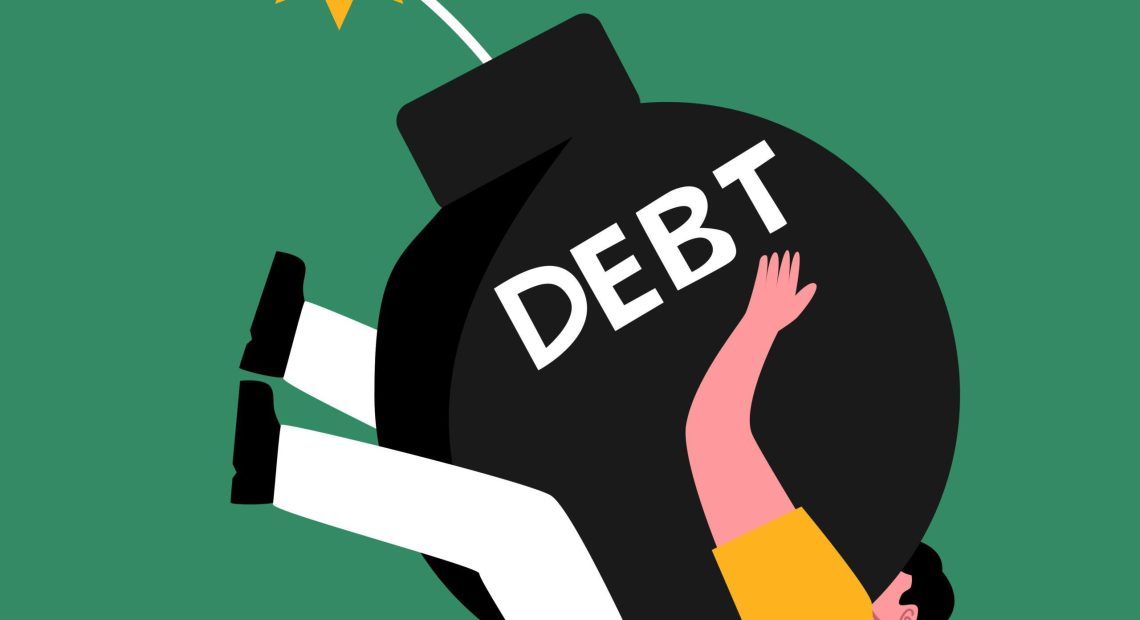
Nigeria finds itself having to constantly contend with debt payment and restructuring plans. As a result of this, the federal government has to enforce taxation on an already impoverished populace. This is a trap set up to keep the country dependent on debt and in a constant debt servicing payment plan incurring budget deficits.
The sheer weight of this can be compared to anvils anchoring a vessel at sea. From 1986 to 1994, the former Head of State of Nigeria under military rule, General Ibrahim Babangida introduced a largely unpopular policy called the SAP (Structural Adjustment Programme), which was an IMF/World Bank supported policy geared towards the restructuring of Nigeria’s public sector driven economy into a free market economic mechanism. This was meant to address Nigeria’s failing economy, but instead contributed to even more hardships, social unrest, inflation and currency depreciations.
The SAP was supposed to help reduce and restructure Nigeria’s external debt and encourage local production. For the keen observer this is almost deja vu. Nigeria’s current administration finds itself in the same situation 40 years later. The country continues to wallow in poverty, while also borrowing to keep up with its ever increasing developmental aspirations and capital expenditures.
Nigeria’s sovereignty comes into question, playing by these rules means the country is compromised, its leadership is also constantly indebted and having to look out for its own interests. There is a need for Nigeria’s leadership to cast aside the loan payment/debt servicing obligations. These loans that come with high interest rates are a new type of slavery, meant to keep nations constantly indebted and incapacitated. Foreign investors become vultures waiting to scavenge the carcass of whatever enterprise that might look appealing with relative ease at discounted rates. This makes it crucial that Nigeria defaults on its loan obligations going forward. Defaulting on loan repayment to foreign institutions might risk Nigeria attaining pariah status, but at least Nigeria is free to start afresh with more room to manoeuvre without the leash on her neck.
It is imperative that this step must be seriously considered for Nigeria to function going forward. At the risk of ostracizing ourselves from the global financial system or even scoring lower on the fitch ratings system (after all, what is the point of being a good debtor if you never have the need for debt? That is food for thought).
At the very least we remove the chains of debt slavery and slow developmental inertia causing us to continuously move in circles. The future of this country must be made secure for the next generations to come. Running large multiple budgets at the cost of accruing more debt only inflicts more pain on the nation’s finances. It becomes a clearer argument when paralleled with the student loans schemes practiced in the UK, U.S and Canada.
The student loan scheme is a loan granted by the government to help underprivileged students with their university tuition fees. Students who enrol in this scheme never manage to pay off their debt obligations decades after graduating university, because the interest rates on these loans are prohibitive— meaning these loans are predatory and often not meant to be fully settled. Often times students find themselves sitting on outstanding debt that is more than what they borrowed initially, even if they have been paying off the loan consistently on a payment plan.
There is an often misguided view that instituting taxes will generate revenue that will enable Nigeria to afford its budgetary lapses. Taxes cannot and will not solve this, it only adds to the problems. Imagine setting buckets under a leaking roof while it is raining. It might solve the problem momentarily, but the roof is still leaking and must be fixed to stop a flood the next time it rains. Taxes will convolute the problem and will heat up the polity. The number of thriving business or qualified taxable individuals that might be able to contribute to the tax base for the federal government’s coffers will disappoint, while hindering those businesses especially.
Tax is the local collection mechanism for the global financial architecture. The government collects taxes to service its debt obligations. In the modern financial system, debt and interest payments keep the system running. The debt which is in the billions of USD are owed to banks and institutions that do not produce, grow or build anything. The money ends up somewhere in Washington or London, where it vanishes in a ledger, but somehow 40 years later, your country still owes these institutions financial obligations. The local currency depreciates, the cost of living deteriorates, your purchasing power erodes; yet the value of that debt never changes. This is a systemic extraction borne from a rigged global financial system. The game stops when the players stop playing.
Accruing debt without the ability to pay back is a sickness that Nigeria has refused to treat.
This pattern plagues the country and will only continue to repeat itself unless drastic measures are taken to cure the chronic ailment. The federal government’s inability or unwillingness to put these loans to productive use is not a mistake, it is by design. Four decades of the same pattern prove that the profligacy of the nation is a feature of the system not a bug to be fixed by a silver bullet and must be addressed at the source. The enrichment of a few people at the expense of a 230 million population and their future without addressing or solving current problems is a dangerous proposition for the interests of the nation. Curing this sickness by eschewing foreign loans and defaulting on foreign debt obligations unleashes real ingenuity and unbound enterprising indigenous efforts for creating internally generated revenues.