The Giant’s Feet of Clay: Why Nigeria’s military pay must compete in Africa, not the West, by Abubakar M. Kareto
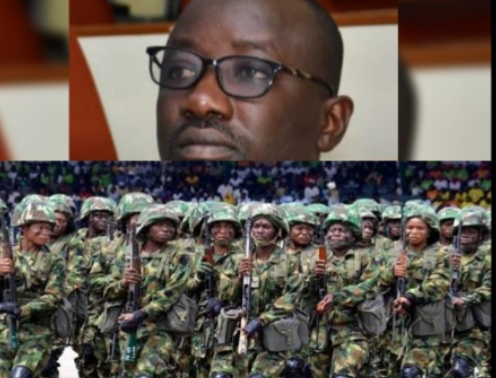
Yesterday, a familiar infographic began making the rounds on X, former Twitter, one of those slick Statista analyses comparing military wages in Nigeria to those in the United States, absolutely the numbers were technically accurate, but contextually, they were utterly meaningless and unnecessary. To compare a Nigerian Private to an American soldier is to ignore every structural, economic, and historical reality that separates our nations. As I always maintained in so many instances in the past, we are not on the same level as the U.S., UK, Canada, or China, and pretending that these are our benchmarks only serves to cloud the very real crisis sitting on our doorstep. Let’s saw our clothes according to our sizes.
If Nigeria is to truly evaluate the welfare of its troops, we must stop looking across the Atlantic and start looking across our dear African continent. Our true contemporaries are not in Washington, Beijing or London; they are in Pretoria, Cairo, Rabat, or Kampala. When we pivot to this realistic lens, the “Giant of Africa” suddenly looks remarkably small. It is a sobering reality that while we claim to be a regional powerhouse, we are failing the very men and women who provide that power.
Interestingly, Nigeria is currently ranked third in Africa for overall military strength, yet we are arguably the least in terms of investment in the welfare men behind the uniforms. A Nigerian Private Solider currently earns approximately ₦104,000, which translates to a meager $75. Compare this to a South African counterpart who takes home roughly R13,000, or about $700. Even in Morocco, entry-level pay exceeds $570. These are not distant Western superpowers; these are our neighbors on the same continent, operating within similar regional challenges.
The most telling comparison, however, is not with the giants like Egypt or South Africa, but with Uganda. Again, for example, despite having a fraction of Nigeria’s GDP, the Ugandan government successfully implemented a phased enhancement that raised a Private Soldier’s salary to approximately $215. Meanwhile, a Nigerian Sergeant, veteran leader who has likely seen years of combat takes home roughly ₦125,000, or $91. In plain terms, a senior Nigerian non-commissioned officer earns less than an entry-level recruit in almost every other contemporary African military.
We often lament the persistence of insurgency in the North East and the spread of banditry in the North West, blaming intelligence failures or a lack of sophisticated hardware. But the silent killer of our counter-terrorism efforts is the unmotivated soldier. You cannot expect a man to face a hail of bullets in the Sambisa Forest when his mind is occupied by the hunger of his children at home. Low morale is not just a “feeling” or a grievance; it is a tactical liability that weakens the entire chain of command.
A worried soldier is a distracted soldier. When the state fails to provide a livable wage, the drive to go beyond the call of duty evaporates. Furthermore, when official pay is insufficient for basic survival, it creates a “survival gap” where the temptation for extortion or the diversion of resources increases. This inevitably destroys the fragile trust between the military and the civilians they are meant to protect. It is an expensive price to pay for “cheap” labor.
It would be unfair to ignore that the current administration has begun to acknowledge this widening chasm. In early 2026, the government signaled a commitment to finalizing new salary structures and welfare packages, with the Chief of Defence Staff recently highlighting plans for improved veteran support and enhanced frontline allowances. We are seeing operational “patches” such as the recent push to triple certain field allowances for troops that show a government finally awakening to the reality of the morale crisis. However, these incremental tweaks are like using a bucket to drain an ocean. While any increase is a welcome relief, it remains a reactive measure rather than a proactive strategy to bring the Nigerian soldier into the continental middle class.
The danger of relying on “allowances” rather than a fundamental salary overhaul is that it fails to address the long-term stability of the soldier’s family. An allowance is temporary; a salary is a foundation. When we look at Uganda, where the government is transparently pushing a roadmap to see even the lowest-ranking soldiers reach a million-shilling scale, we see a vision for the future. Nigeria’s current “patchwork” welfare fails to compete with this level of strategic planning. Until our basic pay scales reflect the cost of living in 2026, we will continue to witness a military where the spirit is willing but the pocket is weak, leaving our national security vulnerable to the highest bidder or the deepest frustration.
Nigeria must stop using the excuse that we aren’t America to justify the pittance paid to our troops. We are not asking for Pentagon-level salaries; we are asking for African-level dignity. If we truly intend to end the insurgency and reclaim our internal security, the first “weapon” we must upgrade is the welfare of the man holding the gun. It is time for Nigeria to compete where it belongs within Africa and ensure that being a Nigerian soldier is a badge of honor supported by a fair wage, rather than a sentence to poverty.
~ Abubakar M. Kareto is a Public Affairs Analyst.
A M. Kareto can be reached on amkareto@gmail.com