
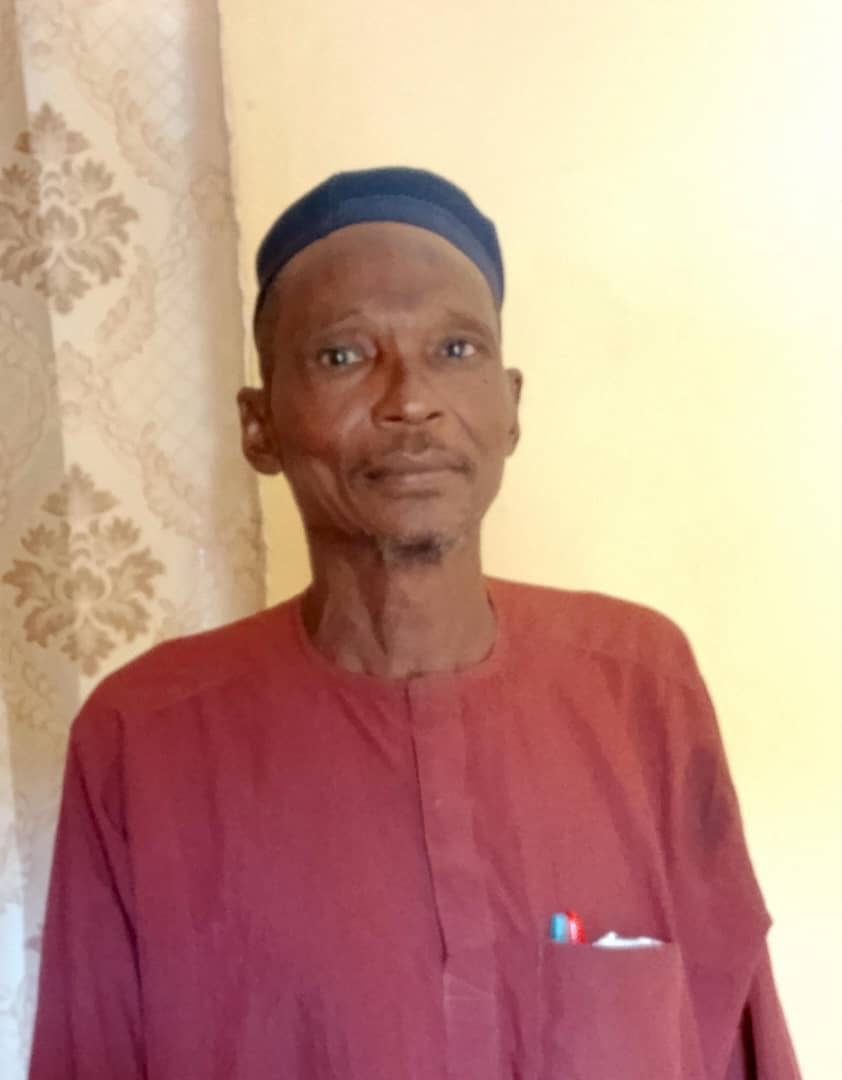
“We shared classrooms with expatriates’ children and competed equally,” says 66-year-old public official
Story by Maryam Saleh Isa
Muhammad Isah is a staff member at Alma’arif College of Nursing, Midwifery and Health Sciences, Potiskum, Yobe State.
As a 66-year-old vibrant and cheerful individual, he sat for an in-depth interview with Neptune Prime’s Maryam Saleh, where he reflects on a childhood shaped by discipline, communal living, and values he believes are gradually fading in today’s society.
Neptune Prime: Can you tell me about your childhood and what life was like when you were growing up?
Muhammad Isah: Life was simple and affordable. In those days, our parents’ friends were like our own parents. One respected elder could enforce a rule, and every child in the settlement would obey it. Trust was common, and disobedience was rare. Children were naturally helpful; whenever we saw an elder carrying a load, we rushed to assist. Even then, we were warned not to accept gifts offered in appreciation. Schooling was well organised and competitive. We were taught by both foreign and local teachers, shared classrooms with expatriate children, and competed academically regardless of gender or background. Poverty was not common. If a neighbour lacked food, others shared freely.
My father was Sarkin Noma. He used to give us millet to take to our neighbours’ houses, especially when the head of the house was not around, so that when he returned it would surprise him.
In those years, we bought Peak Milk at five kobo, Getsha at sile and sisi– Food was affordable, milk was abundant, and livestock was properly inspected before sale. This development was as recent as the 1980s.
Neptune Prime: What are some of the happiest memories from your early years?
Muhammad Isah: One memory I will never forget was when I fell seriously ill during third-term examinations. Despite my condition, my father took me to school every day. Question papers were brought to me, and I was allowed to complete them before returning home. When the results were released, I emerged first overall. I received gifts such as an advanced learner’s dictionary, school items, and uniforms. That experience remains one of the happiest moments of my life.
Neptune Prime: Were there any challenges you faced as a young person that shaped the way you see life today?
Muhammad Isah: I later faced financial challenges, which pushed me to join the Nigerian Armed Forces. While there, I became a squad leader in my platoon. Long before that, my father trained me in farming and discipline. That discipline followed me to this day. I am almost 67 years old, yet I can still match someone in their twenties.
Neptune Prime: What values or principles do you think every young person should live by?
Muhammad Isah: Honesty and trustworthiness should come first. Young people must learn to be independent and find something productive to do. Depending on relatives is risky, as everyone has their own responsibilities.
Education today is also misunderstood. Reading and cramming are not learning. Understanding is learning. Googling and copying alone do not make someone educated.
Young people should also use their phones wisely. Staying on phones 24 hours a day is dangerous to mental health. Take breaks, learn skills, sleep well, and allow your brain to refresh. Media exposure today is making youths more restless than intelligent.
Neptune Prime: If you could go back to your youth, what is the one thing you would do differently?
Muhammad Isah: If I were to return to my youth, I would study tirelessly, from degree level to professorship. Some of my classmates are professors today, some are governors, including people like Alhaji Umaru Jibrilla.
Neptune Prime: What advice would you give young people about handling failure or disappointment?
Muhammad Isah: Young people should embrace Tauheed. Whatever happens, whether good or bad, relate it to Allah. Some disappointments are blessings in disguise.
READ ALSO: Oldies: Govt must heed the cries of the people – Former Rector
Neptune Prime: In your lifetime, what kind of leaders have inspired you the most, and why?
Muhammad Isah: Leaders who inspire me are patriotic leaders—those who place national interest above personal interest. The democracy we practise today is not the same democracy brought to us. Those who introduced it practised it differently.
Neptune Prime: What qualities do you believe good leaders should have to guide society?
Muhammad Isah: For Nigeria to progress, we must admit that democracy is not working as practised. Military rule once worked because of discipline.
Leaders should be merciful and creative in policy-making. My first salary was fifty naira, and a bag of rice was twenty-five naira. The environment is not the problem; honesty and truthfulness are.
During my service as a soldier, I never insulted anyone. What we lack most today is justice and fairness.
Neptune Prime: How do today’s leaders differ from those of your time?
Muhammad Isah: They are very different. During our childhood, emirs allowed us to enter their homes and play with their children freely. Governors’ children attended the same schools as ours and used the same facilities.
Today, once someone attains power, they separate themselves. Their children attend different schools, use different hospitals and the poor are left to manage whatever reaches them.
Neptune Prime: What hobbies or activities have given you the most joy over the years?
Muhammad Isah: What gives me joy is seeing improvement in female healthcare delivery. There was a time when female health workers were very few. In 2009, my wife was stitched by a male doctor during delivery.
Today, from Potiskum to Dawasa, there are many midwives. This gladdens my heart.
Neptune Prime: How do you spend your time now, and what keeps you happy in old age?
Muhammad Isah: I take breakfast with my family, then go to work at Alma’arif. By 4:00 pm, I close and take my medicine bag to offer veterinary services around the community. This helps solve some financial challenges before my salary.
Neptune Prime: Is there a book, song, or tradition that has stayed with you throughout your life?
Muhammad Isah: There are books we read in primary five, especially fairy tales like Na Allah and Locus, and Iliya Dan Mai Karfi. They have stayed with me.
Neptune Prime: What life lessons have you learnt that you wish more people understood?
Muhammad Isah: Patience and perseverance. Be committed to whatever task is assigned to you.
Neptune Prime: How would you like to be remembered by your family and community?
Every night, I sit with my family to read the Qur’an and ask my children questions. I ensured they received both Islamic and Western education. I want to be remembered as someone who educated his children.
Neptune Prime: What message would you leave behind for future generations?
Muhammad Isah: People should work with honesty and truthfulness. Love one another. There is no point where your brother dies and his children suffer under your watch. We must be our brothers’ keepers.
Follow the Neptune Prime channel on WhatsApp:
Do you have breaking news, interview request, opinion, suggestion, or want your event covered? Email us at neptuneprime2233@gmail.com




READING THE SIGNALS BEYOND THE NUMBERS: WHAT THE 2026 BUDGET MEANS FOR THE ORDINARY NIGERIAN
By Tijjani Sarki
Good Governance Advocate and Public Policy Analyst
11th January, 2026
There is a saying that “when a drumbeat changes, the dancer must ask why.”
Budgets, like drumbeats, set the rhythm of national life. They are not just columns of figures on paper, they are moral documents. They quietly reveal who matters, who is protected, who is prioritised and who is expected to keep enduring.
When we look closely at Nigeria’s 2026 budget, beyond the impressive trillions, we begin to hear a deeper and more troubling conversation about our collective hopes, our persistent fears, and the unresolved tensions of a nation struggling to survive today while still dreaming of tomorrow.
As a Public Policy Analyst, I cannot help but feel sceptical. Is this budget backed by coherent, sustainable policies that will truly touch the lives of ordinary citizens? The real questions go far beyond how much was allocated. They are simpler, yet more profound, Who is this budget really for? What problems is it designed to solve? And how will it change the daily realities of the ordinary Nigerian?
SECURITY SPENDING: SAFETY OR A PERMANENT STATE OF EMERGENCY?
The massive ₦5.8 trillion committed to Defence, Police Affairs, Interior, and the Office of the National Security Adviser tells one unmistakable story, Nigeria remains a nation under siege. For millions living under the shadow of banditry, insurgency, kidnapping, and communal violence, this heavy spending offers cautious hope,hope for safer highways, secured farmlands, protected schools, and a restored confidence in the authority of the state.
Yet Nigerians have learned, often through painful experience, that pouring money into security does not automatically bring peace.
If these trillions do not translate into visibly safer communities, fewer displaced families, reopened rural economies, and a restored state presence, then the cost becomes unbearable not only financially, but socially and emotionally. There is a growing fear that insecurity is no longer being decisively confronted, but instead gradually normalised, budgeted for, and accepted as a permanent condition.
For the ordinary citizen, the test is brutally simple, Can I live, work, trade, and travel without fear?
THE COST OF GOVERNANCE: A WIDENING GAP
At a time when inflation is eating deep into salaries, transport fares rise almost weekly, and food prices push families to the edge, the scale of allocations to the Presidency, National Assembly, SGF, and Foreign Affairs raises uncomfortable but unavoidable questions. As a Good Governance Advocate, my conscience is wounded and battered by the sheer cost appropriated to governance.
To many Nigerians, governance now appears insulated from the hardship it routinely asks citizens to endure.
This is not merely a matter of perception, it strikes at the very heart of democratic legitimacy. When the cost of running government expands while household welfare contracts, trust erodes. Democracy itself begins to look expensive, distant, and insufficiently responsive.
Yes, effective governance requires funding. Nigerians are not asking for a weak state. What they demand is value strong laws, responsive leadership, meaningful oversight, and policies that are felt in daily life, not just announced from Abuja.
INFRASTRUCTURE: PROMISE VS. PERFORMANCE
The significant allocations to Works, Power, and Transport remain among the most hopeful elements of the 2026 budget. Roads, electricity, and transport systems are not luxuries, they are the backbone of productivity, mobility, and national cohesion.If implemented with discipline and transparency, these investments could reduce food inflation through better logistics, create jobs across multiple sectors, and strengthen national integration.
But Nigerians carry a heavy memory of abandoned projects, inflated contracts, and infrastructure that exists only in budget speeches. The problem is no longer funding, it is execution. Infrastructure only matters when it shortens travel time, lowers costs, and tangibly improves daily life.
FISCAL REALITY: THE SILENT WEIGHT ON TODAY AND TOMORROW
The ₦16.78 trillion allocation to the Ministry of Finance is perhaps the most sobering signal in the entire budget. It reflects a government increasingly consumed by debt servicing and fiscal survival, rather than expanding social investment.
For ordinary Nigerians, this means fewer resources for health, education, and welfare, alongside rising taxes, levies, and the hidden costs of economic adjustment.
While debt management may be unavoidable, the deeper danger lies in intergenerational injustice,where citizens bear the burden of past borrowing without seeing commensurate improvements in opportunity, infrastructure, or human development.
AGRICULTURE AND INDUSTRY: A HALF-TOLD ECONOMIC STORY
The allocation to Agriculture and Food Security is a welcome acknowledgment of the hunger and food inflation squeezing Nigerian households. If efficiently deployed, it could support farmers, stabilise supply, and ease food prices.
Yet agriculture without strong agro-processing and industrial linkages remains fragile. The comparatively modest allocations to Industry, Trade, and Steel expose a familiar weakness, Nigeria continues to export raw materials and import value-added goods.
Without deliberate industrial expansion, food security will remain unstable, and the economy will stay trapped in a cycle of low value, high vulnerability.
SCIENCE, TECHNOLOGY, AND THE YOUTH QUESTION
Spending on Science, Technology, Innovation, and the Digital Economy signals recognition of Nigeria’s youthful population and future potential. For millions of young Nigerians facing unemployment and underemployment, these sectors represent real hope.
But innovation cannot thrive on announcements alone. Weak coordination and fragmented implementation risk diluting impact. If these investments do not translate into real skills, real jobs, and real enterprises, youthful optimism may harden into frustration and social tension.
DEMOCRACY, OVERSIGHT, AND INSTITUTIONAL BALANCE
INEC’s strong funding reflects a commitment to elections, but democracy does not end at the ballot box. Oversight and accountability institutions remain comparatively underfunded, limiting their ability to protect citizens and enforce public integrity.
This imbalance is dangerous. Elections without strong accountability structures risk producing authority without restraint and legitimacy without trust.
CONCLUSION: A BUDGET MET WITH CAUTION, NOT CELEBRATION
The 2026 budget is ambitious, but ambition alone no longer excites Nigerians. It arrives under the heavy weight of insecurity, debt, decaying infrastructure, and rising public expectations, yet also under deep public scepticism.
For citizens, the real concern is not abstract macroeconomic stability, but everyday survival. Will this budget reduce hunger? Restore purchasing power? Make life more affordable? Open genuine pathways to opportunity?
Until Nigerians feel tangible change,through cheaper food, reliable electricity, safer streets, and accessible jobs, budget figures, however impressive, will continue to be met with doubt rather than trust.
In a country where resilience has too often replaced prosperity, the true test of the 2026 budget is whether it finally shifts the burden away from citizens’ endurance toward the state’s responsibility. Until then, scepticism is not cynicism, it is a rational response shaped by lived experience.
Tijjani Sarki
Good Governance Advocate and Public Policy Analyst
Writing from Zawaciki, Kano
11th January, 2026