WES 2025: Economist sees Nigeria’s productivity challenge as human tragedy and defining opportunity
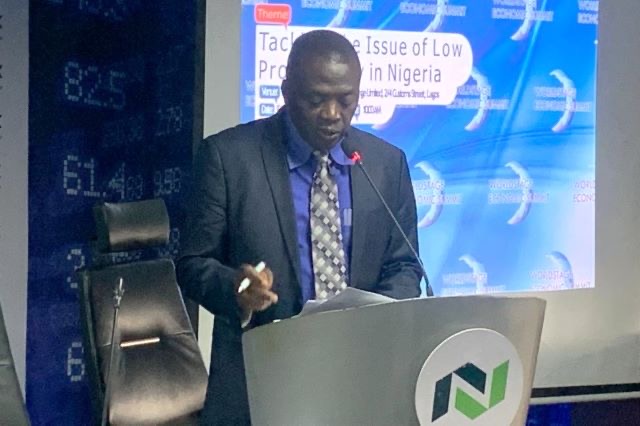
Nigeria’s low productivity has become both a human tragedy and a historic opportunity for transformation, according to Dr. Abidemi C. Adegboye of the University of Lagos, who spoke on Friday at the 2025 WorldStage Economic Summit (WES) in Lagos.
Delivering a keynote address on the theme “Tackling the Issue of Low Productivity in Nigeria,” Dr. Adegboye said Nigeria can reverse decades of stagnation if political will, private sector leadership and coordinated policy reforms converge to harness its demographic strengths and technological potential.
He noted that Nigeria’s productivity crisis is severe and worsening: GDP per worker stood at $11,800 in 2024—far below the global average of $49,000—while productivity growth averaged only 0.22% since 2010, far short of the 3.5% required to absorb the country’s 3.5 million yearly labour market entrants. The average Nigerian worker earns $7 per hour compared to South Africa’s $30, reflecting just 7% of the global productivity level.
READ ALSO: WES 2025: EFCC invests heavily in digital forensics, others to tackle emerging crime challenges
Despite being Africa’s most populous nation with significant demographic potential and a growing services and ICT sector, Nigeria remains trapped in what he called a “productivity paradox”—massive scale coexisting with chronic inefficiency. Agriculture employs 40% of the population but cannot feed 230 million Nigerians, while 63% of citizens (133 million people) remain multidimensionally poor.
Dr. Adegboye identified wide sectoral gaps:
• Agriculture: 40% of jobs, 22% of GDP—lowest productivity.
• Manufacturing: stagnant at 12% of GDP.
• Services: over 50% of GDP but dominated by informal, low-productivity activities.
He warned that low productivity carries heavy economic costs: Nigeria loses $4–6 billion in GDP annually, real wages have fallen 40% since 2019, youth unemployment stands at 15.2%, and each 1% productivity decline wipes out 0.5% of fiscal revenue.
He outlined critical drivers Nigeria must confront—innovation, infrastructure, physical and human capital, health, demographics, governance, gender equality, trade, FDI and access to finance. Current performance, he said, is weak across the board: R&D is just 0.2–0.3% of GDP, logistics costs are four times the global average, power outages cost the economy $29 billion annually, and only 10–12% of workers have tertiary education.
To reverse the trend, he proposed a multi-pronged strategy including:
• A comprehensive policy framework: diversify beyond oil, achieve 10,000 MW reliable power by 2027, raise R&D funding to 1% of GDP by 2030, and scale vocational training for 10 million youth.
• Economic diversification: leverage AfCFTA, boost agro-processing, manufacturing and digital services, and pursue policies targeting 3% annual productivity growth.
• Infrastructure investment: deploy InfraCorp’s $10 billion for roads, rail and ports, reduce logistics costs from 40% to 15%, and commit 2–8% of GDP annually to SDG-aligned infrastructure.
• Human capital development: expand digital skills hubs, strengthen health and nutrition programs, and formalize apprenticeship systems.
• Technology and innovation: incentivize startups, build innovation hubs around universities, and deploy digital tools across agriculture and manufacturing.
• Financial access: expand credit through fintech platforms, address collateral constraints and support SME growth.
• Agricultural modernization: advance agro-industrial zones and target 15–20% productivity gains through value addition.
• Inclusive growth: promote gender equity, climate resilience, social protection and urban-rural productivity integration.
He concluded that productivity reforms must underpin Nigeria’s quest for inclusive prosperity, warning that GDP growth without productivity will remain “hollow,” leaving millions behind. But with demographic strength and technological shifts, Nigeria can still “decisively reverse the current productivity malaise” and move toward middle-income status and regional leadership.
Other speakers at the summit included Dr. Olasupo Olusi, Managing Director/CEO of the Bank of Industry (BoI), and Mr. Olanipekun Olukoyede, Chairman of the Economic and Financial Crimes Commission (EFCC).
Follow the Neptune Prime channel on WhatsApp:
Do you have breaking news, interview request, opinion, suggestion, or want your event covered? Email us at neptuneprime2233@gmail.com