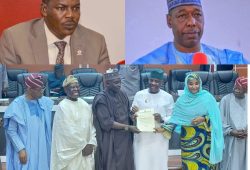
Listening to Kenyan President William Ruto poke fun at Nigerians from faraway Italy, one would think he had borrowed a page from Amos Tutuola’s The Palm-Wine Drinkard.
Ruto appeared to assume that Nigerians spoke the same unconventional English style immortalised by Tutuola in his celebrated tale of magical realism drawn from Yoruba mythology.
True, Tutuola’s English was not the polished Oxford diction associated with Ngugi wa Thiong’o or the sophisticated command of language for which Nobel laureate Wole Soyinka is renowned. Yet, much like Mark Twain’s The Adventures of Huckleberry Finn, Tutuola was not attempting to write like Charles Dickens or George Orwell. He simply told his story freely and authentically — in the unmistakable Nigerian spirit.
Ruto, apparently enjoying a temporary respite from mounting protests over the high cost of living and difficult economic reforms in Kenya, seemed relaxed enough to tease Nigerians about their English while addressing Kenyans abroad. Though he later attempted to soften the remarks, the message had already landed.
Who English epp?
While Ruto jokes about Nigerians needing English lessons, many Kenyan content creators have taken to social media, baiting Nigerians online for traffic and engagement.
If the Kenyan High Commissioner in Nigeria were paying attention, he would probably hear many Nigerians laughing and responding with the popular expression: “Who English epp?” — a Nigerian phrase questioning the practical value of speaking perfect English.
Even if Kenyans arguably speak “better” English — which itself is debatable — that has not shielded the country from severe economic challenges. Those difficulties, which President Bola Tinubu recently referenced and which provoked Ruto’s response, remain very real.
Economic hardship does not disappear because citizens speak with polished accents or imitate the late Queen Elizabeth’s refined pronunciation.
Both Ruto and Tinubu must confront the difficult reality of fixing struggling economies — a task that does not reward eloquence alone.
Kenya’s economy, largely driven by tourism and agriculture, only modestly compares to Nigeria’s South-West region economically. Although Kenya’s GDP per capita of about $2,132 appears higher than Nigeria’s $1,378, Kenyans frequently erupt in mass protests over economic conditions.
Mother of all protests
During a visit to Bayelsa State on April 10, President Tinubu remarked that despite rising fuel prices and economic hardship, Nigerians were still “better off” than citizens of some other African countries.
He reportedly said:
“Yes, I hear you from various angles of the economy. The fuel price is biting hard, but look around… You are better off. Listen to them in Kenya and other African countries and what they are going through.”
Contextually, Tinubu may not have been entirely wrong. Kenya provided a relatable example.
Since September 2022, Kenya has experienced repeated demonstrations over the rising cost of living, tax increases, and fuel prices. Reports suggest there have been at least six major protests between 2022 and 2025, with hundreds reportedly killed during clashes linked to public demonstrations.
Where the shoe pinches
The ongoing conflict involving the United States, Israel, and Iran has further worsened global oil prices through supply disruptions, increasing Kenya’s fuel import costs and aggravating living conditions.
As a net importer of petroleum products, Kenya has faced sharp increases in transport fares, food prices, production costs, and pressure on its currency. Inflation reportedly rose to 4.4 percent in March 2026 from 4.3 percent the previous month.
Nigeria, however, faces remarkably similar realities despite Tinubu’s attempt to draw comparisons. It was somewhat like a struggling father telling his children that other families are also unable to pay school fees.
Nigeria remains under immense economic strain, and the endurance of its citizens often becomes a subject of humour across the continent.
The Tinubu-Ruto exchange gained attention largely because it came from presidents. But ordinary Africans have long sparred with Nigerians — sometimes playfully, sometimes seriously, and often simply because Nigerians are impossible to ignore.
The matter of size
There is logic behind Nigeria’s visibility. Roughly one out of every six Africans is Nigerian. With an estimated population exceeding 240 million, Nigeria accounts for about 15 percent of Africa’s population.
The country’s demographic weight gives it both influence and vulnerability. Nigerians are highly visible across the continent and beyond.
Then comes the endless debate over who makes the best jollof rice between Nigeria, Ghana, and Senegal.
Many Nigerians believe that argument should have ended when Nigerian chef Hilda Baci gained global recognition. Yet Ghanaians remain unconvinced, while Senegal — widely regarded as the original home of jollof — appears less invested in the rivalry.
Language differences and geography may explain why Senegal largely watches from the sidelines while Nigeria and Ghana continue the culinary war.
What about the Kenyan accent?
English, a colonial inheritance, is hardly the ultimate measure of intelligence or national development. Otherwise, Britain itself would unquestionably be the most advanced society on earth.
Both Nigeria and Kenya inherited English as an official language, but each country naturally developed its own accents, speech patterns, and local adaptations shaped by indigenous languages.
Nigeria alone has over 500 languages influencing cadence, pronunciation, and expression. Kenya’s own ethnic and linguistic diversity similarly shapes its distinctive accents.
As Nigerian activist Shehu Sani noted on X, Ruto was mocking “the English of the country with a Nobel Prize winner in literature” — referring to literary giants such as Wole Soyinka, Chinua Achebe, and Chimamanda Ngozi Adichie.
Sani could also have mentioned 17-year-old Nigerian student Nafisa Abdullahi, who reportedly outperformed over 20,000 contestants from 69 countries in the 2025 TeenEagle English competition held in London.
We no carry last!
Nigeria remains home to more English speakers than any other African country. Over time, the language has evolved into a recognised variety often referred to as “Nigerian English,” increasingly influencing global expressions and popular culture.
Kenyans themselves understand that outside athletics — especially marathons and steeplechase — Nigerians rarely like to come second in anything.
Yet the deeper reality is that worsening economic hardship in both countries is making it harder for citizens to appreciate the humour in presidential exchanges.
From their shared colonial histories and youthful populations to entrepreneurship, entertainment, sports, and ethnic diversity, Nigeria and Kenya have far more in common than divides over accents or English pronunciation.
Ultimately, both Tinubu and Ruto should focus less on banter and more on fixing their economies.
That is what truly concerns their citizens.
After all, na who Queen’s English epp?