


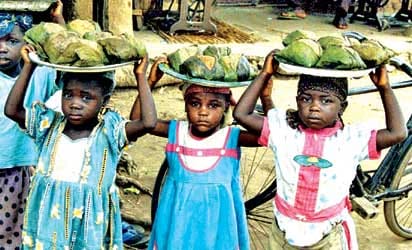
Child Hawking: A lifeline for families but a serious threat to children’s safety, by Gift Luckson
Child hawking remains a common sight in many developing countries, especially in low-income communities in Nigeria where families struggle to meet basic needs.
While it is often seen as a means of contributing to household income, it carries significant risks that can hinder a child’s well-being and future development.
Economic Contribution
For many families living in poverty, child hawking serves as an immediate source of financial relief.
• Children help sell items such as fruits, snacks, water, or household products.
• The income they generate supports daily survival, food, transportation, school fees, and medical bills.
• In areas with limited job opportunities, parents may rely on their children to supplement household earnings, making hawking an informal but significant economic activity.
READ ALSO: Ability in Disability: The entrepreneurial spirit of Persons with Disabilities, by Gift Luckson
In this way, child hawking plays a small role in community-level economic activity by keeping micro-businesses running and sustaining family livelihoods.
The Dangers to Children
Despite its economic role, the risks far outweigh the benefits. Child hawking exposes children to several dangers that can have lifelong consequences.
Physical Danger
Children who hawk on roads or in crowded markets face a high risk of accidents, kidnapping, assaults, or being exploited by adults.
Health Risks
Long hours in the sun, poor nutrition, exhaustion, and exposure to pollution weaken their physical health. Many children also carry loads that strain their developing bodies.
Education Disruption
Hawking often interferes with schooling. Some children skip classes, arrive late, or eventually drop out entirely. This limits their future opportunities and keeps the cycle of poverty alive.
READ ALSO: Ancient Idanre Hill: Nature’s masterpiece in Ondo State, by Gift Luckson
Emotional and Psychological Harm
Constant stress, harassment, and the responsibility of earning money at a young age can affect a child’s emotional development and sense of security.
Vulnerability to Abuse and Exploitation
Child hawkers are more vulnerable to sexual abuse, forced labour, trafficking, and manipulation due to their lack of protection and dependence on strangers for sales.
Need For Sombre Reflection
Child hawking reflects both the economic struggles of families and the gaps in social protection systems.
Although it provides short-term financial support, it poses serious dangers to children’s safety, health, education, and overall development.
READ ALSO: Thomas Fuller: From enslavement to mathematical brilliance, by Gift Luckson
Long-term solutions, such as poverty reduction programmes, accessible education, and stronger child protection policies, are essential to addressing the root causes and ensuring that children grow up in safe, supportive environments.
Follow the Neptune Prime channel on WhatsApp:
Do you have breaking news, interview request, opinion, suggestion, or want your event covered? Email us at neptuneprime2233@gmail.com