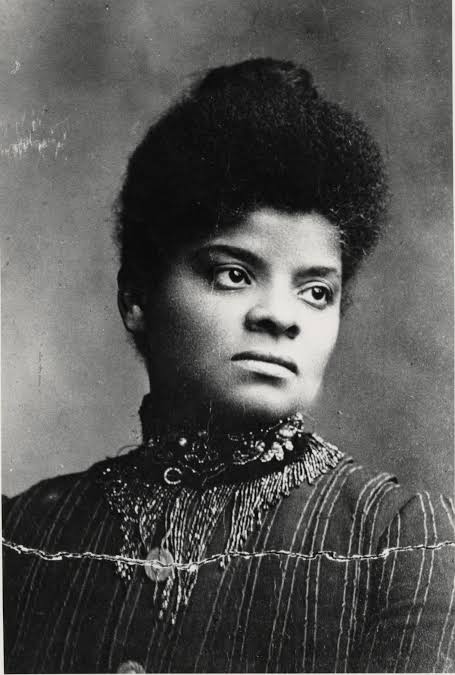
Ida B. Wells-Barnett: A pioneering voice against racism and injustice, by Gift Luckson
Ida Bell Wells-Barnett (July 16, 1862 – March 25, 1931) was an American investigative journalist, sociologist, educator, and early leader in the civil rights movement.
She was one of the founders of the National Association for the Advancement of Coloured People (NAACP).
Wells dedicated her career to combating prejudice and violence, and advocating for African-American equality—especially for women.
READ ALSO: The ancient Japanese city where deer are regarded as heavenly animals, by Gift Luckson
Throughout the 1890s, Wells documented lynching of African-Americans in the United States in articles and through pamphlets such as Southern Horrors: Lynch Law in all its Phases and The Red Record, which debunked the fallacy frequently voiced by whites at the time – that all Black lynching victims were guilty of crimes.
Wells exposed the brutality of lynching, and analysed its sociology, arguing that whites used lynching to terrorise African Americans in the South because they represented economic and political competition—and thus a threat of loss of power—for whites.
She aimed to demonstrate the truth about this violence and advocate for measures to stop it.
Background
Wells was born into slavery in Holly Springs, Mississippi. She was freed as an infant under the Emancipation Proclamation, when Union Army troops captured Holly Springs.
At the age of 14, she lost both her parents and her infant brother in the 1878 yellow fever epidemic. She got a job teaching and kept the rest of the family together with the help of her grandmother, later moving with some of her siblings to Memphis, Tennessee.
READ ALSO: Ships of the Desert: The enduring importance of camels to humanity, by Gift Luckson
Life As A Journalist
Soon, Wells co-owned and wrote for the Memphis Free Speech and Headlight newspaper, where her reporting covered incidents of racial segregation and inequality.
Eventually, her investigative journalism was carried nationally in Black-owned newspapers. Subjected to continued threats and criminal violence, including when a white mob destroyed her newspaper office and presses, Wells left Memphis for Chicago, Illinois.
Personal Life
She married Ferdinand L. Barnett in 1895 and had a family while continuing her work writing, speaking, and organising for civil rights and the women’s movement for the rest of her life.
A Powerful Activist
Wells was outspoken regarding her beliefs as a Black female activist and faced regular public disapproval, sometimes including from other leaders within the civil rights movement and the women’s suffrage movement.
She was active in women’s rights and the women’s suffrage movement, establishing several notable women’s organisations.
A skilled and persuasive speaker, Wells travelled nationally and internationally on lecture tours.
READ ALSO: Henna: A natural tradition rooted in beauty, health, and heritage, by Gift Luckson
Death and Legacy
Wells died on March 25, 1931, in Chicago, and in 2020 was posthumously honoured with a Pulitzer Prize special citation “for her outstanding and courageous reporting on the horrific and vicious violence against African Americans during the era of lynching.”
In 1889, Thomas Henry Moss Sr. (1853–1892), an African American, opened People’s Grocery, which he co-owned. The store was located in a South Memphis neighbourhood nicknamed “The Curve”.
Wells was close to Moss and his family, having stood as godmother to his first child, Maurine E. Moss (1891–1971).
Moss’s store did well and competed with a white-owned grocery store across the street, Barrett’s Grocery, owned by William Russell Barrett (1854–1920).
On March 2, 1892, a young Black male youth named Armour Harris was playing a game of marbles with a young white male youth named Cornelius Hurst in front of the People’s Grocery.
The two male youths got into an argument during the game, then began to fight. As the Black youth, Harris, seemed to be winning the fight, the father of Cornelius Hurst intervened and began to “thrash” Harris.
READ ALSO: Dada Masiti’s contribution to Islamic literature during the era of slavery, by Gift Luckson
The People’s Grocery employees William Stewart and Calvin R. McDowell (1870–1892) saw the fight and rushed outside to defend the young Harris from the adult Hurst as people in the neighbourhood gathered into what quickly became a “racially charged mob”.
The white grocer Barrett returned the following day, March 3, 1892, to the People’s Grocery with a Shelby County Sheriff’s Deputy, looking for William Stewart. Calvin McDowell, who greeted Barrett, indicated that Stewart was not present, but Barrett was dissatisfied with the response and was frustrated that the People’s Grocery was competing with his store.
Angry about the previous day’s mêlée, Barrett responded that “Blacks were thieves” and hit McDowell with a pistol. McDowell wrestled the gun away and fired at Barrett—missing narrowly. McDowell was later arrested but subsequently released. On March 5, 1892, a group of six white men including a sheriff’s deputy took electric streetcars to the People’s Grocery.
Follow the Neptune Prime channel on WhatsApp:
Do you have breaking news, interview request, opinion, suggestion, or want your event covered? Email us at neptuneprime2233@gmail.com