


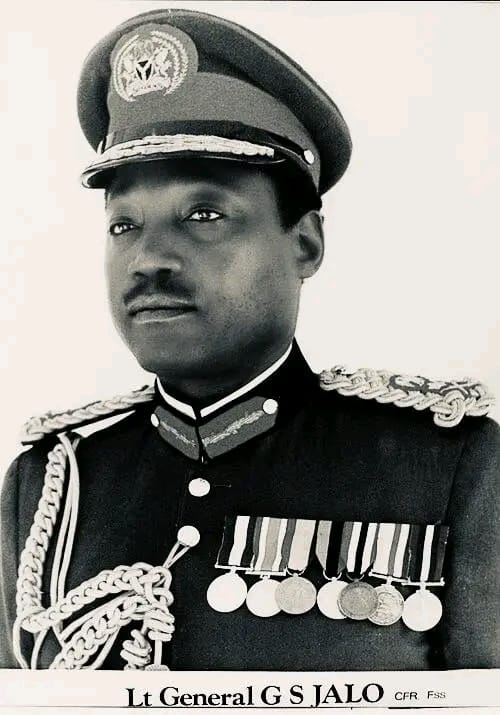
Lt. Gen. Gibson Sanda Jalo’s journey from traditional authority to military discipline, dedication
Lieutenant General Gibson Sanda Jalo CFR, FSS, was one of the quiet but deeply influential figures in Nigeria’s military history.
Born on March 1, 1939, in Demsa, in what was then Adamawa Province of British Northern Nigeria, he grew up within the royal household of the Batta people.
His father, Chief Zaro Kpanti, widely known as Hama Batta, was a paramount ruler, while his mother was Kukulu Laiyatu Jalo. From this background of traditional authority and discipline, Jalo developed a strong sense of duty that would shape his life’s path.
His early education took him through Numan Elementary School between 1946 and 1950, followed by Yola Middle School from 1951 to 1952.
READ ALSO: Lieutenant General Joshua Nimyel Dogonyaro: Celebrating 30 years of distinguished military service
He later attended Keffi Government College in Nassarawa Province from 1953 to 1958, a school that produced many notable Nigerians of his generation. Jalo remained proud of his Keffi years and stayed active in the Keffi Old Boys Association.
Among his classmates were future national figures such as Wantaregh Paul Iyorpuu Unongo and Dr Nuhu Andeyaba, men who, like him, would go on to leave lasting marks on the country.
Jalo entered military service on 20 September 1959 when he enlisted in the Infantry Corps of the Royal Nigerian Military Force. He was commissioned as a Second Lieutenant on 4 November 1960 after completing his training at the Regular Officers’ Training School in Teshie, Ghana.
In the same year, he further redefined his skills at the Royal Military Academy, now known as the Mons Officer Cadet School in Aldershot, United Kingdom. These formative years laid a solid professional foundation for a career that would span more than two decades.
In his early postings, Jalo steadily rose through the ranks, serving as a Platoon Commander, Battalion Adjutant, Company Commander, and eventually Battalion Commander between 1960 and 1967.
During the Nigerian Civil War, he played a significant operational role. He served first as Second in Command of the Second Division and later as its Division Commander, leading troops during some of the most decisive phases of the conflict between 1967 and 1970. His wartime experience cemented his reputation as a calm and capable field officer.
After the war, Jalo moved into senior command and strategic roles. He served as Garrison Commander in Lagos, Deputy Commandant of the Nigerian Defence Academy in Kaduna, and later became Commandant of the Academy itself between 1975 and 1977.
He succeeded Brigadier General Illiya Bisalla in that role and was later succeeded by Brigadier General E S Armah. From there, he was appointed General Officer Commanding of the Third Infantry Division in Jos, which later became the Third Armoured Division, before rising to Deputy Chief of Army Staff in 1979.
In April 1980, Jalo reached one of the highest points of his career when he was appointed Chief of Army Staff, a position he held until October 1981. He was then appointed the second Chief of Defence Staff of Nigeria, serving from 1981 to 1983. In this role, he followed Lieutenant General Ipoola Alani Akinrinade and was later succeeded by General Domkat Bali.
During these years, he was also a member of the Supreme Military Council and the National Defence Council, placing him at the heart of national decision-making. At one point in the 1970s, he briefly served as Acting Military Governor of Lagos State.
Alongside his command responsibilities, Jalo held important staff and ceremonial roles. He served as Aide de Camp to the British General Officer Commanding of the Royal Nigerian Army in the early 1960s and later as Adjutant of the First Battalion of the Nigerian Army.
His professional education included advanced training at the Joint Services Staff College in Latimer House, Buckinghamshire, and the National Defence College in India, reflecting the breadth of his military exposure.
Lieutenant General Jalo retired voluntarily from the Nigerian Army on 3 January 1984. His Certificate of Military Service was formally issued on 7 March 1984 by the then Chief of Army Staff, Major General Ibrahim Babangida.
Retirement did not mark the end of his public engagement. He moved into the private sector, where he held several high-level positions, including Chairman of Société Bancaire Nigeria Limited, Chairman of Mix and Bake Flour Mills Limited, Non-Executive Director of Union Bank of Nigeria Plc, Chairman of Sea Trucks Group Nigeria, and Chairman of Jason Oilfield Ventures Limited.
He also continued to contribute to national development efforts. Jalo was appointed a member of the Traditional Rulers and Leaders of Thought Committee and later served as Chairman of the Sub Committee on Solid Minerals under Nigeria’s Vision 2010 programme.
In recognition of his service to the nation, he was awarded several honours, including the Commander of the Federal Republic and the Force Service Star.
Beyond uniforms and boardrooms, Jalo was a sportsman at heart. He enjoyed field hockey and football and earned the affectionate nickname “7 Miles” on the football pitch during his younger days.
He passed away in London, United Kingdom, on 10 January 2000, leaving behind the legacy of a soldier, leader, and statesman whose life reflected both discipline and quiet dedication to Nigeria.
Follow the Neptune Prime channel on WhatsApp:
Do you have breaking news, interview request, opinion, suggestion, or want your event covered? Email us at neptuneprime2233@gmail.com