Magnificent Dalla Hills: Exploring the ancient symbol of Kano’s heritage, by Gift Luckson
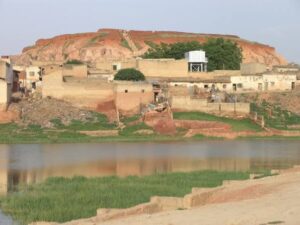
Dalla Hill (also spelt Dala) is a hill in Kano, Kano State, Nigeria. It is 534 metres (1,753 ft) high and contains a stairway with 101 steps from the bottom to the top.
History
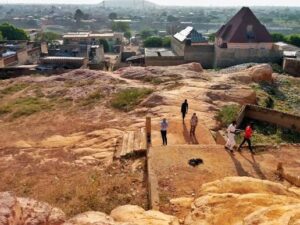
In the seventh century, the hill was the site of a community that engaged in iron-working. It was called the Tsumburbura shrine from 700 CE up until the creed’s collapse as a result of Islamic dominance later in the 13th century. Kano was originally known as Dala, after the hill.
The hill is a crucial part of the history of the city of Kano. It is believed that Barbushe, a man of great stature and might who hunted elephants with his stick and carried them on his back to the hill, resided there hundreds of years ago.
It was said that there, Barbushe built a shrine to worship a deity called Tsumburbura who is believed to have been worshipped by the Hausa people at the time before the arrival of Islam.
The only person who was allowed access to the shrine was Barbushe; anyone who entered it without his permission is said to have died tragically. Barbushe never descended from Dalla except on the two days of Idi. When the days drew near, the people who lived in the vicinity of the hill came from all over with animals to sacrifice with the hopes of gaining favour with Tsumburbura.
This also has ties to the Bayajidda legend in Hausa folklore which is an account of a stranger believed to have been from Baghdad, who arrived in the future Hausaland, married into an existing ruling family, and fathered the rulers of the seven city-states which were to make up that elastic, but successful confederation known as the Hausa Bakwai.
Retained Significance

Despite the hill being a symbol of paganism and idol worship, it still kept its significance after the arrival of Islam. The power of the sacred hill was so fixed in early Hausa tradition that as late as 1819, the second Fulani Muslim ruler used the hill as a spiritual summit where he would combine his prayers of forty days and perform them at the top of the hill, thus gathering assurance of victory in war.
The old “pagan” centre energised prayers sent up to Allah. Dalla Hill was the centre of power around which all rituals revolved. There, the ancestor figure, leader of the race, first lived. There, he had his wives and seven children. It was there that the first event took place.
Ancient Kano City
The Ancient Kano City Walls were ancient defensive walls built to protect the inhabitants of the ancient city of Kano. The wall was initially built from 1095 through 1134 and completed in the middle of the 14th century. The Ancient Kano City Walls were described as “the most impressive monument in West Africa”.
The Ancient Kano City Walls were built as a defensive wall with the construction of the foundation laid by Sarki Gijimasu (r. 1095–1134), the third king of the Kingdom of Kano in the Kano Chronicle. In the mid-14th century, during the reign of Zamnagawa, the wall was completed before it was further expanded during the 16th century. According to historians, the then General-Governor of the Colony and Protectorate of Nigeria, Fredrick Lugard, wrote in a 1903 report about the Kano Walls that he had “never seen anything like it in Africa” after capturing the ancient city of Kano along with British forces.
Follow the Neptune Prime channel on WhatsApp:
Do you have breaking news, interview request, opinion, suggestion, or want your event covered? Email us at neptuneprime2233@gmail.com