
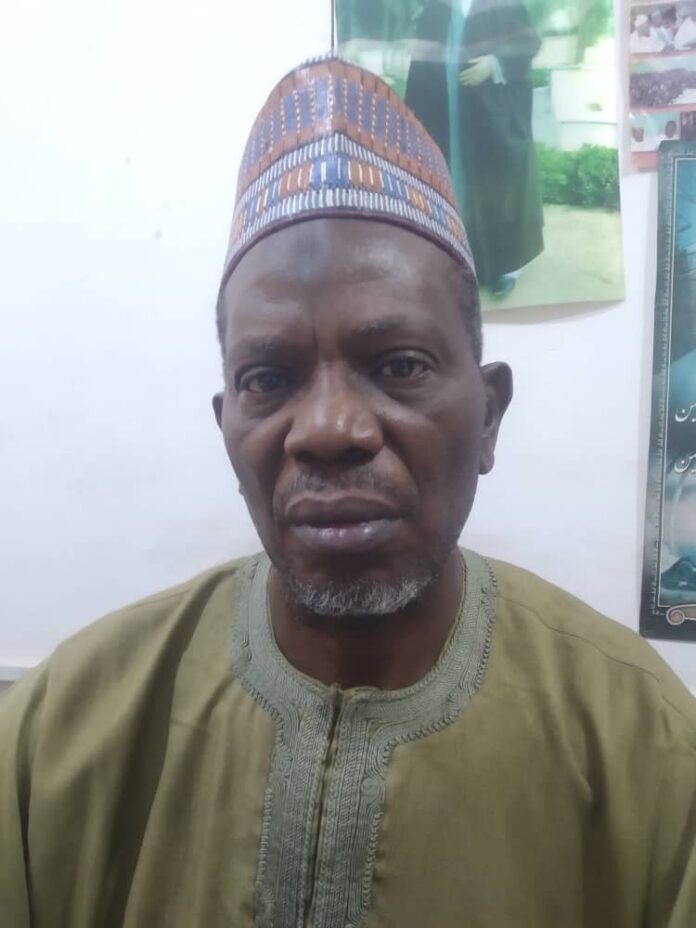
Global Intifadah: Nigerian stand and the gap, by Professor I. H. Mshelgaru
1. INTRODUCTION
Thank you to the chairman and the program coordinator for having me on the program. I am going to speak on the global Intifadah: Nigerian stand and the gap. With special emphasis on the capacity, prospect and the position Nigeria as the giant of the continent, occupies in the sphere of the worldwide Intifadah.
2. GLOBAL INTIFADAH (UPRISING)
As we may know, there has been a strong storm of Intifadah (uprising of a kind) raging all over the globe triggered by the 2023 Gazan operation al-Aqsa flood. Though, the first of its kinds, the global Intifadah within a short period spread to every nook and cronies of the world within two years exhibiting the same ambition and message: – resistance against international hegemony and totalitarianism and the network of their machinations.
Even though, the enemy the global Intifadah is fighting is same everywhere, the strength and the spread of the Intifadah has never been evenly distributed across continents of the world just as it has been in Palestine where it originates.
For instance; on American continent USA is severely hit while on Europe the UK is the most hit. On the continent of African, the united Sahel countries of west Africa subregion is the most stroked while the rest of the continent remained relatively low. So, Nigeria is on the African continent and it is its most populous and influential country; what then is the status of Nigerian global Intifadah? To answer this question let’s start by analyzing its Intifadah
3. ANALYSIS OF INTIFADAH IN NIGERIA
To scrutinize the Nigerian global Intifadah, let’s understand what the concept of Intifadah is before going into its characteristics.
Definition of Intifadah:
An Intifadah is an Arabic word meaning uprising also called a rebellion, revolt, or insurrection that is sustained, organized, and often violent challenge to established authority, typically with the aim of forcing a significant political change. It is a middle-ground phenomenon, between protest and full-blown revolution.
Possibility of Nigeria to Experience Intifadah (Uprising)
A nation’s capacity to engage in significant civic mobilization is determined by a complex mix of fundamental social strengths and the presence of specific, actionable factors that can be influenced.
Here is a summary of the factors influencing Nigeria’s capacity for an uprising, drawing from Nigeria’s history and current conditions.
Contextual Factors
(i) Social Cohesion and Networks: Strength of community bonds, social trust, and shared identity. This provides the foundational social fabric for collective action. Strong networks enable communication and mutual aid.
(ii) Economic Equity: Distribution of resources and socioeconomic status. Greater equity can reduce internal fragmentation and increase the pool of individuals with resources to participate.
(iii) Education Levels: General level of public education and critical thinking. Higher education correlates with better organization, strategy formulation, and critical analysis of the status quo.
(iv) Institutional Integrity: Functioning of democratic institutions and rule of law. Determines whether formal channels for change are available or if they are seen as ineffective, pushing action outside institutions.
Target Factors
(i) Trust in Leadership and Institutions: Public confidence in civil society organizations, movement leaders, and remaining credible institutions. A critical catalyst. Low trust in existing authority can be a motivator, but high trust in alternative leadership is essential for organizing.
(ii) Shared Grievance and Narrative: A widespread, clearly communicated perception of threat or injustice that unites diverse groups. Creates a common cause, transforming individual discontent into a collective motivation for action.
(iii) Organizational Capacity: Ability to coordinate, communicate, and mobilize logistics (e.g., via unions, NGOs, digital networks). Turns potential energy into kinetic action. Enables strikes, mass rallies, and sustained campaigns.
(iv) Perceived Efficacy: The collective belief that action can and will make a difference. Combats fatalism and apathy. Successes (like effective boycotts or legal wins) reinforce this perception.
Economic and Livelihood: Nigeria is abounded with:
(i) Deepening economic crisis,
(ii) Persistent fuel and electricity price hikes
(iii) High unemployment (32.2%)
(iv) inflation (15%)
Governance and Political:
(i) Widespread perception of elite corruption
(ii) Political exploitation of ethnic/religious divides
(iii) Legacy of successful mass protests
(iv) State security apparatus remains cohesive & repressive
(v) Lack of unified national leadership for broad uprising
Social Cohesion:
(i) High potential for cross-ethnic/class unity on economic issues
(ii) Active and mobilized civil society and unions
(iii) Deep regional, ethnic, and religious fault lines
(iv) Multiple localized conflicts divert energy and focus
Security:
(i) Multiple active insurgencies and widespread criminality show state’s limited control
(ii) Military and security forces remain key state
The Threshold and Tactical Repertoire (range):
Research on nonviolent movements suggests that:
(i) The active and sustained participation of about 3.5% of the population is often a tipping point for achieving major political change.
(ii) Successful movements employ a diverse “toolbox” of tactics beyond protests, including: general strikes, targeted boycotts, strategic non-cooperation, and mass litigation.
(iii) The diversification of tactics helps sustain momentum and apply pressure across different sectors of society.
The characteristics and the strength of the Nigerian Intifadah:
a. Core political and motivational characteristics of Nigerian Intifadah:
(i) Targeted Opposition to Authority: Nigeria has movements whose primary goal is to confront and displace a specific ruling power. Not just about a single policy, but the legitimacy of the rulers and the system.
(ii) Political Objective: While the uprising groups are driven by deep grievances (injustice, oppression, economic crisis), their aims range from political change—regime change, secession, to radical systemic reform.
(iii) Widespread Legitimacy Crisis: The uprisings draw energy from a broad perception that the existing authority is illegitimate, corrupt, or has broken social contracts.
b. Organizational and Strategic Characteristics of Nigerian Intifadah:
(i) Sustained Action: they are not one-off event. they involve series of actions over days, weeks, or months, years, indicating planning and persistence.
(ii) Emerging Leadership and Organization: the Nigerian uprisings have developed coordinating bodies, charismatic leaders, and decentralized cell structures, especially with the Islamic movement. An indication that they are not pure chaos.
(iii) Dual Strategy: They typically employ a combination of: Violent Tactics: Armed clashes, guerrilla attacks, sabotage, seizures of government buildings; and Non-Violent/Civil Disobedience: Mass strikes, blockades, parallel governments, and large demonstrations. And the mix varies. The Islamic movement chose purely non-violent tactics as its strategy
(iv) Control of Territory: A key indicator. Uprising participants seize and hold physical space—neighbourhoods, cities, or regions or mind and souls —creating “liberated zones” beyond state control.
c. Participatory and Social Characteristics of the Nigerian Intifadah:
(i) Mass Participation: they have broad-based support beyond a small cadre. This includes combatants, as well as a sympathetic populace that provides supplies, shelter, and information.
(ii) Cross-Sectional Support: While often led by a particular group, successful uprisings draw participants from various social strata (students, workers, defected soldiers, intellectuals, ethnic groups) united by a common goal.
(iii) Symbolism and Communication: Use of unifying symbols (flags, gestures), and strategic use of media to mobilize support, control narrative, and communicate internally.
4. WHICH RESISTANCE GROUP HAS POTENTIALS FOR NATIONAL INTIFADAH?
There are many active and vibrant groups, such as the occupy Nigeria now, the IPOB, the Insurgency groups, the Islamic Movement and so on, capable of mobilizing huge population to alter political landmark in Nigeria, identified by research institutions and organizations. Almost all of these groups were restricted to specific local domain or communities with slight exception of the ‘occupy Nigeria now’ which is believed to have national coverage and shared cause but is limited with leadership which is an inevitable factor for long time survival and sustainability.
Contrary to all, is the Islamic movement which possesses all the factors required for effective and successful Intifadah not only across the nation but across the west African region. The Islamic Movement, which is usually neglected as formidable force to recount with, is however, the only group enjoying large grassroot support, cutting across all walks of life, stretching the width and breadth of the country and spreading beyond the national boundaries to neighboring countries with unified cause and ambition—Islam.
5. WHAT OTHER RESISTANCE GROUPS LACK FOR STRONGER INTIFADAH IN NIGERIA
Nigeria has seen recent protests driven by severe hardship, but an organised, nationwide uprising faces significant obstacles. Based on the search results, the groups, with the exception of the Islamic Movement, primarily lack the following to translate widespread discontent into a coordinated revolution.
(i) Lack Unified Leadership and clear political alternative: Protests are fragmented and “leaderless,” without a single political cause or leader to unite behind at the national level.
(ii) Lack regional and have distinct causes: making it difficult for grievances to coalesce into a single, nationwide uprising against the federal government.
(iii) Fragmented National Identity and Goals: Grievances and demands differ starkly by region; there is no single “enemy” or goal for a national movement.
(iv) They are
(v) Overwhelming Security Presence and Repression: Security forces consistently use lethal force and mass arrests to crush dissent, raising the cost of protest.
(vi) Pervasive Insecurity and Survival Mode: Daily threats from armed groups drain people’s energy and resources, making sustained political mobilisation extremely difficult.
(vii) Government Monopoly on Legitimacy: Despite failures, the federal government retains the formal authority and military strength to frame dissent as “chaos” or “treason”.
6. LATENT CAPACITY FOR STRONGER INTIFADAH ASSOCIATED WITH NIGERIA
(i) Declining Institutional Trust: there are sharp drops in trust towards the government, courts, institutions and the media
(ii) Coalition-Building: Separate groups can form alliances around a common threat
(iii) Tactical Experimentation: the civil actions are moving beyond simple protests to include strikes, boycotts, and sophisticated legal challenges
(iv) Narrative Strength: Is there a powerful, unifying story about the nature of the grievance and the desired future that crosses demographic lines
(v) Largely a grassroots mobilisation: involving all categories of people and professions
(vi) Potential for Unexpected Triggers: A major event, such as a severe economic shock or a catastrophic security failure, could act as a catalyst, potentially forcing groups into chaotic alignment against the state.
7. CONCLUSION
There is a share of the global Intifadah groups, with similarity to the Palestinian ones, engulfing the country, Nigeria. The only group with the most need capacity to attain the threshold of 3.5% of population for a successful full-blown national Intifadah against governments’ brutal forces and imposed hardships, is the Islamic Movement. If only the rest of the groups can correct their shortcomings, a united gigantic Intifadah movement can be formed to bring power to the people. This is the position Nigeria occupies and the gap its groups need to fill with regards to the spirit of the global Intifada.
Professor I. H. Mshelgaru writes from Zaria.
Follow the Neptune Prime channel on WhatsApp:
Do you have breaking news, interview request, opinion, suggestion, or want your event covered? Email us at neptuneprime2233@gmail.com