


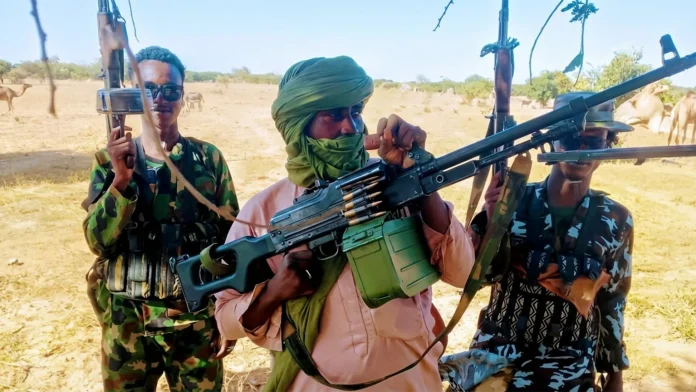
Nigeria witnessed about 2.2 million kidnapping incidents within one year, with ransom payments estimated at ₦2.2 trillion, according to security expert Prof. Oyesoji Aremu.
Aremu disclosed this during a public lecture organised by the Social Sciences Students’ Association (SOSSA) of Adekunle Ajasin University in Ondo State, where he examined Nigeria’s declining security situation and its impact on the economy and society.
The University of Ibadan scholar, who also serves as Acting Vice-Chancellor of Achievers University, Owo, said the figures, attributed to data from the National Bureau of Statistics released in December 2024, reveal the rise of a thriving “ransom economy” fuelled by banditry, kidnapping rings and insurgent groups operating across the country.
According to him, the growing wave of abductions has transformed insecurity into an organised criminal enterprise with severe consequences for citizens, businesses and national development.
Aremu noted that Nigeria continues to perform poorly on global security rankings, citing the country’s position of 142 out of 143 on the World Justice Project Rule of Law Index, 148 out of 163 on the Global Peace Index, and fifth globally on the Global Terrorism Index.
He said the rankings reflect worsening insecurity, weak governance structures and declining investor confidence.
The professor traced the roots of the nation’s security challenges to historical crises such as the Civil War, Maitatsine uprisings, Niger Delta militancy and the Boko Haram insurgency, warning that many of the threats escalated due to ignored warning signs and delayed government response.
He further explained that the emergence of splinter extremist groups like ISWAP, alongside expanding banditry and illegal mining activities, has complicated efforts to restore peace and stability.
Aremu also expressed concern over the use of large ungoverned forests, including Sambisa, Alagarno, Kamuku, Kuyambana, Kuduru and the Old Oyo National Park, as operational bases for criminal elements, describing the situation as evidence of weak state control in remote areas.
He pointed to repeated attacks on schools, including the Chibok, Dapchi, Kagara and Greenfield incidents, as proof of continued lapses in intelligence gathering and preventive security measures.
The security scholar criticised the lack of synergy among security agencies, saying rivalry and blame-shifting have weakened Nigeria’s response to insecurity.
To tackle the crisis, Aremu advocated the establishment of state police, improved community intelligence gathering, stronger collaboration among security agencies, coordinated surveillance across neighbouring states and the deployment of forest guards to secure vulnerable areas.
In his remarks, the Vice-Chancellor of Adekunle Ajasin University, Prof. Olugbenga Ige, represented by the Deputy Vice-Chancellor (Academic), Prof. Adebisi Daramola, described the lecture as timely in view of the country’s current security challenges.
Also speaking, the Dean of the Faculty of Social Sciences, Prof. Adesuyi Adebukola, stressed the need for continuous collaboration among stakeholders, noting that insecurity remains a major setback to Nigeria’s development.
Follow the Neptune Prime channel on WhatsApp:
Do you have breaking news, interview request, opinion, suggestion, or want your event covered? Email us at neptuneprime2233@gmail.com