


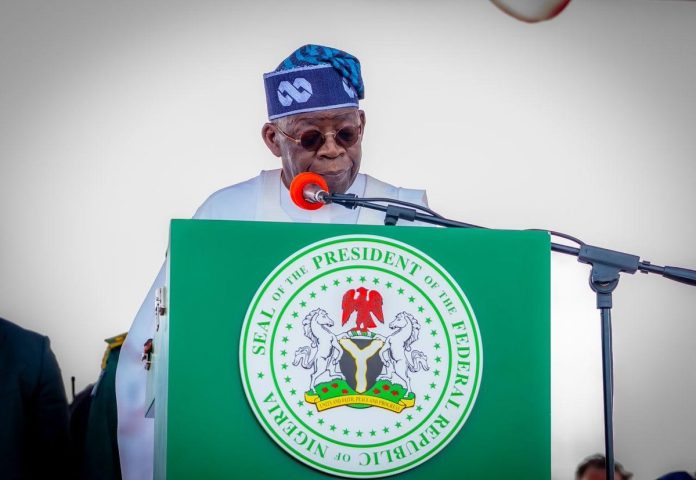
Bending, Bleeding, and Buying Bread: X-raying today’s Tinubu’s Democracy Day address, by Abubakar M. Kareto
For twenty-seven unbroken years, the Nigerian experiment has somehow survived against all odds. Since May 29, 1999, our people have chosen to fight their battles in courtrooms and legislative chambers rather than on blood-soaked streets. On paper, we are celebrating the longest stretch of civilian rule in our history. But as President Bola Ahmed Tinubu delivered his 2026 Democracy Day address, a heavy question hung in the air: can state-sponsored nostalgia really satisfy a hungry nation?
Beneath the flawless prose, the President attempted a massive psychological heavy-lifting operation, trying to convince Nigerians that the current shege of hyperinflation and high cost of living is actually a form of patriotic, “generational sacrifice.”
The Generational “Sacrifice” vs. Daily Survival
The entire rhetorical framework of the speech relies on a very neat, poetic timeline: “The generation of our founding fathers secured independence, the generation of June 12 secured democracy. Our generation must secure prosperity.”
This is brilliant speechwriting, but let’s call a spade a spade: it functions as an ideological shield. By elevating the current economic hardship into an epochal struggle akin to the anti-colonial movement, the President is asking the masses to view their suffering through a romanticized historical lens.
But this logic is fundamentally flawed. The heroes of June 12 fought against a clear, identifiable, human adversary: military dictatorship. The current adversary, however, is a harsh economic wilderness directly engineered by executive policy choices, namely the aggressive removal of fuel subsidies and the floating of the Naira. Asking citizens to endure unprecedented hardship as a form of patriotic duty feels detached from the realities of a mother who can no longer afford a bag of rice. Transfiguring policy fallout into a “patriotic baptism of fire” is a clever defensive play, but the patience of Nigerians is wearing dangerously thin.
The Illusion of the Imperial Balance Sheet
To project absolute control over national security, the address drops massive, intimidating numbers: a ₦5.41 trillion defense budget, 50,000 new police recruits, and an 81% reduction in terror-related deaths since 2015.
While these metrics look spectacular on a federal spreadsheet, they reveal a profound disconnect from the localised anxieties of ordinary citizens. Comparing security data in 2026 to 2015, the absolute peak of Boko Haram’s territorial occupation, is a classic political sleight of hand. The average Nigerian today is not losing sleep over theater-level warfare in the Lake Chad basin; they are terrified of the rampant, opportunistic economy of kidnapping and banditry closing in on places like Oyo, Borno, and the federal capital territory itself. When the state speaks in trillions but the citizen is calculating ransom money, the language of governance ceases to communicate security: it communicates distance.
The ₦4 Trillion Power Gamble
The President proudly pointed to the Electricity Act and a newly authorized ₦4 trillion bond to wipe out legacy debts in the power sector. While unlocking the grid legally is a progressive step, this massive debt-securitisation strategy should make any financial analyst nervous. Dropping a ₦4 trillion liability into a struggling economy acts as a major inflationary risk, all while millions of homes remain unmetered and left in total darkness on the ground.
FAAC Windfalls vs. The Empty Pocket
With commendable candor, the President admitted the ultimate metric of any democratic system: “We believe that Democracy must be felt in the pocket.”
Yet, this admission stands in total friction with the rest of his economic evaluation. The speech boasts that federation revenues have risen exponentially, giving state and local governments unprecedented cash to deploy.
But let’s unmask that revenue surge. It is a mathematical optical illusion born out of a heavily devalued currency. The Federal Accounts Allocation Committee (FAAC) is sharing massive nominal sums simply because the Naira has been systematically diluted, not because local productivity has skyrocketed.Therefore, while state governors are enjoying record-breaking financial windfalls, the purchasing power of the ordinary Nigerian has been completely gutted. Boardroom metrics like a 21% rise in non-oil exports mean absolutely nothing to a population experiencing structural inflation. Until macro reforms translate to micro relief, the claim that democracy is being felt “in the pocket” reads like an unintended irony.
The Honours List: Shoring Up the Base
A significant portion of the address was dedicated to a long, meticulous roll-call of national awards for pro-democracy activists, journalists, and “soldier-democrats.” While honoring the icons of the June 12 struggle is culturally necessary, a critical look at the list reveals a highly strategic, localised concentration.
The majority of the civilian honorees represent the frontline media architects and progressive activists of the old Southwest axis, many of whom are long-time intellectual defenders and political allies of the President’s career. With crucial gubernatorial elections looming in Ekiti and Osun, this honors list is a masterclass in domestic alliance consolidation. It serves to secure the administration’s ideological home base, weaponising historical sentimentality to insulate the president from contemporary political defections.
The Verdict: Endurance is Not a Policy
The President concluded by stating that Nigerians “bend, we bleed, but we do not break.” It is a moving, evocative truth. Our history is indeed a testament to miraculous endurance. But endurance is a symptom of a people left with no alternative; it is not an economic policy.
While the administration has crafted a highly sophisticated ideological script for its own survival, it has fundamentally failed to bridge the gap between macroeconomic restructuring and grassroots survival. Political freedom was bought by the blood of the June 12 martyrs. Economic freedom, however, cannot be bought with grand historical tributes. If this administration truly intends to usher in a generation of prosperity, it must understand that the ultimate legitimacy of a democracy is never decided in the halls of memory: it is decided at the dinner table.
About the Author:
Abubakar M. Kareto is a seasoned Public Affairs Analyst, strategic communications expert, and policy commentator specialising in continental, national, and sub-national governance, security dynamics, and socio-economic issues. He can be reached via amkareto@gmail.com.
Follow the Neptune Prime channel on WhatsApp:
Do you have breaking news, interview request, opinion, suggestion, or want your event covered? Email us at neptuneprime2233@gmail.com