


Beyond Infrastructure: How Yobe state is rewriting the healthcare narrative in Sub-Saharan Africa, by Abubakar M. Kareto
The popular maxim dictates that health is wealth. In the calculus of socio-economic development, there is an unassailable truth that the productivity, economic vitality, and developmental velocity of any nation are directly proportional to the health status of its citizens. This foundational principle explains why healthcare delivery in Yobe State, under the administration of Governor Mai Mala Buni, has moved beyond routine administrative attention to become the central pillar of the state’s governance blueprint.
When Governor Buni assumed office, he inherited a landscape emerging from the complex disruptions of regional insecurity, where rural communities faced significant barriers to accessing basic medical care. In his inaugural address, the governor unveiled a structured healthcare development programme aimed at establishing one functional, fully equipped Primary Healthcare Centre (PHC) in each of the 178 political wards across the state. This was not merely a political promise but a calculated master plan to democratize access to medical care.
To date, 140 of these centers have been completed, equipped, commissioned, and integrated into active public use. These are not empty concrete shells; each custom-built facility features an equipped laboratory, a functional labor room, a pharmacy stocked with medical consumables, dedicated male and female wards, and standard staff quarters. By providing housing on-site, the administration has solved the age-old problem of medical absenteeism, ensuring twenty-four-hour, seven-days-a-week clinical presence in rural communities.
For border communities such as Bulatura and Gumsi in Yusufari Local Government Area, Dole Machina and Taganama in Machina Local Government Area, and Ma’anna in Geidam Local Government Area, this policy has engineered a profound geopolitical shift. For decades, residents in these frontier settlements had to cross international borders into the neighboring Niger Republic to seek basic medical attention. The institutionalization of functional PHCs within these territories has restored human dignity, preserved household income, and turned a multi-generational vulnerability into a triumph of domestic governance.
Upgrading the Continuum of Care
Recognizing that a robust primary tier must be backed by a strong secondary system, the Buni administration simultaneously executed a massive vertical upgrade of the state’s healthcare architecture. Four Strategic General Hospitals were transformed into ultra-modern Specialist Hospitals, while eight Primary Healthcare Centers were systematically upgraded to full-fledged General Hospitals. This deliberate expansion has drastically minimized referral times and brought complex diagnostic and therapeutic services closer to the grassroots.
The crown jewel of this infrastructural renaissance is the newly constructed 375-bed capacity Maternity and Child Care Health Complex in Damaturu, unarguably the largest dedicated maternal and child clinic in Nigeria.
The architectural masterpiece consists of seven blocks of interconnected one-storey structures. The Obstetrics and Gynaecology wing features 64 open cubicles, five call duty rooms, five satellite pharmacies, and four nurses’ stations. The Special Baby Care Unit (SCBU) incorporates an advanced triage division, separating twenty-eight cots for neonates suspected of sepsis, ten cots for out-born babies, and ten cots for in-born babies, supported by a specialized ten-bed unit where nursing mothers can comfortably breastfeed and bond with their infants.
Furthermore, the surgical and pediatric divisions operate at an elite institutional standard. The labor ward and obstetrics theatre host four state-of-the-art operation suites, advanced sterilization zones, and six recovery rooms. The Pediatric Medical Ward provides forty dedicated cubicles, while the Emergency Pediatric Unit adds thirty-two specialised emergency spaces, including a high-dependency resuscitation cubicle.
During the formal commissioning of the complex, former President Muhammadu Buhari observed that the facility possesses the scale and sophistication to service maternal and child health needs across the entire West African sub-region. This assessment was reinforced by the United Nations Resident Coordinator in Nigeria, Mohamed Yahya, who remarked during an assessment tour that Yobe’s deliberate capital investment in medical infrastructure offers an exemplary model for post-conflict development.
Institutionalising Sustainability and Human Capital
In the global theater of public health administration, infrastructure without human capital is a monument to waste. To avoid the manpower deficits that plague many developing healthcare systems, the Yobe State Government leveraged the state-owned College of Nursing and Midwifery in Damaturu to train, graduate, and automatically absorb over 1,200 nurses, midwives, and community midwives directly into the state civil service, instantly stabilizing the staffing matrix across all newly established facilities.
This intentional governance style has earned the state significant institutional validation. At the national Primary Healthcare Leadership Challenge, organized by the Nigeria Governors’ Forum in collaboration with the National Primary Health Care Development Agency (NPHCDA) and UNICEF, Yobe State achieved an unprecedented double victory. The state emerged as the Grand Overall Best Performing State in Nigeria, securing a $700,000 performance prize, alongside the Zonal Best Performing State award for the Northeast, which carried an additional $500,000.
This historic $1.2 million prize, backed by the Bill and Melinda Gates Foundation, was awarded based on independent metrics evaluating quality of care, institutional accountability, and grassroots patient satisfaction. Far from treating this windfall as passive revenue, the Yobe State Contributory Healthcare Management Agency (YOCHMA) has strategically deployed these resources to expand the enrollment of civil servants and highly vulnerable groups into its equity fund, making Yobe the first state in the Northeast sub-region to achieve 100 percent implementation targets in organized contributory healthcare insurance programs.
Pioneering Medical Tourism and Frontier Science
The dividends of these structural reforms are actively transforming Yobe State into a highly competitive hub for domestic medical tourism. The deployment of advanced medical technology at the Yobe State University Teaching Hospital (YSUTH) has begun diverting patients who previously sought care abroad. A notable testament is that of a retired permanent secretary from Bauchi State, whose son required intricate specialized surgery and was initially referred to Cairo, Egypt. On the advice of clinical experts, the family opted for YSUTH, where the procedure was completed successfully at a total cost lower than a single economy-class flight ticket to North Africa.
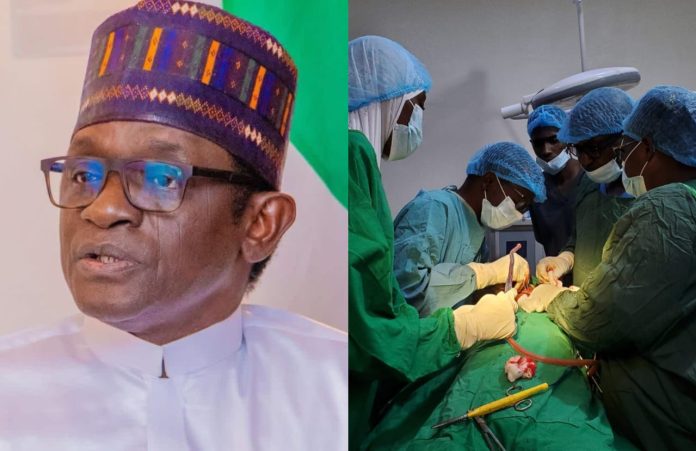
This capacity was recently demonstrated when clinical teams at the Specialist Hospital Damaturu successfully executed a complex segmental mandibulectomy and immediate reconstruction with an iliac crest bone graft on a forty-year-old female patient suffering from mandibular ameloblastoma (a rare, aggressive tumor of the jaw). Led by Dr. Muhammad Ayuba Fusami, a Consultant Oral and Maxillofacial Surgeon, alongside Dr. Peter Umejiego, this pioneering breakthrough confirmed that advanced tertiary interventions are now firmly within the domestic capability of Yobe’s public health system.
Perhaps the most visionary dimension of Yobe’s health strategy lies in its embrace of cutting-edge biomedical research. Under the administration’s patronage, the Biomedical Science Research and Training Centre (BioRTC) at Yobe State University has emerged as one of West Africa’s elite research labs. BioRTC recently made scientific history by acquiring Nigeria’s first LSM 780 Confocal Microscope—a highly advanced imaging technology that allows researchers to study cellular structures at a molecular level.
Rather than focusing exclusively on general science, Governor Buni has directed this elite scientific capacity toward solving localized public health crises. For years, communities living along the banks of the River Yobe—particularly within the Bade and Jakusko local governments—have suffered from an unexplained, abnormally high burden of Chronic Kidney Disease of unknown cause (CKDu). Driven by clinical data showing that a significant percentage of young, productive agricultural workers were succumbing to renal failure without the traditional risk factors of diabetes or hypertension, the governor took the fight to the global scientific stage.
In a move without precedent for a subnational government in West Africa, Governor Buni secured strategic partnerships with world-renowned scientific bodies, including the London School of Hygiene and Tropical Medicine and University College London. Led by internationally celebrated epidemiologists and nephrologists like Professor Neil Pearce and Professor Ben Caplin, alongside home-grown scholars like Professor Baba Goni Waru and Dr. Mahmoud Bukar Maina, a massive spatiotemporal mapping and environmental toxico-epidemiological study is underway. By analyzing soil, water, and human tissue samples using the sophisticated infrastructure at BioRTC, this international coalition is isolating the specific environmental causative agents responsible for the renal hotspot along the Kumadugu River valley.
To cushion the immediate impact on affected families, Yobe stands alone as a beacon of social security, providing completely free dialysis treatment for all kidney patients within the state. This comprehensive approach—combining free tertiary clinical management with advanced epidemiological research to mitigate the root cause defines the true essence of statecraft.
A Masterclass in Subnational Governance
The profound transformation of Yobe State’s health architecture has caught the attention of veteran administrators across the country. During a national broadcast, the Katsina State Governor, Dr. Dikko Radda, openly commended the Buni administration, citing Yobe’s healthcare models as the gold standard that other states must replicate to achieve genuine universal health coverage.
The lessons from Yobe State are clear, precise, and universally applicable. They demonstrate that transforming a healthcare system does not require a state to possess the largest share of federal allocations; rather, it demands absolute clarity of vision, institutional discipline, and an unwavering commitment to human-centered development. By seamlessly linking grassroots primary access, elite maternal tertiary infrastructure, sustainable health insurance models, and international scientific research, Yobe State has successfully moved from post-insurgency recovery to the absolute frontier of healthcare innovation in Africa.
Abubakar M. Kareto is a Public Affairs Analyst. He can be reached via amkareto@gmail.com.
Follow the Neptune Prime channel on WhatsApp:
Do you have breaking news, interview request, opinion, suggestion, or want your event covered? Email us at neptuneprime2233@gmail.com