


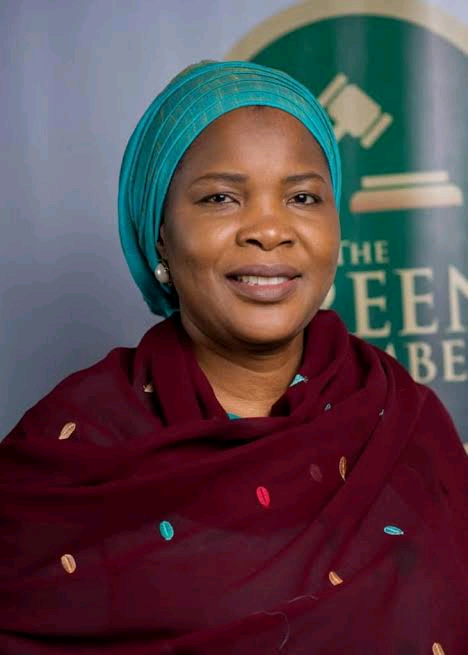
Debacle of Honourable Zainab Gimba: A challenge to democratic credentials of Governor Zulum, by Ayuba Ahmad
In a chat with journalists in Lagos, the National Chairman of the All Progressives Congress, APC, Professor Netanwe Goshwe Yilwatda described the party’s ongoing primary elections as, “the most competitive in the history of party primary elections in the country.”
Indeed, the APC chairman is unarguably correct in terms of the large numbers of aspirants jostling to fly the party’s flag in the forthcoming general elections. However, it is also a fact that the exercise has thrown up a whirlwind of spectacles that do not speak too positively to the postures of the party as a hallmark for the advancement of democracy.
The party had chosen to use either the direct primary elections mode or the uniquely Nigerian consensus method in the selection of its candidates. In practice on the fields, the two modalities have resulted in a flurry of incidents of protests and violent conflicts over allegations of brazen abuse of due process or outright nepotistic manipulations.
Grievances and protests have trailed the conduct of the exercise in Lagos, Rivers, Katsina, Plateau, Nasarawa and Kogi States. The reported defeat of incumbent Senator Ned Nwoko by former Governor Ifeanyi Okowa in the Delta North senatorial primary contest has been gathering momentum with the grim prospects of exploding into a major inferno.
In Jos North, tension is mounting as party faithfuls in the area are at daggers drawn over the alleged denial of the party’s flag to Honourable Adamu Aliyu despite being the clear winner of the primary election to the state Assembly. At the Jushi ward of Sabon Gari local government area in Kaduna State, a party member was killed in clashes between supporters of rival aspirants.
The spate of conflicts over the APC primary elections across the country could have been averted if party chieftains had not brazenly embarked on the imposition of their proteges as flag bearers. In most cases, the criteria for the preferred choices of the party leaders defy simple logic and reasoning. In some instances, a party chieftain’s opposition to certain aspirants is based on mundane, narrow and self-centred grounds.
The fate of Honourable Zainab Gimba in the APC primary election for the Bama/Ngala/Kalabalge in Borno State to the House of Representatives, exemplifies the hazy and bizarre criteria applied in the selection of suitable standard bearers of the party.
A thoroughly polished and experienced politician, Honourable Zainab Gimba is in her second term as one of the ten representatives of Borno State in the Federal House. She is the only female legislator in the state and one of the handful of women elected from the entire North-East zone and the northern region as a whole since the inception of the Fourth Republic.
Unlike most of her male counterparts from the state and the region, Honourable Gimba has not been one of those referred to in the Nigerian parlance as a “bench warmer.” She is rather, a vocal and active member of the House known for sponsoring and supporting bills, especially on education, women’s rights, social welfare and security. She has persistently, as well as used the platform of the House to advocate for the rehabilitation and resettlement of conflict-affected communities in the North-East.
On account of her activities as a lawmaker and a strident champion of women’s advancement, she was selected to represent Nigeria at the Commonwealth Women Parliamentarians Forum, where she was initially elected as the 1st Vice President, African region and later as chairperson, Commonwealth Women International. She is also the President of the ECOWAS Women Parliamentarians Association.
As a representative, she enjoys an overwhelming grassroots popularity and acceptance among a broad-spectrum of people in the area. This is in recognition of her numerous socially relevant constituency projects.
Her imprints in the preceding six years of her tenure include numerous personal interventions in education, capacity building, women and youth empowerment programmes and projects.
She has also engaged in the construction of several boreholes in urban and rural areas of her constituency, rehabilitation and construction of classrooms in primary and secondary schools and facilitating donor agencies and government intervention in primary healthcare delivery.
Paradoxically, in spite of her outstanding accomplishments as a representative, the powers that be in the state, decided to deny her the mandate of her constituents to represent them yet again in the 11th National Assembly. Certainly, she could not have been faulted or found wanting on the ground of incompetence or poor representation.
The latest decision to stop her from going to the House was not the first time. In the countdown to the 2023 general elections, she successfully fought against similar attempts to scuttle her second term in the Green Chambers. This time, her detractors seem to be very determined to stop her by whatever means, fair or foul. They got desperate and went off the tracks of decency.
On the day of the primary election, a large number of gangs of political thugs, using horse whips and sticks, ferociously descended on and inflicted critical injuries on the women who had turned out to exercise their franchise as registered members of the party.
With the security agents looking away, the women who had turned out in their numbers, were dispersed without casting their votes. It was a mission accomplished because the goal of those who had instigated the assault was to deny Honourable Zainab Gimba, the huge chunks of votes that would have come from the women.
The decision to stop Honourable Zainab Gimba from going back to the House in 2027 had been taken long before the primary elections in the state. Those who played god by sitting in judgment over her, were vehemently resolved. In the circumstance, there was little she could have done to salvage the situation.
What was the rationale or the criteria used by the party’s leadership to arrive at its decision to drop Honourable Zainab Gimba from the ten members of the House of Representatives from the state? The simple answer is: she is the victim of misogynists, those who are congenitally averse to the participation of the female gender in the scheme of public affairs.
There is, otherwise, no other palpable or logical explanation why the electorate of Bama, Ngala and Kala Balge should be so brazenly denied the right to elect the representative of their choice. That is, just as it is sad that the entire Borno State and the North-East zone are being robbed of a chance to continue to showcase one of their own as a quintessential female role model by global standards.
Come to think of it, is it not sad as it is perplexing, that the charade about Honourable Zainab Gimba took place in a state where Professor Babagana Umara Zulum is governor and leader of the APC party? “If gold rusts”, as the saying goes, “what would the iron do?”
Ayuba Ahmad is a Kaduna-based veteran Journalist and Public Commentator.
Follow the Neptune Prime channel on WhatsApp:
Do you have breaking news, interview request, opinion, suggestion, or want your event covered? Email us at neptuneprime2233@gmail.com