


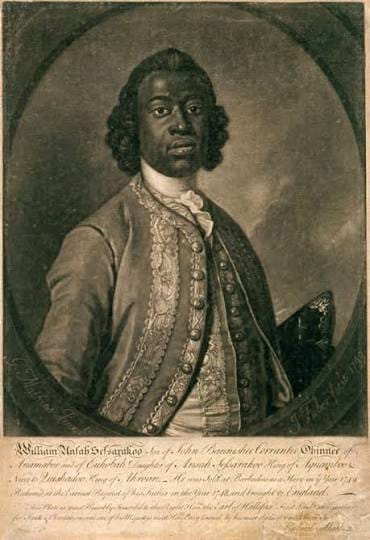
William Ansah Sessarakoo: The story of the African Prince wrongfully sold into slavery, by Gift Luckson
William Ansah Sessarakoo (1735 – 1770) was a Fante trader and public figure, best known for his enslavement in the West Indies, subsequent rescue, and high-profile stay in England.
He was both prominent among the Fante people and influential among Europeans concerned with the transatlantic slave trade.
Enslavement
His father, John Corrente, had previously sent Ansah’s brother to France, and around 1744 he arranged to have Ansah travel to England to gain an education, curry favour with the British, and serve as his eyes and ears in Europe.
The ship captain entrusted with Ansah’s transport, however, sold him into slavery along with the rest of the human cargo in Barbados before going on to England.
Ansah remained enslaved there for several years, until a free Fante trader happened to recognise him and quickly alerted Corrente of his son’s fate.
Corrente petitioned the British Royal African Company for aid, who sent an agent to emancipate Ansah and complete his transport to England, finally arriving in the summer of 1748.
Delayed Release
Upon his delayed arrival, Ansah was received as a prince and quickly became a fascination of London’s high society.
READ ALSO: Belinda Sutton: The remarkable Ghanaian slave who won the first reparation petition, by Gift Luckson
Most notably, he attended a live performance of Oroonoko, and, much to the audience’s surprise, fled the theatre in tears. The play depicted a wrongly enslaved African prince who likely reminded Ansah much of himself.
Upon returning to Anomabu in 1750, Ansah took up work as a writer at Cape Coast Castle, the primary British fortification on the Gold Coast.
After leaving Cape Coast on bad terms, Ansah worked as a slave trader. The details of his death are unknown.
Corrente was described by European traders as “absolute master at Annamaboe”, holding the greatest authority in matters of politics, commerce, diplomacy, and military in the town and surrounding region.
Family of Interest
Most importantly to Westerners, Corrente was the chief caboceer—those responsible for supplying African slaves to European traders—and therefore Ansah and his family were of interest to the many European polities competing for access to abundant trade from Annamaboe.
By the time of Ansah’s birth, the primary competitors were France and England. The British had constructed a fort at Annamaboe in 1674, but it was abandoned and destroyed by 1731, as the Royal African Company was in a declining economic state.
With the French aiming to gain a foothold on the Gold Coast, Corrente seized every opportunity to play them and the British against each other, accepting lavish gifts from both. One such concession from the French was the opportunity to have one of his sons (Ansah’s half-brother, named Bassi) be educated and feted in Paris.
Bassi returned to Annamaboe with a European education and extensive knowledge of France, having even been introduced to the King. Corrente’s strengthening relationship with France, however, worried the English traders in Annamaboe. In turn, the Royal African Company offered to host another of Corrente’s sons in London.
READ ALSO: Outlasting Slavery: How George Freeman Bragg Jr. became a force for racial justice, by Gift Luckson
Ansah Sent to Europe
Corrente eagerly agreed to send Ansah. Some time between 1741 and 1746, Ansah was taken aboard a ship under the command of Captain Hamilton, which was to convey him to London after offloading its cargo of slaves in the West Indies along the way.
Hamilton, however, betrayed Ansah’s trust and sold him also into slavery in Bridgetown, Barbados. John Corrente and the Fante people, having lost contact with Ansah, could only presume him dead.
The exact nature or extent of Ansah’s servitude on Barbados is not known. The purported Memoirs of the Young Prince, written in 1750 by an anonymous Englishman, states only that “he fell into the Hands of a Gentleman of distinguished Character, where he was treated with much Humanity”.
This “gentleman” was probably Jonathan Blenman, the Attorney General of Barbados, whose name was recorded on Ansah’s bill of sale.
Fortunately, Ansah was well known by the Fante people, and he was eventually discovered by a Fante trader who was doing business in Barbados.
Once the news of Ansah’s enslavement reached Annamaboe, Corrente insisted that Ansah be freed and conveyed the rest of the way to England. British officials agreed, concluding that securing his son’s freedom “will be a means to conciliate Corrantee to, and rivet him in the Interest of the British Nation in opposition to the French”.
English trade had, during Ansah’s enslavement, been suffering in Annamaboe as Corrente blamed the nation for his son’s presumed death. It was not surprising that the English were quick to jump on the opportunity to return to Corrente’s good graces.
An agent of the Royal African Company, David Crichton, set out from Annamaboe, bringing along the son of another caboceer, a boy called Frederick, who would be accompanying Ansah to England upon his release.
READ ALSO: Outlasting Slavery: How George Freeman Bragg Jr. became a force for racial justice, by Gift Luckson
He arrived in Barbados in October 1747, located Ansah, and secured his legal freedom in February 1748, purchased for £120. Perhaps as a compensatory gesture after Ansah’s betrayal at the hands of a fellow Englishman, Crichton spent lavishly on commissioning fine clothing for Ansah and Frederick, as well as their food, lodging, and spending money while in Bridgetown.
Ansah’s Journey
Ansah’s journey to London itself was not unique for the time, being just one of “several African princes educated in England”, but his dramatic betrayal into enslavement and subsequent redemption along the way attracted much attention and sympathy among the British upper classes.
He was compared to Ayuba Suleiman Diallo, another prominent African trader who had been freed from slavery in Maryland by the Royal African Company about 15 years prior.
In both cases, concerns for the plight of individual African aristocrats should not be generalised to indicate broader abolitionist sentiment. These princes were set apart from others of their race, due to their “exceptional social and personal nobility”, as well as the critical economic importance they had to England as sellers of less “noble” Africans as chattel.
Legacy
Ansah’s story inspired two popular poems by William Dodd, styled as letters exchanged between “the African prince” and his (invented) lover Zara, left behind in Annamaboe.
This version of Ansah bemoans his princely obligation to his duties which demanded their separation, and keenly conveys the degradation of his betrayal, when “the shouted prince is now a slave unknown”.
He is forced to mingle with “a wretched crew” of other slaves below his station, “of manners brutish, merciless and rude”.
READ ALSO: Istanbul (Constantinople): The city of the world’s desire, rooted in antiquity, by Gift Luckson
In her reply, Zara is incredulous that his betrayers would dare to bind “a prince, whom no indignities could hide”, but is gratified that he now finds himself freed and “in Britain’s happy courts to shine”.
Follow the Neptune Prime channel on WhatsApp:
Do you have breaking news, interview request, opinion, suggestion, or want your event covered? Email us at neptuneprime2233@gmail.com