
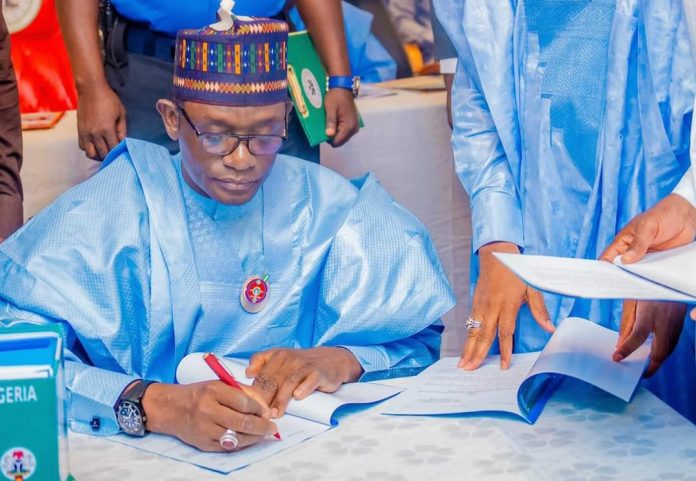
The Buni Model: Prudence over populism in Yobe’s quiet budgetary revolution for fiscal discipline, by Abubakar M. Kareto
In the contemporary discourse on Nigerian governance, subnational budgets are too often treated as mere annual rituals. They are frequently bloated with ambitious projections and heavy on political rhetoric, but remarkably thin on actual execution. As the country wrestles with persistent inflationary pressures, fluctuating federal allocations, and severe macroeconomic headwinds, the real measure of governance is no longer how much a state proposes to spend, but how efficiently and transparently those resources are managed.
While heavyweights with massive internally generated revenue profiles frequently dominate national headlines, an objective, data-driven look at recent fiscal metrics reveals an unexpected trailblazer in budgetary integrity: Yobe State.
Far from being an exercise in mere speculation, Yobe’s fiscal standing stands out as fundamentally superior to many of its peers. This assessment is firmly grounded in empirical data from the 2025 BudgIT Subnational Report, the 2024 Agora Policy budgetary performance evaluation, and the state’s own Medium-Term Expenditure Framework. In an era where subnational governance is frequently critiqued for fiscal recklessness, Yobe demonstrates an exemplary model of discipline, exceptional implementation rates, aggressive capital spending, and human-centric sectoral allocations.
1. The Gold Standard in Budget Implementation
The most glaring vulnerability of the Nigerian subnational fiscal architecture is the implementation gap. Historically, the national average for state budget execution hovers around a modest 70 percent, with capital project implementation dropping even lower. Many states routinely announce spectacular, multi-billion naira budgets, only to deliver less than two-thirds of their promises due to unrealistic revenue forecasting and systemic inefficiencies.
Yobe State has systematically broken this wheel. In the landmark 2024 Agora Policy report, which rigorously evaluates budgetary discipline, transparency, and financial prudence across all 36 states, Yobe ranked first nationwide with an unprecedented budgetary performance score of 98.6 percent. It narrowly outpaced Delta State at 97.9 percent and Rivers State, while leaving fiscal giants like Lagos and several North-Central states far behind.
Yobe’s near-perfect implementation score is a direct translation of budgetary discipline. This represents the rare ability to align projections with actual economic realities, adhere strictly to public procurement due process, and eliminate financial waste.
This is not a one-off fluke. Historically, Yobe’s revenue outturn between 2018 and 2022 averaged a resilient 90.4 percent, anchored by a 96.4 percent performance in federation account receipts. Even into the first quarter of 2025, despite broader economic volatility, the state recorded robust revenue inflows, with external grants exceeding projections by over 130 percent. This track record explains why Yobe previously earned consecutive accolades from the World Bank’s State Fiscal Transparency, Accountability, and Sustainability program, as well as the Paradigm Leadership Support Initiative. Every single naira budgeted in Yobe has a significantly higher probability of actually being spent on the ground than almost anywhere else in Nigeria.
2. Prioritizing the Future: A High Capital-to-Recurrent Ratio
A structural defect of many Nigerian states is an over-bloated recurrent expenditure profile. When a state spends 60 to 70 percent of its resources on civil service overheads, political appointments, and administrative consumption, it leaves very little room for developmental infrastructure.
Yobe State’s budgetary framework deliberately flips this paradigm. For the 2025 fiscal year, capital expenditure constituted an impressive 72.2 percent of its N320.8 billion budget. While the state’s total envelope is understandably smaller in absolute terms compared to oil-producing or industrial hubs, its utilization efficiency is remarkably high. Looking ahead to the 2026 projections, out of a total proposed budget of N515.6 billion, capital expenditure maintains a dominant lion’s share of 62.7 percent, which amounts to N323.5 billion.
To put these figures into a national perspective, a look at the 2025 capital allocations shows Yobe sitting firmly among the top performers in the country. While the national average range for capital allocation typically sits between 50 and 55 percent, Yobe’s allocation of 72.2 percent places it right behind aggressive infrastructure investors like Enugu State at 86.3 percent and Abia State at 81.5 percent. This stands in stark contrast to states lagging at the bottom of the spectrum, such as Ekiti State at 48.9 percent and Osun State at 44.8 percent.
While states like Osun and Ekiti struggle below the 50 percent threshold, meaning they spend more on running the government than building the state, Yobe sits comfortably alongside top-tier reformers. By aggressively anchoring its spending to the Yobe State Development Plan and the Sustainable Development Goals, the administration ensures that scarce resources are channeled into roads, schools, and hospitals rather than administrative consumption.
3. Human Capital over Politics: Sectoral Equity
A budget is ultimately a moral document because it shows exactly what a government values. In Yobe, a state recovering from the profound socio-economic disruptions of a decade-long insurgency, the emphasis has been unreservedly placed on human capital development.
Nowhere is this more evident than in the state’s health and education allocations, where Yobe consistently hits international benchmarks that wealthier states comfortably ignore.
For instance, in healthcare, Yobe has met the strict criteria of the Abuja Declaration. In 2001, African Union states pledged to allocate at least 15 percent of their annual budgets to health. In 2025, Yobe hit this exact 15 percent target by dedicating N48.1 billion to the sector. This positions it in an elite bracket alongside Kaduna and Bauchi, which allocated 16 percent. Conversely, states with far greater fiscal liquidity, like Enugu, dipped to as low as 5.94 percent in health spending. For Yobe, this funding ensures the sustained revitalization of primary healthcare centers and subsidized maternal care in vulnerable communities.
Education tells a similarly progressive story. Yobe allocated 18.09 percent, totaling N70.2 billion, of its 2025 budget to education. This significantly outpaces its neighbors, including Borno at 12.12 percent and Adamawa at 17.10 percent, and stands in stark contrast to states like Niger, where education funding plummeted to a low of 7.81 percent.
Beyond the social safety net, the state allocated 5.16 percent, amounting to N16.5 billion, to targeted agricultural interventions designed to boost food security in the region, alongside a robust 10 percent baseline for critical public works and infrastructural connectivity.
The Path Forward: Institutionalizing the Gains
To maintain absolute intellectual honesty, it must be acknowledged that Yobe, like virtually all Nigerian subnationals, faces structural vulnerabilities. The state remains heavily reliant on the Federation Account Allocation Committee crumbs, leaves itself exposed to national inflation risks, and occasionally experiences slow capital release cycles in the opening quarters of the fiscal year.
However, within the parameters of what a state administration can control, which includes procurement discipline, realistic forecasting, transparency, and a structural bias toward capital development, Yobe has proven to be an exceptional manager of public finances.
The lesson from Yobe is simple yet profound. Fiscal excellence is not a function of how much oil flows beneath your soil or how many corporate headquarters line your capital city. It is a function of discipline, political will, and citizen-centered planning. As Nigeria navigates this delicate economic epoch, federal policymakers and subnational executives alike would do well to look northward. Yobe State is quietly demonstrating exactly how to make every single Naira count.
Abubakar M. Kareto is a frontline Public Affairs Analyst and Strategic Communications Specialist. He can be reached via amkareto@gmail.com.
Follow the Neptune Prime channel on WhatsApp:
Do you have breaking news, interview request, opinion, suggestion, or want your event covered? Email us at neptuneprime2233@gmail.com