


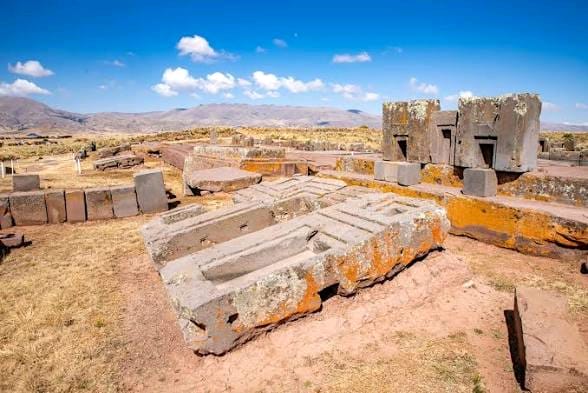
Tiwanaku, Bolivia: The mysterious collapse of a once-great city of civilisation, by Gift Luckson
High in the desolate, windswept Altiplano of western Bolivia—over 12,500 feet (3,800 meters) above sea level—lies Tiwanaku (often spelled Tiahuanaco).
Long before the Inca carved out their famous empire, Tiwanaku was the thriving capital of a powerful pre-Columbian civilisation that dominated the southern Andes between 500 CE and 1000 CE.
It was a city born of harsh conditions, designed with staggering astronomical precision and engineering that still leaves modern stone masons scratching their heads.
High-Altitude Masters of Agriculture
Surviving at such extreme altitudes is incredibly difficult; the air is thin, the soil is poor, and freezing night frosts can easily wipe out a season’s crops. Yet, at its height, Tiwanaku sustained a city centre of roughly 40,000 people and a broader regional population stretching into hundreds of thousands.
They achieved this through a brilliant agricultural invention called sukakollu (raised-field agriculture).
Engineers dug parallel canals and used the excavated dirt to build raised planting beds.
The surrounding canals filled with water, which absorbed the intense, high-altitude solar radiation during the day.
At night, as temperatures plummeted to freezing, the heated water evaporated, creating a warm microclimate blanket over fields of potatoes and quinoa while preventing frost from killing the roots.
This system was so efficient that modern agricultural trials in Bolivia using duplicated sukakollu techniques out-produced standard modern chemical-fertiliser farming in the region.
Megalithic Masonry and the Architecture of Power
When the Inca later stumbled upon the ruins of Tiwanaku, they were so awestruck by the scale of the stone structures that they integrated the city into their own creation myths, believing their creator god, Viracocha, made humanity right there.
READ ALSO: Outlasting Slavery: How George Freeman Bragg Jr. became a force for racial justice, by Gift Luckson
The masonry at Tiwanaku rivals any in the ancient world. Builders didn’t use mortar; instead, they cut and dressed volcanic andesite and sandstone blocks so perfectly that they locked together by friction alone.
For critical structural joints, they carved precise channels into adjacent stones and poured molten copper-arsenic-bronze into them—creating custom metal clamps that held the walls together against seismic activity.
Key Landmarks Within the Core
The Akapana Pyramid: A massive, seven-tiered earthen mound faced with monumental stone blocks. It was designed to mimic the sacred mountains surrounding the valley and featured a complex internal plumbing network to channel rainwater down its terraces, likely symbolising a sacred, life-giving spring.
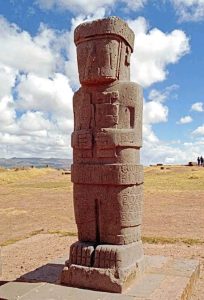
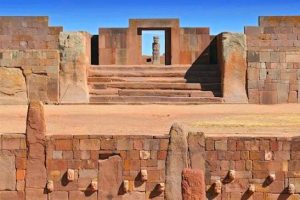
The Kalasasaya Temple: A grand, walled courtyard that served as an astronomical observatory. On the spring and autumn equinoxes, the sun rises precisely through the centre of the main monolithic gateway.
The Gate of the Sun (Puerta del Sol): Carved out of a single, massive block of volcanic stone weighing an estimated 10 tons. The upper frieze features a prominent central figure—frequently identified as the “Staff God” or a proto-Viracocha—flanked by dozens of winged attendants.
The Semi-Subterranean Court: A sunken plaza whose walls are studded with hundreds of unique, carved stone “tenoned heads.” Archaeologists believe these may represent the distinct ethnic groups and lineages that swore allegiance to the Tiwanaku state.
The Mysterious Collapse
Around 1000 CE, the great metropolis went quiet. There are no signs of a grand military invasion or violent sacking. Instead, ice cores taken from nearby Andean glaciers tell a story of a severe, multi-decade megadrought that struck the region.
As Lake Titicaca receded and groundwater levels plummeted, the ingenious sukakollu canal system finally dried up. The agricultural surplus that bound the diverse empire together vanished. Unable to feed its population, the centralised state dissolved, and the people fractured into smaller, localised Altiplano kingdoms—leaving their monumental stone city to the elements.
Follow the Neptune Prime channel on WhatsApp:
Do you have breaking news, interview request, opinion, suggestion, or want your event covered? Email us at neptuneprime2233@gmail.com